Cloud-Edge Effect: Why Solar Panels Exceed Rated Power
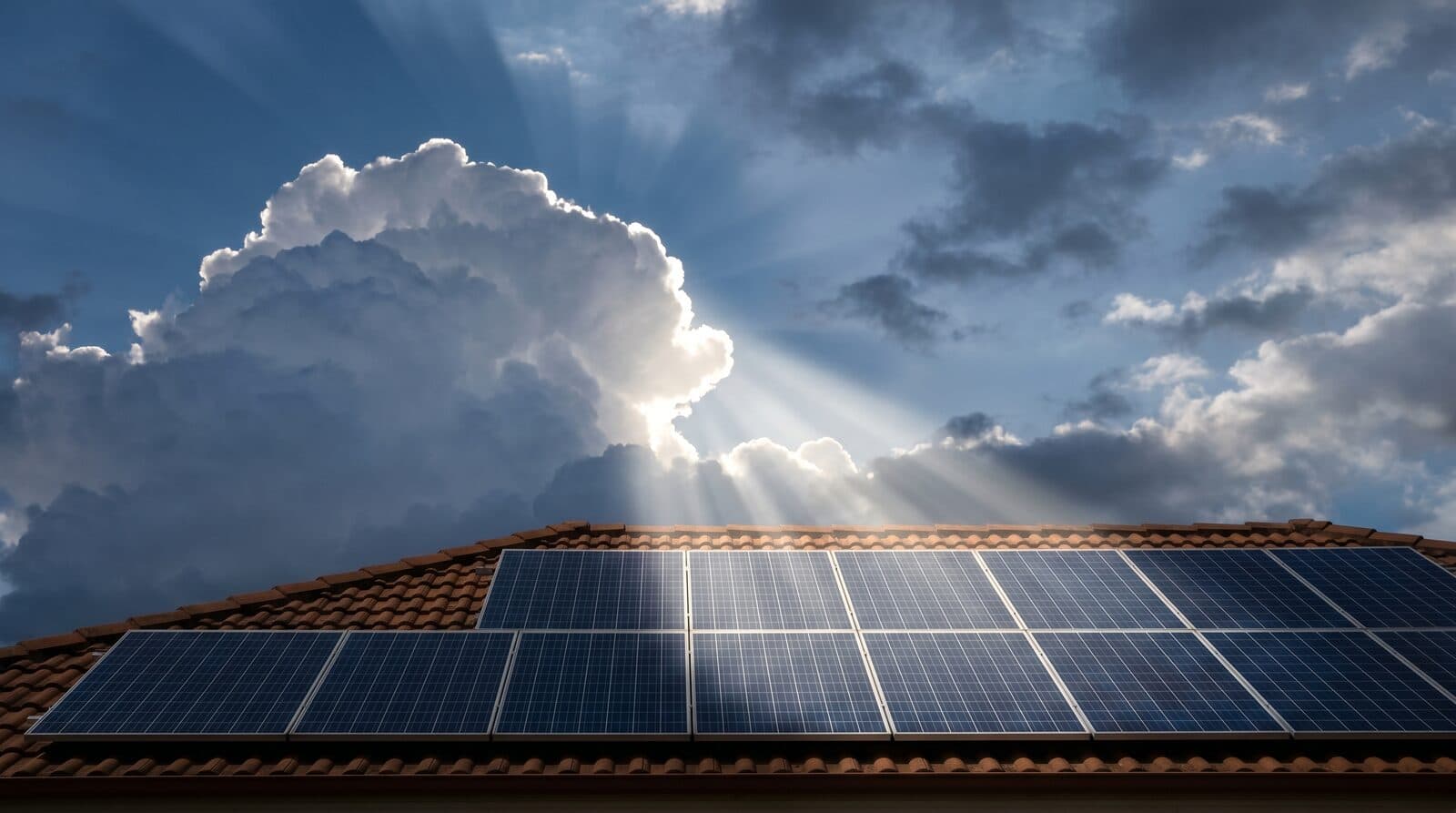
Yes, your solar panels can briefly exceed their rated power
If your monitoring app has ever shown your panels producing more than their nameplate watts on a partly cloudy day, you're seeing the cloud-edge effect — also called cloud lensing, cloud enhancement, or overirradiance. White cumulus cloud edges reflect direct sunlight onto panels that are still in direct sun, briefly pushing irradiance from STC's 1000 W/m² up to 1100–1400 W/m². Panels respond by producing 10–30% above rated power for seconds to a few minutes.
It's not a fault, not a measurement glitch, and not dangerous in itself — but it has real implications for inverter sizing, fuse selection, and yield monitoring. Modern panels are designed to survive these spikes; the question is whether your inverter can absorb the brief excess without losing too much energy to clipping. This article explains what's happening, when to care, and how Solar Stack's calculator already builds the safety margin in for you.
What it isn't
Why cloud edges briefly amplify sunlight
On a perfectly clear day, your panel receives direct beam radiation (about 850 W/m² in mid-latitudes at solar noon) plus diffuse skylight (around 100–150 W/m²) — roughly 1000 W/m² total, the STC reference. When broken cumulus clouds pass overhead, two things can line up at once: the gap between clouds happens to be over your roof so you stay in direct sun, and the bright white edges of nearby cumulus clouds reflect additional sunlight onto your panels through Mie scattering.
Imagine a tilted mirror bouncing extra sunlight onto a sunbathing surface. A bright cumulus cloud edge is a diffuse mirror — its albedo can hit 0.7–0.9, far higher than the typical 0.2 of grass or 0.5 of light concrete. When the geometry lines up, your panel briefly receives direct beam plus extra reflection, and total irradiance jumps above 1000 W/m². Researchers have measured peaks up to 1500 W/m² in well-instrumented studies (Tapakis 2014, Yordanov 2013).
How much extra power: typical peaks by cloud type
Not every cloudy moment causes a spike. The conditions that produce cloud-edge enhancement are specific: scattered or broken cumulus clouds, the sun unblocked, and panels facing the gap. Stratus, overcast, and high cirrus do not trigger it — they reduce irradiance instead. Here is what real-world measurements show:
| Cloud cover | Typical peak | Duration | Frequency |
|---|---|---|---|
| Clear sky | ≤ 1000 W/m² | n/a | Baseline (STC reference) |
| Scattered Cu (1–3/8 cover) | 1000–1100 W/m² | Seconds | Common, mild gain |
| Broken Cu (4–6/8 cover) | 1100–1300 W/m² | Up to 5 minutes | Frequent on convective days |
| Passing front (Cu build-up) | 1200–1400 W/m² | 1–10 minutes | A few times per month |
| Extreme (rare alignment) | 1400–1500 W/m² | Brief | Documented in research, rare in practice |
These are not theoretical — pyranometer logs from monitoring services routinely show 1100–1200 W/m² readings. The single highest documented cloud-edge spike is around 1.55× STC, equivalent to 1550 W/m² (Tapakis 2014). Annual contribution to total yield is small (≈0.5–2%) because events are brief, but the instantaneous power is what stresses inverters and fuses.
Will my inverter clip during a cloud-edge spike?
It depends on your DC/AC ratio. A string inverter rated 5000 W AC will refuse to output more than its nameplate, regardless of how much DC power your panels deliver. The excess is dissipated as a small amount of heat and the inverter holds steady at its limit. This is called clipping. It is normal and harmless — but every clipped watt is energy you didn't capture.
DC/AC ratio
DC/AC ratio = Total panel STC power (W) ÷ Inverter nominal AC power (W)
Example: 7000 W panels ÷ 5000 W inverter = 1.40 (40% oversize)
If your DC/AC ratio is below the type-specific limit, cloud-edge spikes mostly fit within the inverter's headroom and clip rarely. Above that limit, even normal mid-day production starts clipping daily, and cloud-edge spikes only add to the loss. Solar Stack's calculator emits a warning when your ratio crosses the type-specific threshold.
Solar Stack's per-type DC/AC limits
Why panels can take 1500 W/m² without damage
Solar panels are tested to international standards (IEC 61215, IEC 61730) that explicitly account for transient overirradiance. The qualification protocols include hot-spot endurance at elevated cell temperature, mechanical loading, UV exposure, and electrical stress at 1.25× the open-circuit voltage. A few minutes per day at 1200–1400 W/m² is well within the design envelope of any IEC 61215-certified panel.
What changes briefly during a cloud-edge spike is short-circuit current (Isc rises in proportion to irradiance) and operating power (Pmax rises with irradiance, partially offset by warming cell temperature). Open-circuit voltage barely moves — Voc is governed mostly by cell temperature, which lags by minutes behind sudden irradiance changes. So the voltage safety margin you sized for at −10 °C cold morning is not threatened by a noon cloud-edge event.
What is threatened: Isc-rated devices
Cloud-edge effect vs bifacial gain: not the same
Both phenomena push panel output above the front-side STC rating, but they have nothing else in common. Bifacial gain is steady, predictable, and modeled; cloud-edge enhancement is transient, stochastic, and not modeled in standard yield software. Confusing the two leads to bad sizing decisions.
| Aspect | Cloud-edge effect | Bifacial gain |
|---|---|---|
| Source | Reflection from cloud edges | Light captured by rear cell side |
| Peak amplification | +10–50% (transient) | +5–25% (continuous) |
| Duration | Seconds to minutes | Hours, all day in good albedo |
| Predictability | Stochastic — depends on weather | Predictable — known albedo, layout |
| In Solar Stack | Calculator absorbs via DC/AC ratio limits | Calculator includes bifacial gain (BIFACIAL_VIEW_FACTOR=0.7) |
Real-world impact: yield, fuses, monitoring
For yield modeling, ignore cloud-edge — it adds 0.5–2% annually for typical sites and is not in SAM or PV*SOL. Treat it as a small bonus that's already absorbed into your safety margins. For fuse and breaker selection, it is the reason the 1.25× Isc safety factor exists in NEC 690.8 / IEC 62548. Always apply it.
String fuse minimum (NEC 690.8 / IEC 62548)
I_fuse_min = 1.25 × Isc_STC × N_strings_in_parallel
Example: Isc 14 A, 2 parallel strings → 1.25 × 14 × 2 = 35 A minimum
For monitoring, expect to occasionally see momentary readings 5–25% above your panels' nameplate when scattered cumulus clouds pass overhead. This is normal. If you see sustained readings above nameplate, your data source likely has a calibration error, or it is reporting input current including reflection from snow or water — investigate.
Why some installers say "don't oversize"
Worked example: 7 kWp array on a 5 kW string inverter
Let us run a real cloud-edge spike through a typical residential system. We use a 5 kW string inverter and a 7 kWp array (DC/AC = 1.4 — within the STRING 1.5 limit). On a partly cloudy summer day, a cloud edge briefly pushes irradiance to 1180 W/m² for 2 minutes.
Setup
Inverter: 5000 W AC (string type, DC/AC limit 1.5). Array: 14 × 500 W panels = 7000 W STC. DC/AC ratio: 7000 ÷ 5000 = 1.40. Cell temperature: 50 °C (typical mid-summer). Pmax temperature coefficient: −0.35%/°C.
Instantaneous DC power during spike
Pdc = 7000 × (1180/1000) × [1 + (−0.35/100) × (50−25)]
     = 7000 × 1.180 × 0.9125
     ≈ 7,537 W
Clipped power
Pclip = max(0, Pdc − Pac_nom) = 7,537 − 5,000 = 2,537 WEnergy lost to clipping during the 2-minute spike
E = 2,537 W × (2 ÷ 60) h ≈ 85 Wh — about 8.5 cents on a typical residential tariff. Per spike. Even with 30 such events per summer day, the annual loss for a 1.40 DC/AC ratio is ~1–2% of total production. The extra capture during normal hours easily outweighs this.
The takeaway: cloud-edge spikes are real, your inverter handles them by clipping briefly, and oversizing within the per-type DC/AC limit is the right design choice. The energy gained the rest of the day far exceeds the energy lost to clipping.
How Solar Stack handles cloud-edge effects in sizing
Our calculator does not model individual cloud-edge events — they are stochastic and do not materially affect annual yield. Instead, we absorb the phenomenon into safe DC/AC ratio limits and Isc safety factors that make every recommended configuration cloud-edge-safe by construction:
- Per-type DC/AC ratio thresholds
STRING 1.5, HYBRID 2.0, OFF_GRID 2.0, MODULAR_C_I 2.5, MICROINVERTER 1.3, POWER_OPTIMIZER 1.5. The Solar Stack calculator emits a clipping warning when these are exceeded. Stay inside them and cloud-edge spikes clip briefly, harmlessly.
- Isc safety factor in current checks
Our maxInputCurrent and shortCircuitCurrent checks compare panel Isc (temperature-adjusted to hot conditions) against the inverter's MPPT input rating. The inverter rating already includes margin for cloud-edge transients per IEC 62548.
- Cell-temperature model for current and voltage
Current scales with irradiance (rises during a spike) but voltage is governed by cell temperature, which lags by minutes. Our calculator uses worst-case Isc (hot ambient + 1000 W/m²) and worst-case Voc (cold ambient, low irradiance) — the cloud-edge case is bracketed.
- Bifacial gain modeled separately
Bifacial gain — the predictable above-100% phenomenon — is applied as a multiplier on Isc with BIFACIAL_VIEW_FACTOR = 0.7. Cloud-edge effect is neither modeled nor needs to be — the safety margins above already cover it.
Try the calculator
Plug in your panel and inverter. We show every safety check, including DC/AC ratio with the per-type cloud-edge-safe limit.
Quick takeaways
Cloud-edge effect is real, briefly spikes irradiance to 1100–1400 W/m², and explains why your panels sometimes appear to produce above their rating. Modern panels handle it safely thanks to IEC 61215 testing. The right defense is staying within the DC/AC ratio limit for your inverter type — STRING 1.5, HYBRID 2.0, MICRO 1.3 — and applying the 1.25× Isc safety factor on fuses. Respect both, and cloud-edge spikes become a free, occasional bonus.
Find a matching inverter
Tell us your panels — we will suggest inverters that stay within safe DC/AC limits, with cloud-edge headroom built in.
Frequently asked questions
Can solar panels really produce more than their rated power?
Yes — briefly. The STC rating is a reference at 1000 W/m². When cloud edges push irradiance to 1100–1400 W/m², panels output proportionally more, typically 10–30% above nameplate for seconds to minutes. This is the cloud-edge effect.
Is the cloud-edge effect bad for my inverter?
No, as long as your DC/AC ratio stays within the limit for your inverter type (STRING 1.5, HYBRID 2.0, MICRO 1.3). At those ratios the inverter clips briefly and harmlessly. Above them, you'll lose more energy to clipping than you gain from oversizing.
How often does the cloud-edge effect happen?
Several times per day on partly cloudy summer days with scattered or broken cumulus clouds — the kind that produce shifting sun-shadow patterns. It rarely happens on overcast days or perfectly clear days. Annual contribution to total energy is about 0.5–2%.
Does cloud-edge effect mean I need a bigger inverter?
No. The right answer is to size your DC/AC ratio inside the per-type limit (STRING 1.5, HYBRID 2.0, MICRO 1.3). At those ratios, cloud-edge spikes either fit within inverter headroom or clip for seconds to minutes — not enough to justify upsizing.
Will my fuses or breakers trip during a cloud-edge spike?
Not if you sized them per code (NEC 690.8 / IEC 62548), which require a 1.25× safety factor on Isc_STC. That margin exists specifically to absorb cloud-edge transients plus manufacturer tolerance. If you used Isc_STC directly without the multiplier, nuisance trips are possible.
Does cloud-edge effect contribute to annual yield?
A little — about 0.5–2% extra over a year for typical sites. Most yield-modeling software (SAM, PV*SOL) does not model it explicitly, treating it as a small bonus already absorbed into oversizing margins. Don't budget for it; treat it as a free occasional gift.
Is cloud-edge effect the same as 'overirradiance' or 'cloud enhancement'?
Yes — cloud-edge effect, cloud enhancement, cloud lensing, and overirradiance all refer to the same phenomenon. Researchers (Yordanov, Tapakis, Gueymard) typically use 'cloud enhancement' or 'overirradiance'; installers use 'cloud-edge effect.' All describe transient irradiance above 1000 W/m² caused by cloud-edge reflection.


Discussion
Sign in to join the discussion
We require a quick sign-in to keep this thread free of spam.
No comments yet. Be the first to share your experience.