NOCT vs STC: Why a 580W Panel Really Makes ~440W
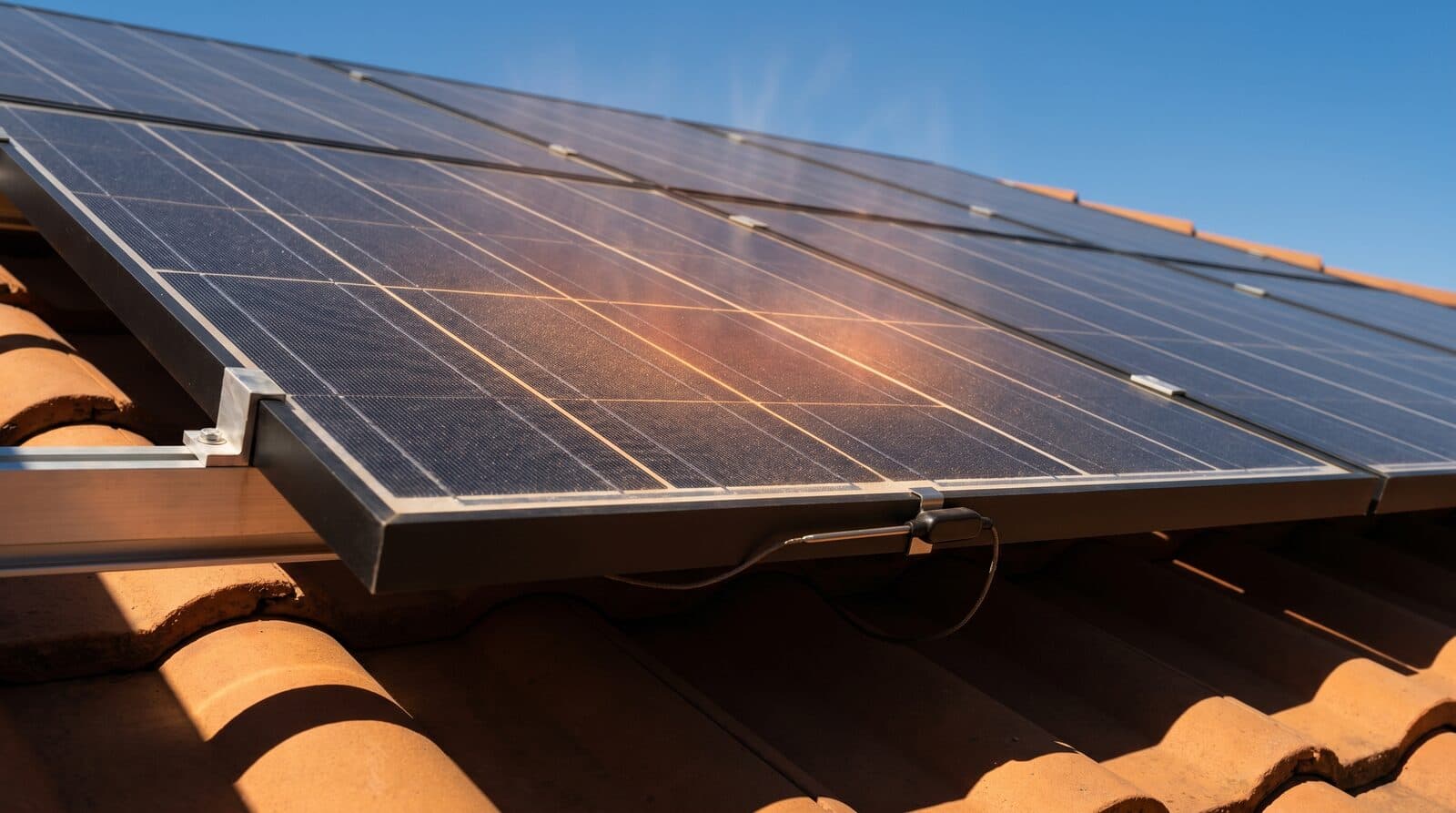
The watt that wasn't
When you buy a 580W solar panel, you do not get 580W on a sunny afternoon. You get closer to 440W. The other 140W is not lost to defects or installer error — it is the gap between two standardized testing conditions that every datasheet uses: STC (Standard Test Conditions) and NOCT (Nominal Operating Cell Temperature).
Across all major manufacturers, panels deliver about 75% of their STC nameplate when measured under NOCT conditions. That ratio is so consistent it is almost a law. This guide explains what each rating measures, why they disagree, and how to use both numbers correctly when sizing a system or comparing panels.
Both numbers are on every datasheet — neither is wrong
STC — the lab benchmark (1000 W/m², 25°C cell)
STC is the universal benchmark every manufacturer uses for the headline Pmax number. Three conditions define STC, all chosen to be reproducible inside a flash tester rather than realistic on a roof:
| Parameter | STC | NOCT |
|---|---|---|
| Irradiance | 1000 W/m² | 800 W/m² |
| Reference temperature | 25°C cell temperature | 20°C ambient air |
| Wind speed | Not specified (still air) | 1 m/s |
| Solar spectrum | AM 1.5G | AM 1.5G |
STC exists so that a panel from LONGi, Jinko, Canadian Solar, and Aiko can be compared on the same axis. Without it, every brand would publish power numbers measured in their own factory under their own conditions, and you could not tell which 580W panel actually produces 580W. The price of comparability is realism: cells almost never sit at 25°C while irradiance is at 1000 W/m². On a sunny day cells reach 50–70°C even when the air is mild.
NOCT — the realistic baseline (800 W/m², 20°C ambient, 1 m/s wind)
NOCT was defined to bridge the gap between the lab and the roof. Instead of forcing the cell to 25°C, it measures the cell's natural operating temperature when the air is 20°C, the wind is a gentle 1 m/s, and the irradiance is a realistic 800 W/m² (a thin overcast or late-afternoon sun, not the brightest moment of the day).
Two things change versus STC. First, irradiance drops from 1000 to 800 W/m², which mechanically reduces output by 20%. Second, the cell heats up to its natural NOCT temperature — typically 41°C to 45°C — which costs another 5% via the negative Pmax temperature coefficient. Multiplied together, NOCT power lands near 75% of STC power. The exact ratio depends on the cell technology and mounting, but the pattern is remarkably consistent.
The performance gap on real datasheets
These four panels are taken from current production datasheets — not derived, not estimated. The Pmax_NOCT values come straight from the manufacturer-published electrical tables. The STC-to-NOCT ratio sits between 74% and 76% across PERC and TOPCon technologies:
| Panel | Cell tech | Pmax STC | Pmax NOCT | NOCT / STC |
|---|---|---|---|---|
| LONGi Hi-MO 7 LR5-72HGD-580M | PERC, half-cell | 580 W | 441.5 W | 76.1% |
| Canadian Solar TOPHiKu6 CS6.1-72TD-620 | TOPCon | 620 W | 469 W | 75.6% |
| Trina Vertex S TSM-DE09R.08-425 | PERC | 425 W | 321 W | 75.5% |
| Jinko Tiger JKM560M-72HL4-V | PERC | 560 W | 417 W | 74.5% |
Notice the spread is tiny: 74.5% to 76.1%. The cell technology barely matters for this ratio because both PERC and TOPCon panels share similar Pmax temperature coefficients (-0.28% to -0.34%/°C). What does change between brands is the absolute Pmax_NOCT value — a higher-efficiency panel with the same form factor delivers more usable power per square metre at NOCT.
NOCT power is not your daily output
Calculating real cell temperature with NOCT
NOCT is not just a power rating — it is a cell-temperature predictor. Once you know the panel's NOCT (printed on every datasheet), you can estimate cell temperature at any ambient temperature and irradiance using the simplified Sandia formula. This is the standard formula professional design software uses internally, and the one Solar Stack's calculator runs when a panel has NOCT data.
Cell temperature from NOCT
T_cell = T_ambient + (NOCT − 20) × G / 800 ≈ T_ambient + (NOCT − 20) × 1.25 at G = 1000 W/m²Worked example: a panel with NOCT = 45°C, on a 35°C summer day at full sun (1000 W/m²): T_cell = 35 + (45 − 20) × 1.25 = 66.25°C. That is the cell temperature you should plug into your voltage and power formulas — not the air temperature. The 31°C lift between ambient and cell is exactly what most people forget when they ask why their panels underperform on hot days.
From cell temperature to actual power
Once you have the cell temperature, the Pmax and Voc temperature coefficients translate it into real-world output. Both formulas are linear above and below the STC reference of 25°C, and both apply the coefficient as a percentage per degree:
Power at temperature T_cell
P_actual = P_stc × (1 + (TC_Pmax / 100) × (T_cell − 25))Open-circuit voltage at temperature T_cell
V_actual = V_stc × (1 + (TC_Voc / 100) × (T_cell − 25))Continuing the example with the 580W LONGi panel (TC_Pmax = −0.28%/°C): on a hot 35°C afternoon at full sun, cell temperature reaches 66.25°C and P_actual = 580 × (1 + (−0.28/100) × 41.25) = 580 × 0.8845 = 513W. That is the temperature-only loss at full irradiance. To verify the datasheet's published Pmax_NOCT, use NOCT's own operating point instead: 800 W/m² irradiance and cell temperature equal to NOCT itself (45°C). Then P_NOCT = 580 × (800/1000) × (1 + (−0.28/100) × 20) = 580 × 0.8 × 0.944 = 438W — within 1% of LONGi's published 441.5W. Both effects must be applied — irradiance first, then temperature — and the temperature you use must match the operating point you are describing, not the hottest cell temperature of the day.
NMOT — the newer IEC 61215 standard
If you read a datasheet from 2023 onward you may see NMOT (Nominal Module Operating Temperature) instead of NOCT. NMOT is the updated definition introduced by IEC 61215-2:2016 and adopted by most major brands by 2023. It uses the same conditions in spirit (800 W/m², 20°C ambient, 1 m/s wind, AM 1.5) but tightens the measurement procedure: the module is mounted in an open rack with controlled tilt, and the cell-temperature instrumentation has stricter tolerances.
In practice the numerical difference between NOCT and NMOT for the same module is 1–2°C. Canadian Solar's TOPHiKu6 datasheet, for example, lists NMOT = 41 ±3°C — the same value range you would have seen labelled NOCT a decade ago. For sizing purposes, treat them as interchangeable: every Solar Stack input field labelled NOCT accepts the NMOT value verbatim.
Don't get caught on the rebrand
Climate impact: hot vs cold sites
The NOCT/STC gap hits hardest in hot climates where ambient temperatures push cell temperature far above the NOCT reference of 45°C. In Murcia, Spain or Athens, Greece a roof at 35°C ambient pushes a NOCT-45 panel to 66°C cells — a 5% Pmax loss on top of any irradiance shortfall. In a cold maritime climate like Galway or Hamburg, the same panel sits at 45°C cells on a clear summer day and runs much closer to its STC rating.
A practical rule of thumb: every +10°C of cell temperature above NOCT costs 3 to 4% of Pmax for typical TOPCon and PERC panels. HJT panels with TC_Pmax around −0.24%/°C lose less (about 2.4% per +10°C), which is why HJT outperforms PERC most clearly in hot deserts and on dark roof mounts where airflow is restricted. For roof installs in southern Europe, southern Ukraine, or the southern US, prioritize panels with both low NOCT and low TC_Pmax — they keep more of the rated power when the day is hot.
Reading datasheets correctly
When you compare two panels, do not stop at Pmax_STC. The honest comparison uses three numbers together: Pmax_STC (peak capacity), Pmax_NOCT (realistic capacity), and TC_Pmax (sensitivity to heat). A 580W panel with NOCT 45°C and TC_Pmax −0.28%/°C will outperform a 580W panel with NOCT 47°C and TC_Pmax −0.34%/°C every hot afternoon, even though their nameplates are identical.
Picking the better hot-climate panel
Compare panels by real-world specs, not just nameplate
Solar Stack's matcher surfaces NOCT and temperature coefficients alongside Pmax — find a panel that fits your inverter and your climate.
How Solar Stack uses NOCT in the calculator
Every panel in our equipment database carries its NOCT value (when the manufacturer publishes one). The string compatibility calculator uses it automatically: when you enter your minimum and maximum ambient temperatures, the calculator computes cell temperature with the formula T_cell = T_ambient + (NOCT − 20) × 1.25 and feeds that into the voltage and current checks. The result is a more accurate hot-temperature MPPT lower-voltage check and a more accurate cold-temperature Voc upper limit.
When NOCT is missing from the datasheet (older panels and many off-grid imports omit it), the calculator falls back to a mounting-type offset: +25°C above ambient for ground-mounted arrays, +30°C for racked roof installs, +35°C for flush roof installs. NOCT-driven cell temperatures are usually within ±2°C of the mount-offset estimate, so the fallback is conservative but reasonable.
Run a temperature-aware string check on your panels
The calculator applies NOCT or mount-offset cell temperatures automatically, then runs all 7 IEC 62548 string-sizing checks against your inverter.
Frequently asked questions
What does NOCT stand for in solar?
NOCT stands for Nominal Operating Cell Temperature. It is the cell temperature a module reaches when irradiance is 800 W/m², ambient air is 20°C, wind speed is 1 m/s, and the module is mounted in an open rack. Most modern modules have NOCT between 41°C and 47°C.
Why is NOCT power lower than STC power?
Two effects stack. NOCT irradiance is 800 W/m² instead of 1000 W/m², which proportionally reduces output by 20% (the panel produces less when there is less light). And cell temperature at NOCT is roughly 41–47°C instead of STC's 25°C, which costs another 4–6% via the negative Pmax temperature coefficient. The combined NOCT/STC ratio lands near 75% for almost every modern panel.
Which is more important: STC or NOCT?
Both, for different jobs. Use Pmax_STC when sizing your inverter (DC/AC ratio, peak instantaneous power). Use Pmax_NOCT when projecting daily energy yield, comparing brands for a hot climate, or checking that the temperature-corrected MPPT range still covers your string. STC tells you the ceiling; NOCT tells you what you actually live with.
Where do I find the NOCT value on a datasheet?
Look for a small box labelled 'Operating Conditions', 'Mechanical Data', or 'Temperature Ratings'. The line reads 'NOCT' or 'Nominal Operating Cell Temperature' followed by a value like '45 ±2°C'. Newer 2023+ datasheets may label it NMOT instead — the value is interchangeable. Pmax_NOCT itself appears in a separate electrical table, often titled 'Electrical Data at NOCT' or 'Electrical Characteristics at NMOT'.
Can a solar panel actually exceed its STC rating?
Yes, briefly. On a clear, cold, low-elevation morning with snow on the ground reflecting extra light, a panel can exceed its STC Pmax for a few minutes. Cell temperature is below 25°C (boosting voltage), irradiance can hit 1100–1200 W/m² with cloud edge enhancement, and reflected light adds gain on bifacial modules. Inverter clipping limits how much of this overage you actually capture. STC is a typical maximum, not a hard ceiling.
What is the difference between NOCT and NMOT?
NMOT (Nominal Module Operating Temperature) is the updated IEC 61215-2:2016 definition that replaced NOCT in newer datasheets. The conditions are essentially the same — 800 W/m², 20°C ambient air, 1 m/s wind, AM 1.5 spectrum — but the measurement protocol uses tighter instrumentation and a standardized open-rack mount. Numerical values typically agree to within 1–2°C, so you can use NMOT and NOCT interchangeably for sizing.
Why don't all manufacturers list a Pmax at NOCT?
Bifacial datasheets sometimes replace the NOCT power table with a 'rear-side gain' table (e.g., Pmax with 10% rear irradiance contribution) because that better showcases the bifacial advantage. Older monofacial panels and some off-grid budget panels also omit NOCT power to keep the datasheet shorter. The NOCT cell temperature itself is almost always present even when Pmax_NOCT is not.
Does NOCT account for shading, soiling, or wiring losses?
No. NOCT only accounts for irradiance and cell temperature under a defined operating condition. Real-world shading, dust, snow, mismatch between panels, MC4 connector resistance, DC cable voltage drop, and inverter losses are all extra deratings on top of the NOCT-to-real-world translation. Plan for another 5–15% combined loss from these effects depending on site conditions and system quality.


Discussion
Sign in to join the discussion
We require a quick sign-in to keep this thread free of spam.
No comments yet. Be the first to share your experience.