PERC vs TOPCon vs HJT: Which Panel Wins in 2026?
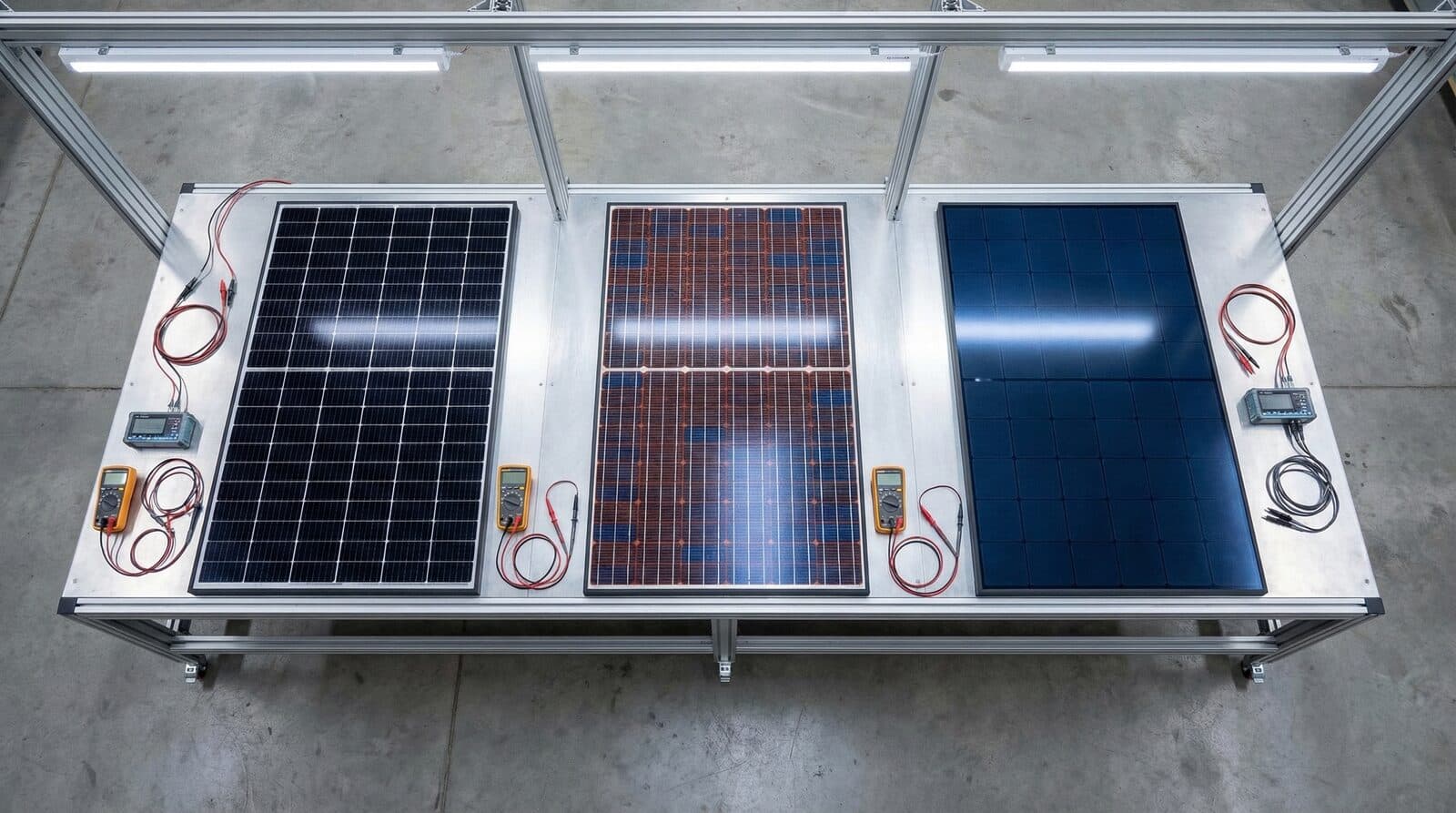
Why Panel Technology Matters for Your Solar Installation
Not all solar panels are created equal. The cell technology inside a panel determines how much electricity it produces, how it performs in hot weather, and how long it will last. Over the past five years, new cell architectures have pushed commercial panel efficiencies from 20% past 23%, meaning you can generate more power from the same roof area.
Understanding the differences between PERC, TOPCon, and HJT technologies helps you make a smarter purchasing decision — and ensures your panels are properly matched to your inverter. A panel with a lower temperature coefficient, for example, produces higher voltage in cold weather, which directly affects string sizing calculations.
Why this matters for beginners
How a Solar Cell Works — A Quick Primer
A solar cell is a thin wafer of silicon with two layers. The top layer (N-type) has extra electrons, and the bottom layer (P-type) has "holes" where electrons are missing. When sunlight hits the cell, it knocks electrons loose, creating an electric current that flows through your wires.
The challenge is that not all the sunlight gets converted to electricity. Some light reflects off the surface, some passes through without being absorbed, and some energy is lost as heat. Every new cell technology listed below is essentially a different strategy for reducing these losses.
Key takeaway
PERC — The Proven Workhorse
PERC (Passivated Emitter and Rear Cell) has been the dominant solar cell technology since around 2019. It adds a reflective passivation layer to the back of a conventional silicon cell. This layer bounces unabsorbed light back through the cell for a second chance at conversion, and reduces electron recombination at the rear surface.
As of early 2026, PERC panels hold roughly 40% of the global market — down from 60% just two years ago — as manufacturers rapidly shift production lines to TOPCon. Commercial PERC panels typically achieve 20.5–22.5% efficiency, with the technology approaching its theoretical limit of approximately 24.5%.
Advantages
- Lowest cost per watt — mature manufacturing means the most competitive pricing at $0.07–0.10/W at module level (China FOB)
- Proven 25-year track record with well-understood degradation behavior
- Widely available from every major manufacturer worldwide
Limitations
- Efficiency ceiling effectively reached — laboratory records around 24.5% leave little room for improvement
- Higher temperature coefficient of Pmax (typically −0.34 to −0.38 %/°C) means more power loss in hot climates
TOPCon — The New Industry Standard
TOPCon (Tunnel Oxide Passivated Contact) panels use an ultra-thin tunnel oxide layer (about 1.5 nanometers) between the silicon wafer and a doped polysilicon contact. This layer allows electrons to "tunnel" through while dramatically reducing recombination losses. The result is higher voltage and better efficiency.
TOPCon has been the fastest-growing technology in 2024–2026, overtaking PERC by late 2025 with approximately 49% of global market share. Major manufacturers like JinkoSolar (Tiger Neo), Trina Solar (Vertex N), JA Solar (DeepBlue 5.0), and Canadian Solar have converted their production lines. Commercial efficiencies range from 22–24%, with laboratory records exceeding 27%.
Advantages
- Higher efficiency (22–23.5% commercial) means more power per panel and fewer panels needed
- Better temperature coefficient (typically −0.29 to −0.32 %/°C for Pmax) — less power loss in summer heat
- Compatible with existing PERC production equipment, making the transition economical for manufacturers
Limitations
- Slightly higher price per watt compared to PERC (roughly 0–5% premium as of early 2026), with effective cost parity already achieved in many markets
- Newer technology means less long-term field data compared to PERC (though accelerated testing is promising)
Industry trend
HJT — Heterojunction Technology
HJT (Heterojunction with Intrinsic Thin layer) panels sandwich a crystalline silicon wafer between thin layers of amorphous (non-crystalline) silicon. This creates a fundamentally different cell structure that achieves excellent surface passivation on both sides simultaneously, resulting in the highest voltages and the best temperature performance of any mainstream technology.
HJT panels currently hold about 8–11% of the market, manufactured primarily by Huasun Energy (the world's largest HJT producer with 20 GW capacity), REC Group (Alpha series), and Risen Energy. Commercial efficiencies reach 22.5–24.5%, with Huasun achieving 26.2% cell efficiency in mass production. The key advantage is not just peak efficiency — it is how well HJT panels perform in real-world conditions.
Advantages
- Best temperature coefficient (typically −0.24 to −0.27 %/°C for Pmax) — ideal for hot climates where panels routinely reach 65–75°C cell temperature
- Lowest degradation rate (0.3–0.4% per year, near-zero first-year LID) — more energy over the panel lifetime, with 87–90% power retained at year 30
- Naturally bifacial with high bifaciality factor (85–95%) — excellent for ground-mount and elevated installations
Limitations
- Highest cost per watt (15–30% premium over PERC) due to specialized manufacturing equipment, though expected to decrease as silver-free copper plating scales in 2026–2027
- Smaller manufacturer base limits availability and competitive pricing in some markets
Bifacial Panels — Harvesting Light From Both Sides
Bifacial panels can absorb light on both the front and rear surfaces. The rear side captures reflected light (albedo) from the ground, nearby walls, or snow. This can boost energy production by 5–25% depending on the mounting height and surface reflectivity beneath the panels.
All three technologies (PERC, TOPCon, HJT) can be manufactured in bifacial versions, but they differ in bifaciality factor — the ratio of rear-side efficiency to front-side efficiency. A higher bifaciality factor means the rear side captures a larger share of available reflected light.
Bifacial gain calculation
Isc_bifacial = Isc_front × (1 + bifaciality × albedo × view_factor)Typical albedo values: grass = 0.20, concrete = 0.30, white gravel = 0.50, fresh snow = 0.80. The view factor (typically 0.7) accounts for the fact that not all reflected light reaches the rear cells.
When is bifacial worth it?
Check bifacial compatibility
Our calculator accounts for bifacial gain and albedo when checking string compatibility. Try it with your panel specs.
N-Type vs P-Type Silicon — Why the Industry Is Shifting
Every solar cell starts with a silicon wafer. That wafer is either P-type (doped with boron, creating "holes") or N-type (doped with phosphorus, creating extra electrons). PERC panels predominantly use P-type wafers, while TOPCon and HJT use N-type.
The shift from P-type to N-type is one of the most significant changes in solar manufacturing history, driven primarily by degradation advantages.
LID (Light-Induced Degradation)
P-type cells suffer from LID — when first exposed to sunlight, boron-oxygen complexes form that permanently reduce cell efficiency by 2–3%. N-type cells are essentially immune to LID because they use phosphorus instead of boron, which does not form these destructive complexes.
LeTID (Light and Elevated Temperature Induced Degradation)
P-type PERC cells can also experience LeTID, a slower degradation that occurs over months of operation at elevated temperatures. The exact mechanism is still debated, but it can cause an additional 1–2% efficiency loss. N-type cells show negligible LeTID.
Practical impact
Technology Comparison — Side by Side
The table below summarizes the key specifications across all three technologies. These are typical commercial values as of 2025 — individual models may vary.
| Specification | PERC | TOPCon | HJT |
|---|---|---|---|
| Commercial efficiency | 20.5–22.5% | 22–24% | 22.5–24.5% |
| Temp. coeff. Voc | −0.27 to −0.29 %/°C | −0.26 to −0.28 %/°C | −0.23 to −0.25 %/°C |
| Temp. coeff. Pmax | −0.34 to −0.38 %/°C | −0.29 to −0.32 %/°C | −0.24 to −0.27 %/°C |
| Annual degradation | 0.55–0.70%/yr | 0.40–0.50%/yr | 0.30–0.40%/yr |
| Bifaciality factor | 65–75% | 75–85% | 85–95% |
| Relative cost ($/W) | 1.0× (baseline) | 1.00–1.05× | 1.15–1.30× |
| Expected lifespan | 25–30 years | 30+ years | 30+ years |
Note: temperature coefficients directly impact string sizing. A panel with a lower (less negative) Voc temperature coefficient produces less voltage swing between summer and winter, making it easier to stay within inverter MPPT limits.
How to Choose the Right Panel for Your Project
There is no single "best" technology — the right choice depends on your specific constraints. Here is a practical decision framework:
If budget is the top priority
Go with PERC. It is the most affordable option and delivers reliable performance. For residential rooftop systems where space is not a constraint, the lower cost per watt outweighs the efficiency difference.
If you live in a hot climate
Choose HJT or TOPCon. Their lower temperature coefficients mean 5–10% more energy production in summer compared to PERC. In regions where ambient temperatures regularly exceed 35°C, this translates to hundreds of extra kilowatt-hours per year.
If roof space is limited
Choose the highest-efficiency panel you can afford (HJT > TOPCon > PERC). Every percentage point of efficiency means roughly 5W more per panel, which adds up when you can only fit 10–15 panels on your roof.
If you want maximum 30-year production
Choose N-type (TOPCon or HJT). Lower degradation rates mean you will produce 3–5% more total energy over the system lifetime compared to PERC. The higher upfront cost is offset by greater cumulative production.
How Panel Technology Affects String Sizing
Panel technology does not just affect power output — it directly impacts how you wire your solar array. The temperature coefficient of Voc determines how much the panel voltage changes with temperature, which is the foundation of all string sizing calculations.
In cold weather, panel voltage increases. A panel with a lower (less negative) temperature coefficient will have a smaller voltage increase, allowing you to fit more panels per string without exceeding the inverter maximum DC voltage limit.
Voltage at temperature
V_cold = Voc × (1 + (TcVoc / 100) × (T_cold − 25))For example, a TOPCon panel with TcVoc = −0.25%/°C at −20°C produces 11.25% higher voltage than its STC rating. A PERC panel with TcVoc = −0.29%/°C at the same temperature produces 13.05% higher voltage. This difference can mean fitting one extra panel per string with TOPCon while staying within safe limits.
Check your string sizing now
Use our free calculator to verify panel-inverter compatibility with real temperature coefficients and your local climate data.
Frequently Asked Questions
Is TOPCon really worth the extra cost over PERC?
In early 2026, absolutely. The price premium has shrunk to nearly zero (0–5%) while TOPCon delivers 10–15% more energy over 25 years due to higher efficiency and lower degradation. TOPCon has already overtaken PERC as the dominant technology, accounting for 49% of global market share.
Can I mix different panel technologies on the same inverter?
You should never mix different panel models within the same string (series connection). However, you can connect strings of different panels to separate MPPT inputs on the same inverter, since each MPPT tracker operates independently.
Do bifacial panels work on a standard rooftop?
They work, but the benefit is minimal on a flush-mounted dark roof. Bifacial panels shine in ground-mount or elevated rack systems where the rear side receives reflected light. For a typical residential roof, the bifacial premium usually is not justified.
What is the best solar panel technology for hot climates?
HJT panels perform best in hot conditions due to their lowest temperature coefficient (−0.24 to −0.27 %/°C for Pmax). In a climate where panels regularly reach 70°C cell temperature, HJT produces roughly 8% more power than PERC and 3% more than TOPCon.
How do I know which technology my panel uses?
Check the datasheet. It will state the cell type (PERC, TOPCon, HJT) and the wafer type (P-type or N-type). You can also look at the temperature coefficient of Pmax — values better than −0.30 %/°C almost always indicate N-type (TOPCon or HJT).
Will PERC panels become obsolete?
PERC panels will remain available for a few more years, but new manufacturing investment has already shifted to TOPCon. Most top-five manufacturers have converted their production lines. If you buy PERC today, your panels will still work fine for 25+ years — they will not suddenly stop producing power. However, replacement availability and warranty support may become harder to find after 2028–2030.


Discussion
Sign in to join the discussion
We require a quick sign-in to keep this thread free of spam.
No comments yet. Be the first to share your experience.