Bifacial Solar Panels: Complete Guide to Dual-Sided Generation
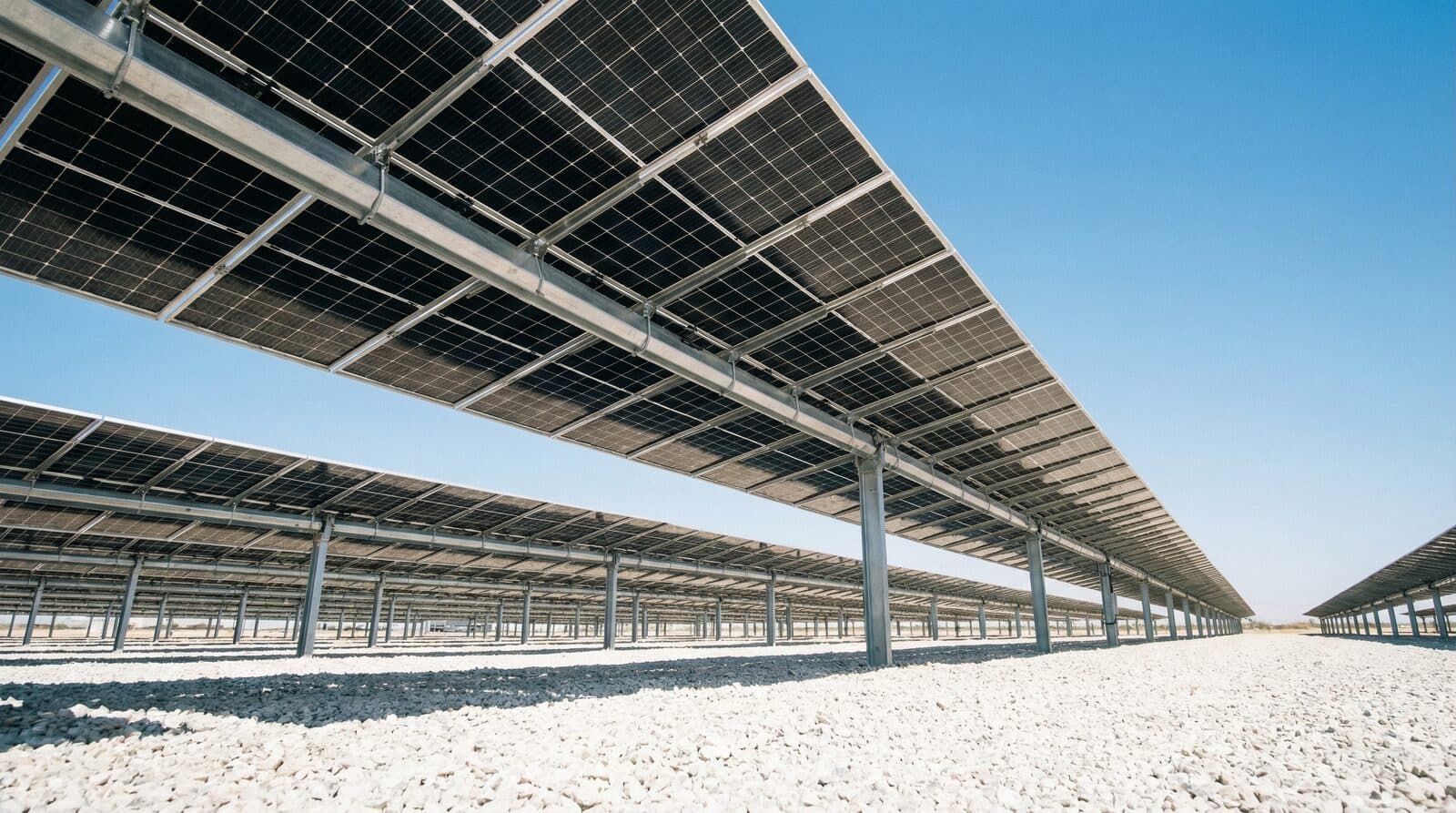
Why your system generates more than the rated output
A familiar situation: you install 8 panels rated at 615 W each, giving a nominal 4.92 kW on paper, yet the inverter monitoring shows more. This is not a meter error — it is the bifacial effect that installers rarely mention during setup.
Most modern panels rated 550+ W are dual-sided (bifacial). Their rear side also generates electricity by collecting reflected and diffuse light from the surface beneath the panels. The nominal power in the datasheet covers only the front side under Standard Test Conditions (STC). The rear side adds an extra 5–30 % on top, depending on mounting conditions.
Your 4.92 kW is the minimum the manufacturer guarantees. Real generation is higher because the rear side captures light that conventional single-sided panels simply ignore.
Why doesn't the datasheet show this?
What is a bifacial (dual-sided) panel
A conventional (monofacial) panel has an opaque back sheet — usually a white or black film. A bifacial panel replaces this film with glass on both sides. Through the transparent rear, the solar cells receive light from behind as well.
The front side works the same as any standard panel — absorbing direct sunlight. The rear side collects light reflected off the ground, roof or other surfaces (this is called albedo), plus diffuse sky light reaching it from below.
The bifaciality factor shows how efficient the rear side is relative to the front. For example, a value of 0.70 (or 70 %) means: if the rear side receives the same irradiance as the front, it will produce 70 % of the front-side power. Modern panels range from 70 % (PERC) to 90 % (HJT).
How to tell if a panel is bifacial
How generation splits between the front and rear sides
The front side receives direct sunlight and delivers 100 % of rated power at STC. The rear side receives only reflected and diffuse light, which is much weaker than direct irradiance. How much exactly depends on the albedo of the surface beneath the panels. Here are real-world values for common surfaces:
| Surface | Albedo | Gain (70 % bif.) |
|---|---|---|
| Green grass | ≈ 20 % | +10–14 % |
| Concrete / paving | ≈ 25–30 % | +12–17 % |
| Sand / light soil | ≈ 30–35 % | +15–20 % |
| Snow | ≈ 60–80 % | +25–40 % |
| White roof / membrane | ≈ 60–70 % | +25–35 % |
| Light gravel / crushed stone | ≈ 30–40 % | +15–22 % |
| Dark bitumen roof | ≈ 5–10 % | +2–5 % |
Bifacial current gain formula
Isc_effective = Isc × (1 + bifaciality × albedo × 0.7)The 0.7 multiplier is the view factor — an industry standard that accounts for the rear side not seeing the surface uniformly: part is blocked by mounting hardware, part by neighbouring panels, and light from the edges arrives at an angle. The AS/NZS 5033:2021 standard uses the same value.
Why shading only matters on the front side
This is a key question that confuses many people. The answer lies in how cells are connected inside the panel and where the light comes from on each side.
The front side receives direct, collimated sunlight. Cells are wired in series in 3 groups (substrings) of 24 cells each (in a typical 144-cell panel). In a series circuit the current is the same through every cell — like water in a pipe. If one cell is shaded, it generates less current and becomes the bottleneck for the entire group. Instead of being a generator, it turns into a load, heats up, and can be damaged (hot spot).
The rear side works fundamentally differently. It collects diffuse and reflected light arriving from all directions — from the ground, walls, and nearby objects. This light does not cast sharp shadows. Even if a mounting rail shades a few cells on the back, the rest of the rear surface continues collecting reflected light from other areas. Losing diffuse light on a few cells costs a few percent of the already modest rear-side gain — not a catastrophic power drop.
The key difference in one sentence
Bypass diodes: how a panel stays partially alive
Every modern panel has 3 bypass diodes — one per cell group (substring). When the cells in a group are shaded and stop generating enough current, the bypass diode opens and routes the current around that group. The panel loses only the shaded third of its output; the other two thirds keep working normally.
Without bypass diodes, shading a single cell would stall the entire string of panels — tens or hundreds of watts lost. With them, the loss is limited to one substring of one panel.
But there is a subtle catch: the bypass diode does not eliminate the problem — it localises it. The shaded group still produces nothing, and the panel operates at 66 % instead of 100 %. In a string of 10 panels, that means roughly 3.3 % total power loss from a single shaded cell. For the front side, this is significant. For the rear side — where total generation is only 10–20 % anyway — bypass diodes almost never activate, because diffuse light does not create enough contrast between cells.
Hot spot — a real danger
How much the rear side adds — real-world examples
The bifacial gain formula takes three factors into account: the panel's bifaciality factor, the surface albedo, and the view factor (0.7). Let's see what this means in practice for a typical panel with 70 % bifaciality:
Practical bifacial gain
Gain = bifaciality × albedo × view_factor
Example: 0.70 × 0.30 × 0.7 = 0.147 = +14.7 %
This gain applies to the short-circuit current (Isc), not directly to power. But since power is proportional to current, the effect on generation is roughly the same.
Ground-mounted array on white gravel
Albedo 35 %, mounting height 1 m. Gain: 0.70 × 0.35 × 0.7 = +17 %. If the array produces 5 kW from the front side, the rear adds roughly 850 W. Over a year, that is an extra 200–250 kWh per 1 kW of installed capacity.
Dark bitumen roof (flush mount)
Albedo 8 %, gap between panel and roof 5 cm. Gain: 0.70 × 0.08 × 0.7 = +3.9 %. Minimal effect — the dark surface reflects very little light, and the small gap prevents diffuse light from reaching the rear side.
Winter with snow cover (cold climates)
Snow albedo 70 %, panels tilted at 35°, mounting height 0.5 m. Gain: 0.70 × 0.70 × 0.7 = +34 %. In winter, when sunlight hours are short, bifacial panels partially compensate by harvesting reflections from the snow. This is one reason they are especially beneficial in northern climates with regular snow cover.
Why does the inverter show more than rated power?
How to maximise the bifacial advantage
Not every installation exploits the full potential of bifacial panels. Here is what actually affects rear-side generation:
Mounting height. At least 30 cm above the surface, ideally 50–100 cm. A greater distance lets reflected light spread more evenly across the rear side. With flush mounting tight against the roof, the bifacial effect is virtually zero.
Surface colour. A light-coloured surface beneath the panels is the simplest way to boost the gain. White gravel, light-coloured paving, or a white membrane on a flat roof can double rear-side generation compared to dark bitumen.
Row spacing. If panels are arranged in multiple rows (ground-mounted array), increase the spacing between rows. The shadow cast by the front row onto the rear side of the next row reduces the gain.
Rear-side cleanliness. Dust, leaves, and bird droppings on the glass rear side reduce light transmission. Glass-glass panels are easy to wash, but this is often forgotten.
Check the bifacial gain in the calculator
Solar Stack automatically accounts for bifacial current when calculating string compatibility. Select your panel, specify the surface albedo, and see the real effect.
When bifacial panels are not worth it
Bifacial panels are not always the best choice. Let's compare typical scenarios:
| Criterion | Monofacial | Bifacial |
|---|---|---|
| Rear generation | 0 % | +5–30 % |
| Snow benefit | None | +25–40 % |
| Price per watt | 3–8 % lower | Baseline |
| Mounting requirements | Any method | Gap ≥ 30 cm for effect |
| Best scenario | Budget rooftop system | Ground mount on light surface |
| Worst scenario | Limited roof area | Flush mount on dark roof |
If panels are flush-mounted on a dark bitumen roof, rear generation will only be 2–5 %. The premium for a bifacial panel will take 10+ years to pay back in that case. For budget systems, it is simpler to choose monofacial panels of the same power class.
Check your system compatibility
The bifacial gain increases the short-circuit current (Isc) flowing through the inverter. If your system is close to the inverter's maxInputCurrent or maxShortCircuitCurrent limit, the additional rear-side current may exceed those thresholds. Solar Stack accounts for this automatically.
The Solar Stack calculator lets you specify the surface albedo and mounting type. If the selected panel has a bifaciality factor above 0, the calculator automatically computes the practical and theoretical gain, checks the current limits, and warns you if the bifacial current approaches the inverter's limits.
Find compatible panels for your inverter
Discover panels that match your specific inverter — factoring in bifacial gain and your local climate.
Frequently asked questions
Do I need a special inverter for bifacial panels?
No, any standard string or hybrid inverter will work. The only thing to check is the input current limit. Bifacial panels generate 5–30 % more current, so make sure the inverter's maxInputCurrent and maxShortCircuitCurrent can handle the increase. The Solar Stack calculator performs this check automatically.
Do bifacial panels work on a flat roof?
They do, but the effect depends on mounting height and surface colour. On a flat roof with a white membrane and 30+ cm mounting brackets, the gain can reach 20–25 %. On dark bitumen with flush mounting, only 2–4 %. If you're planning a flat roof installation, choose a light-coloured surface or use brackets with a gap.
Why is the bifacial effect stronger in the morning and evening?
In the morning and evening the sun is low on the horizon. Direct irradiance on the front side is weak (high angle of incidence). Meanwhile, diffuse light from the sky and reflections off surfaces remains noticeable. So the share of rear-side generation relative to the front increases. In the evening, a bifacial panel can generate 30–50 % more than a monofacial panel of the same rated power.
Is it worth painting the roof white for bifacial panels?
Yes — if the roof is flat and due for resurfacing anyway. A white waterproofing membrane (TPO, PVC) costs about the same as a dark one but raises the albedo from 10 % to 60–70 %. For a 10 kW system, this can add 1–1.5 kW of extra power. But painting a pitched roof solely for the panels is not justified.
Are all Jinko Solar / LONGi / Trina panels bifacial?
No. Major manufacturers produce both monofacial and bifacial versions within the same product line. Bifacial models typically have a suffix like BF, BG, or Bifacial in the name. For example, Jinko Tiger Neo — most models rated 570+ W are bifacial, but lower-wattage models may come in both single- and dual-sided variants. Always check the datasheet.
How do I find the bifaciality factor of my panel?
Look in the datasheet for a "Bifaciality" or "Bifacial Factor" line. The value is given as a percentage (e.g. 70 %) or a decimal (0.70). If there is no such line, the panel is monofacial. In Solar Stack, the bifaciality factor is automatically extracted from PDF datasheets and displayed in the panel specifications.


Discussion
Sign in to join the discussion
We require a quick sign-in to keep this thread free of spam.
No comments yet. Be the first to share your experience.