Ground-Mounted vs Rooftop Solar Panels
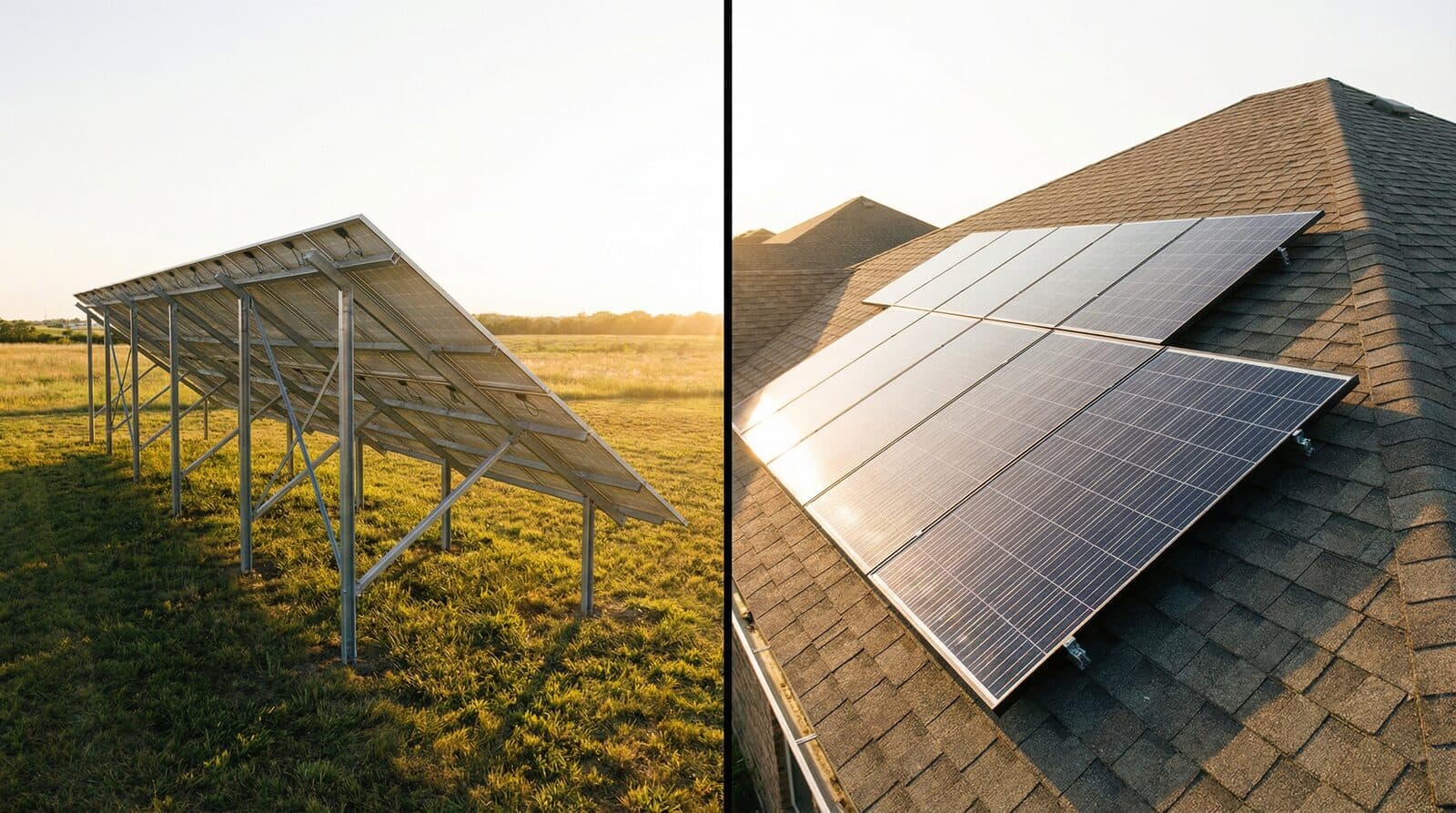
Why the Mounting Choice Matters
Before you buy a single panel, you face a fundamental decision: install on your roof or build a ground-mounted array in your yard. The answer shapes your budget, your system's performance, and even which inverter you can use. Most guides treat this as a simple preference — but the technical differences run deeper than you might expect.
Ground-mounted systems offer optimal tilt angles and better airflow, which keeps panels cooler and more productive. Rooftop systems cost less and use space you're already paying for. But the real surprise? Your mounting choice changes the string sizing math — longer cable runs on ground mounts introduce voltage drop that can push your system outside the inverter's MPPT range.
Why this matters for string sizing
Quick Comparison: Ground-Mounted vs Rooftop
Here's a side-by-side snapshot before we dive into the details. Both options work well — the best choice depends on your property, budget, and goals.
| Factor | Rooftop | Ground Mount |
|---|---|---|
| Cost per watt | ~$2.50–2.70/W | ~$3.00–3.50/W (+20–50%) |
| Energy output | Depends on roof angle/direction | Optimal tilt, 10–25% more vs bad roof |
| Space needed | Uses existing roof area | ~400 sq ft per kW (with setbacks) |
| Permitting | Simpler, 2–4 weeks | More complex, 8–16 weeks |
| Maintenance | Harder to access for cleaning | Easy access, simple snow clearing |
| Orientation | Fixed to roof direction | Any direction, adjustable tilt |
| Installation | 1–2 days, no ground work | 3–5 days, foundation required |
Cost Breakdown: What Drives the Price Difference
Rooftop solar averages $2.50–2.70 per watt installed in 2026, while ground-mounted systems typically run $3.00–3.50 per watt — a premium of 20–50%. For a 10 kW system, that translates to roughly $25,000–27,000 for rooftop versus $30,000–35,000 for ground mount before tax credits.
The premium comes from three sources. First, the racking hardware itself costs more — ground mount racking runs $0.30–0.70/W compared to $0.10–0.20/W for rooftop rails. Second, ground mounts need a foundation: driven piles, concrete piers, or ballasted footings add $500–2,000 depending on soil conditions. Third, trenching for DC wiring from the array to your inverter or electrical panel typically adds another $500–1,500.
However, ground-mount systems often produce more energy per panel thanks to optimal orientation and better cooling. Over a 25-year lifespan, the extra output can offset the higher upfront cost — sometimes achieving a lower levelized cost of energy (LCOE) than a poorly-oriented rooftop system.
When ground mount actually costs less per kWh
Efficiency and Performance
Three factors give ground-mounted systems a performance edge: tilt angle optimization, better ventilation, and freedom from roof shading. The most impactful is temperature — solar panels lose power as they heat up, and mounting type directly controls how hot your cells get.
Cell temperature estimate (mounting offset method)
T_cell = T_ambient + mounting_offset

Ground / open rack:   +25°C
Roof rack (>15 cm):   +30°C
Flush roof mount:     +35°C
On a 35°C summer day, a flush-mounted rooftop panel reaches an estimated cell temperature of 70°C, while a ground-mounted panel with good airflow reaches about 60°C. That 10°C difference matters: with a typical temperature coefficient of -0.27%/°C for Voc, the ground-mounted panel retains roughly 2.7% more voltage — and produces proportionally more power.
Tilt angle is the other big advantage. A south-facing ground mount at the optimal tilt for your latitude (roughly latitude minus 10–15° for annual production) captures 10–25% more energy than a flat or sub-optimally oriented roof. If you can position panels to face true south (or north in the southern hemisphere) at 25–35° tilt, you're extracting close to the theoretical maximum from your location.
Real-world numbers
Space and Site Requirements
A common rule of thumb: ground-mounted solar requires about 400 square feet (37 m²) per kilowatt of installed capacity when you account for row spacing and access paths. A 10 kW ground array needs roughly 4,000 sq ft — about 1/10 of an acre. This includes inter-row spacing to prevent self-shading, typically 2–3 times the panel height.
Setback requirements vary by jurisdiction but typically mandate 10–25 feet from property lines and 5–15 feet from structures. Some municipalities also limit the height of ground-mounted arrays to 6–10 feet, which affects row spacing calculations. Always check your local zoning code before committing to a ground mount design.
Rooftop systems have no extra land requirement, which is their biggest practical advantage. If your usable roof area is limited (dormers, vents, chimneys, skylights), you may not fit enough panels for your energy goals — that's where a ground mount or a hybrid approach (some panels on roof, some on ground) makes sense.
Permitting and Regulations
Rooftop solar typically qualifies as a "building modification" and follows a simpler permitting path: an electrical permit and sometimes a building permit, usually processed in 2–4 weeks. Many jurisdictions have streamlined rooftop solar permits because they don't change your property's footprint.
Ground-mounted systems are classified as "new construction" in most areas. This triggers a longer review: zoning compliance, setback verification, structural/foundation drawings, and sometimes an environmental or stormwater management review. Expect 8–16 weeks for approval. Geotechnical soil testing alone can cost $500–1,500 and take 2–4 weeks.
Check before you dig
Mounting Types Explained
Not all ground mounts are the same. The four main options range from simple fixed-tilt racks to motorized trackers that follow the sun across the sky. Each trades cost for production gain.
| Mounting type | Best for | Energy gain vs flat | Extra cost |
|---|---|---|---|
| Fixed tilt | Most residential installs | +25–35% vs flat roof | Baseline |
| Pole mount | Small arrays (4–16 panels) | +25–35% (seasonal adjust) | +$0.10–0.20/W |
| Single-axis tracker | Large arrays, high-DNI areas | +12–25% vs fixed tilt | +$0.15–0.25/W |
| Dual-axis tracker | Maximum output, large budget | +30–45% vs fixed tilt | +$0.25–0.40/W |
Tracker ROI reality check
The Hidden Factor: String Sizing and Voltage Drop
Here's something no other rooftop-vs-ground comparison covers: your mounting choice fundamentally changes the string sizing math. Ground-mounted arrays sit 30–60 meters from the inverter, compared to 5–15 meters for a typical rooftop system. Those longer DC cable runs create voltage drop — and it can push your system outside the inverter's operating range.
Voltage drop in DC cable (two-way run)
V_drop = 2 × L × I × ρ / A

L = one-way cable length (m)
I = operating current (A)
ρ = resistivity of copper (0.0175 Ω·mm²/m)
A = cable cross-section (mm²)
For example, a 50-meter cable run carrying 11 A through 4 mm² copper wire drops about 4.8 V. On a string of 12 panels with Vmpp of 35 V each, your string voltage at the MPPT input is 420 V minus 4.8 V = 415.2 V. If your inverter's MPPT minimum is 200 V that's fine — but at hot temperatures where Vmpp drops 15–20%, a shorter string might fall below the MPPT floor.
Temperature-adjusted voltage at inverter input
V_mppt = (N × Vmpp × (1 + TcVoc/100 × (T_cell − 25))) − V_dropThe solution: design ground-mount strings with slightly higher voltage — add one more panel per string compared to a rooftop array, or upsize your DC cabling from 4 mm² to 6 mm² (10 AWG to 8 AWG) to cut the voltage drop in half. NEC recommends keeping DC circuit voltage drop under 2%.
This also affects inverter choice. Rooftop installations often use microinverters (short DC runs, panel-level optimization). Ground mounts typically favor string inverters with wide MPPT ranges — you need that range to accommodate both the higher cold-weather voltages and the voltage losses from long cable runs.
Don't forget: mounting type changes cell temperature
Check your string compatibility
Select your mounting type in the calculator to see how it affects cell temperature and voltage limits for your specific panel + inverter combination.
Which Is Right for You?
Run through this checklist to find the best fit for your situation:
- Your roof is south-facing, unshaded, and in good condition →
Rooftop is almost always the better value. Lower cost, simpler permitting, and you're already within a few percent of optimal production.
- Your roof faces east/west or has significant shading →
Ground mount can produce 15–40% more energy. Calculate the lifetime cost per kWh to see if the premium pays off.
- You have plenty of open, unshaded land →
Ground mount gives you complete design freedom — optimal tilt, easy maintenance, and room for future expansion.
- Your roof needs replacement within 10 years →
Either replace the roof first (adds $5,000–15,000 to the project) or go ground-mounted to avoid uninstalling and reinstalling panels later.
- You want the lowest upfront cost →
Rooftop wins on initial price per watt. If budget is tight, a well-sized rooftop system delivers strong returns.
- You plan to expand the system later →
Ground mount is easier to expand — just extend the racking. Rooftop expansion depends on remaining roof space and structural capacity.
Find compatible inverters
Use our matcher tool to find inverters that work with your panels — filter by MPPT range, input current, and number of trackers.
Frequently Asked Questions
Are ground-mounted solar panels more efficient than rooftop?
Ground-mounted panels can produce 5–25% more energy than rooftop panels, depending on the comparison. The advantage comes from optimal tilt angles, better airflow (lower cell temperatures), and freedom from roof shading. However, if your roof faces south at a good angle, the difference narrows to just 3–8% from the cooling advantage alone.
How much more do ground-mounted solar panels cost?
Ground-mounted systems typically cost 20–50% more than equivalent rooftop systems — about $3.00–3.50/W versus $2.50–2.70/W in 2026. The premium covers racking hardware, foundation work, and trenching for wiring. For a 10 kW system, expect to pay $5,000–8,000 more for a ground mount.
Do ground-mounted solar panels need planning permission?
Yes, in most jurisdictions. Ground-mounted systems are classified as new construction and require zoning approval, setback compliance, and structural drawings. The process typically takes 8–16 weeks compared to 2–4 weeks for rooftop. Some rural areas have more relaxed requirements — check with your local building department.
How much space do I need for ground-mounted solar?
Plan for about 400 square feet (37 m²) per kilowatt, including row spacing and access paths. A 10 kW system needs roughly 4,000 sq ft. Add setback requirements (typically 10–25 feet from property lines) to determine total land needed.
Can I install ground-mounted solar panels myself?
The mechanical installation (racking, panel mounting) is within reach for experienced DIYers. However, the electrical work — wiring, grounding, inverter connection, and utility interconnection — requires a licensed electrician in most jurisdictions. Foundation work (driven piles or concrete piers) usually requires rented equipment. Always pull the required permits regardless of who does the work.
What is the best tilt angle for ground-mounted panels?
For maximum annual production, set the tilt angle to your latitude minus 10–15 degrees. For example, at 40°N latitude, aim for 25–30° tilt. If you want to maximize winter production (useful for off-grid systems), increase tilt to your latitude plus 10–15°. Adjustable pole mounts let you change the angle seasonally.
How far can solar panels be from the inverter?
There's no hard maximum distance, but voltage drop increases with cable length. Keep DC circuits under 2% voltage drop per NEC guidelines. For a typical 11 A string at 400 V, that means about 75 meters with 6 mm² cable. Longer runs require thicker wire or higher-voltage string designs. Use our calculator to verify your string voltage stays within the inverter's MPPT range after accounting for cable losses.
Does mounting type affect string sizing calculations?
Yes, in two ways. First, mounting type determines cell temperature: ground mounts run cooler (+25°C offset) than flush roof mounts (+35°C), which changes voltage calculations at both temperature extremes. Second, ground mounts have longer cable runs that create voltage drop, potentially requiring more panels per string to stay above the inverter's MPPT minimum. Our calculator accounts for both factors — just select your mounting type to see the difference.


Discussion
Sign in to join the discussion
We require a quick sign-in to keep this thread free of spam.
No comments yet. Be the first to share your experience.