Solar Panel String Sizing: A Complete Beginner's Guide
What is a solar panel string?
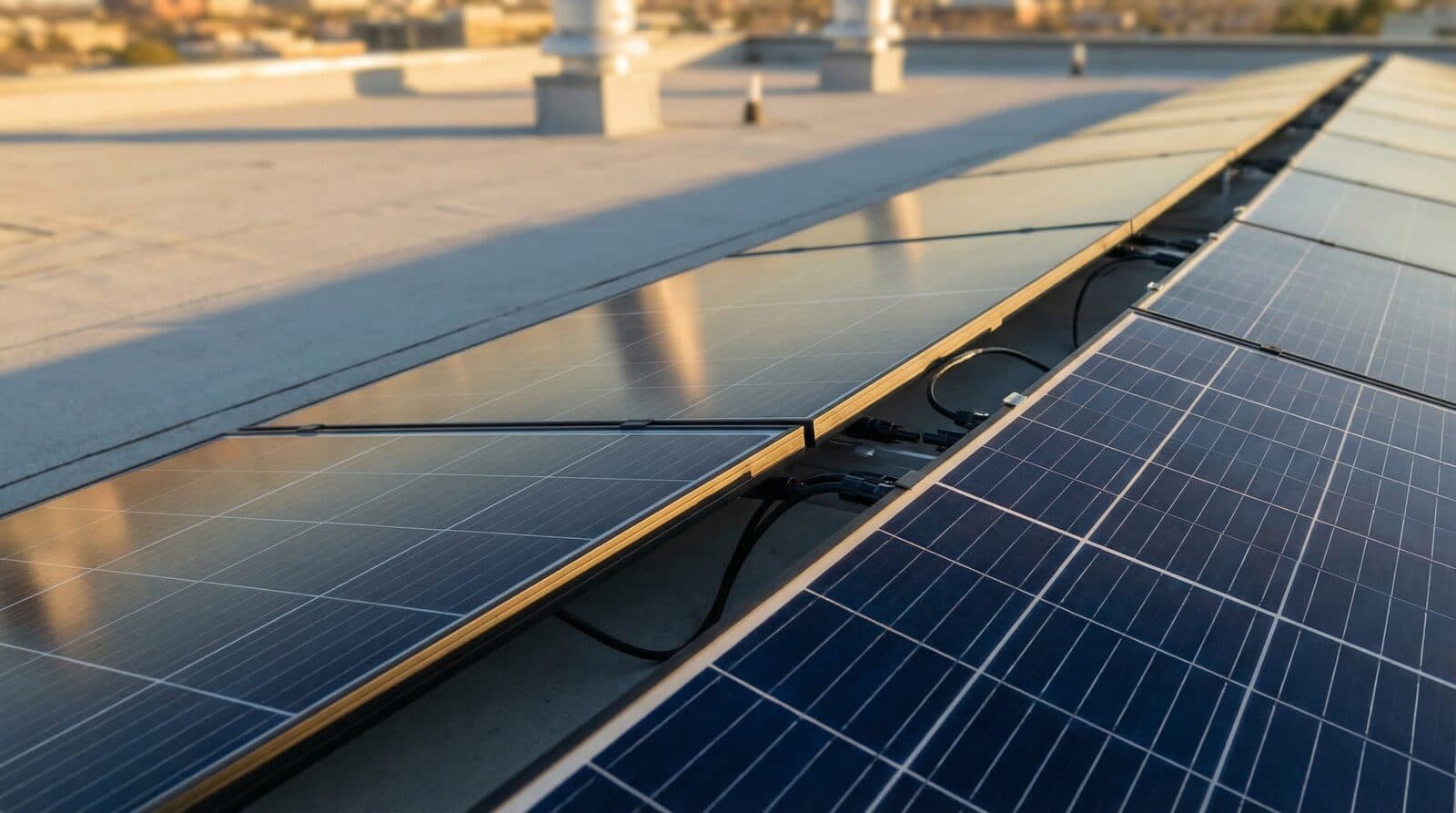
A solar panel string is a group of panels wired together in series — like batteries in a flashlight. When panels are connected in series, their voltages add up while the current stays the same. For example, 10 panels rated at 40V each produce a string voltage of 400V.
Most residential solar installations use between 8 and 20 panels per string, depending on the inverter's voltage limits and local climate. Getting this number right is critical — too many panels can damage your inverter, and too few means the system won't operate efficiently.
Why is it called a "string"?
Why string sizing matters
Incorrect string sizing is one of the most dangerous mistakes in solar installation. If your string produces too much voltage in cold weather, the inverter's input protection can fail — potentially causing permanent damage or even fire. This is not theoretical: inverter manufacturers void warranties for installations that exceed voltage limits.
On the other end, if your string voltage is too low in hot weather, the inverter simply cannot convert the power. It shuts down and your panels sit idle, producing nothing. Every string must stay within a safe voltage window across all possible temperatures.
Real-world risk
Series vs parallel: how voltage and current add up
There are two ways to connect solar panels: in series and in parallel. Understanding the difference is essential for string sizing.
Series connection (string)
Panels connected in series form a string. Voltages add up, current stays the same as one panel. This is how you build the voltage your inverter needs to operate.
String voltage
V_string = N_panels × V_panel (e.g., 10 × 40V = 400V)Parallel connection
Multiple strings can be connected in parallel to one inverter input. When strings are in parallel, their currents add up while voltage stays the same. This is how you increase total power without exceeding the voltage limit.
Total current
I_total = N_strings × I_panel (e.g., 3 strings × 13A = 39A)Understanding voltage: Voc and Vmpp
Every solar panel has two important voltage values printed on its datasheet. Understanding the difference between them is crucial for safe string sizing.
Voc (open-circuit voltage) is the maximum voltage a panel produces when nothing is connected to it — like a battery sitting on a shelf. This is the voltage you must check against your inverter's absolute maximum input. Vmpp (voltage at maximum power point) is the typical operating voltage when the panel is actually generating power. Vmpp is always lower than Voc, usually by 15-20%.
Voc (open-circuit voltage)
Voc = Maximum voltage (no load) → safety limit checkVmpp (voltage at max power)
Vmpp = Operating voltage (under load) → MPPT range checkWhich voltage matters when?
How temperature changes everything
Here's the counterintuitive part that surprises most beginners: solar panels produce higher voltage in cold weather and lower voltage in hot weather. This happens because of the physics of silicon — as temperature drops, electrons have less thermal energy, which actually increases the voltage the cell can produce.
The rate of change is specified by the temperature coefficient of Voc, typically around -0.27%/°C for modern panels. The negative sign means voltage goes the opposite direction to temperature: when temperature drops below 25°C (the standard test temperature), voltage rises.
Temperature-adjusted voltage
V_adjusted = V_stc × (1 + (TempCoeff / 100) × (T_cell - 25°C))At -20°C, a panel rated at 49.6V can reach 55.6V — a 12% increase. Multiply that by 10 panels in a string, and you get 556V instead of 496V. Those extra 60 volts can be the difference between a safe installation and a damaged inverter.
Why 25°C is the baseline
Step-by-step: sizing your string
Follow these five steps to determine the safe number of panels per string for your specific equipment and climate:
- Find your panel's electrical specs
From your panel's datasheet, note: Voc (open-circuit voltage), Vmpp (voltage at max power), Isc (short-circuit current), and temperature coefficient of Voc (usually listed as TC Voc or αVoc). For a typical 550W panel: Voc ≈ 49.6V, Vmpp ≈ 41.7V, TC Voc ≈ -0.27%/°C.
- Find your inverter's limits
From your inverter's datasheet, note: maximum DC input voltage, MPPT voltage range (minimum and maximum), maximum input current per MPPT, and maximum short-circuit current. For a typical residential inverter: max DC = 600V, MPPT range = 150-550V.
- Calculate worst-case cold voltage
Use the coldest temperature your location experiences. Calculate Voc at that temperature for your proposed string length. This must not exceed the inverter's max DC voltage. If it does, reduce the number of panels.
- Calculate worst-case hot voltage
Use the hottest temperature your location experiences. Calculate Vmpp at that temperature. This must stay above the inverter's MPPT minimum voltage. If it doesn't, add more panels.
- Check current limits
If running multiple strings in parallel, multiply the single-string Isc by the number of strings. This total must not exceed the inverter's maximum input current or short-circuit current rating.
Skip the math — use our calculator
Enter your panel and inverter, set your temperature range, and get instant results for all 7 safety checks.
Understanding your inverter's limits
Your inverter has several voltage and current limits, each protecting a different part of the system. Understanding these limits helps you appreciate why string sizing matters.
Maximum DC input voltage
This is the absolute maximum voltage the inverter can safely handle at its DC input terminals. It's a hardware limit — exceeding it can destroy the input stage electronics. This limit is checked against your string's Voc at the coldest expected temperature. Common values: 600V for residential inverters, 1000-1100V for commercial.
MPPT voltage range
The MPPT (Maximum Power Point Tracking) range is the voltage window where the inverter can efficiently convert DC to AC. Below the minimum, the inverter shuts down. Above the maximum, it operates but can't track the optimal power point, resulting in energy loss. Your string's Vmpp should stay within this range across all temperatures.
One more thing to check on modern hybrid inverters: the MPPT inputs are not always identical. A common design pairs a strong tracker that accepts two strings at 36A with a weaker one that takes a single string at 18A — while the datasheet headline quotes only the strongest input. Always read the per-tracker table before assigning strings. Our calculator stores per-input limits for these models and checks every tracker separately.
The gap between max DC and MPPT max
Current limits and parallel strings
When you connect multiple strings in parallel to one MPPT input, their currents add up. Each MPPT input has two current limits: a maximum operating current (maxInputCurrent) and a maximum short-circuit current (maxShortCircuitCurrent). The short-circuit limit is always higher and protects against fault conditions.
Total string current (hot conditions)
I_total = N_strings × Isc × (1 + (TC_Isc / 100) × (T_hot - 25°C))Unlike voltage, current increases slightly in hot weather (temperature coefficient of Isc is positive, typically +0.05%/°C). The increase is small — only about 2-3% at 70°C cell temperature — but it matters when you're near the limit.
Size your DC cables next
Pick the right cable gauge — voltage drop formula, sizing table, and a worked example.
Calculate your exact cable size
Pick your panel from the database — the calculator returns mm², voltage drop, yearly losses and the safety check.
Worked example with real equipment
Let's walk through a complete string sizing calculation using real equipment specs:
Equipment
Panel: Canadian Solar CS6W-550MS (Voc=49.6V, Vmpp=41.7V, Isc=14.0A, TC Voc=−0.27%/°C). Inverter: Huawei SUN2000-10KTL-M1 (Max DC=1100V, MPPT 140–980V, max input=11A/MPPT, max Isc=15A/MPPT, 2 MPPT × 1 string). Configuration: 12 panels per string, 1 string per MPPT, 2 MPPTs used (24 panels total). Location: Central Europe (−15°C winter, +40°C summer).
Calculations
Cold Voc = 12 × 49.6 × (1 + (−0.27/100) × (−15 − 25)) = 595.2 × 1.108 = 659.5V ✓ (< 1100V max DC)Hot Vmpp = 12 × 41.7 × (1 + (−0.27/100) × (70 − 25)) = 500.4 × 0.8785 = 439.6V ✓ (> 140V MPPT min, < 980V MPPT max)Hot Isc = 1 × 14.0 × (1 + (0.05/100) × (70 − 25)) = 14.0 × 1.0225 = 14.32A ⚠ (> 11A max input — significant clipping warning)Cell temp hot = 40 + 30 (rack roof offset) = 70°CResults
Cold Voc 659.5V < 1100V max DC ✓. Vmpp stays within 140–980V MPPT range year-round ✓. Hot Isc 14.32A > 11A max input ⚠ — the panel current significantly exceeds the per-MPPT limit by about 30%, causing substantial clipping at peak sun. The inverter will operate safely but limit current to 11A, losing roughly a quarter of peak output. Hot Isc 14.32A < 15A max short-circuit ✓. DC/AC ratio = 13200W ÷ 10000W = 1.32 ✓.
What a failed check looks like
Now let's see what happens when the configuration doesn't work. Same panels, but 10 per string instead of 12, on a smaller inverter with a 500V max DC voltage limit — in a cold climate (−20°C winters).
Setup
Panel: Canadian Solar CS6W-550MS, Voc = 49.6V, TcVoc = −0.27%/°C. Inverter: Max DC voltage = 500V. Configuration: 10 panels per string. Winter minimum: −20°C.
Voltage check
Voc_cold = 10 × 49.6 × (1 + (−0.27/100) × (−20 − 25)) = 496 × 1.1215 = 556.3V556.3V > 500V max DC ✗ — EXCEEDS inverter limit by 56V!Result
The string voltage at −20°C exceeds the inverter's absolute maximum by 11%. This configuration is unsafe — the inverter could be damaged on the first cold sunny morning. Solution: reduce to 8 panels per string (Voc_cold = 445V ✓) or choose an inverter with a higher voltage limit.
Run this calculation instantly
Our calculator does all 7 checks automatically for any panel + inverter combination in your database.
Panel technology comparison (2026)
Modern solar panels use different cell technologies that directly affect string sizing. The temperature coefficient varies significantly between technologies — meaning the same number of panels may be safe with one technology but not another.
| Technology | Efficiency | TC Voc (%/°C) | TC Pmax (%/°C) |
|---|---|---|---|
| PERC (mono) | 21-23% | -0.27 to -0.29 | -0.34 to -0.38 |
| TOPCon | 22-24% | -0.26 to -0.28 | -0.29 to -0.32 |
| HJT | 22-24% | -0.24 to -0.26 | -0.24 to -0.26 |
HJT panels have the best temperature performance — their voltage rises less in cold weather, allowing more panels per string in the same climate. TOPCon is a good middle ground and dominates new cell production in 2026 with roughly 80% of the market. PERC is the legacy technology, still widely available but gradually being replaced.
5 common string sizing mistakes
- Ignoring temperature extremes
Using summer temperatures only and forgetting that winter cold pushes voltage 10-15% above datasheet values. Always calculate at your coldest expected temperature.
- Confusing Voc with Vmpp
Using Vmpp for the maximum voltage check instead of Voc. Voc is always higher than Vmpp and is the correct value for checking the inverter's DC voltage limit.
- Using air temperature instead of cell temperature
Panels heat up 25-35°C above ambient air temperature depending on mounting. A 40°C summer day means 65-75°C cell temperature, not 40°C.
- Not accounting for manufacturing tolerance
Real panels can produce 2-3% more voltage than the datasheet value due to manufacturing variation. IEC 62548 recommends adding a safety margin for this.
- Mixing different panels in one string
Connecting panels with different current ratings in series. The weakest panel limits the entire string's current, reducing overall output. Different panels should go on separate MPPT inputs.
Finally, a step back: if your roof is small, partly shaded, or split across several orientations, you may not need string sizing at all. Microinverters convert power at each panel individually, so voltage limits and string math disappear — at a different price point.
Microinverters vs string inverters
When per-panel conversion beats a string design — shading, roof layout, cost, and sizing differences.
Frequently asked questions
How many solar panels can I connect in one string?
It depends on your inverter's voltage limits and local climate. Typically 8-20 panels for residential systems. Use a string sizing calculator with your specific equipment and temperature range to find the exact safe number.
What happens if my string voltage exceeds the inverter maximum?
The inverter's input protection circuit may fail, potentially causing permanent damage. Most inverters will attempt to disconnect, but repeated overvoltage events degrade the protection components. This is the most dangerous string sizing error.
Does cold weather really increase voltage?
Yes. Solar panel voltage increases in cold weather due to silicon physics. A typical panel's Voc rises about 0.27% for every degree below 25°C. At -20°C, that's a 12% voltage increase — significant enough to exceed many inverter limits.
Can I use panels from different manufacturers in one string?
Not recommended. Panels in a series string should have matching current ratings (Isc). Different panels should be connected to separate MPPT inputs on your inverter, where each input optimizes independently.
What is the MPPT voltage range?
The MPPT range is the voltage window where your inverter efficiently tracks and converts solar power. If your string voltage falls below the minimum, the inverter shuts down. Above the maximum, it loses tracking efficiency. Your string's operating voltage (Vmpp) should stay within this range year-round.
How do I find my panel's temperature coefficient?
Look on the panel's datasheet under 'Temperature Coefficients' or 'Thermal Characteristics'. The voltage coefficient (TC Voc or αVoc) is listed in %/°C, typically around -0.27%/°C for modern panels. If you have a PDF datasheet, our tool can extract this automatically.
Do I need to worry about string sizing if I buy a pre-designed kit?
Pre-designed kits from reputable manufacturers are usually sized correctly. But if you modify the kit (add panels, change the inverter, or install in a climate different from the kit's design region), you should verify compatibility.
What standards govern string sizing?
IEC 62548 (international) and NEC 690.7 (US) are the primary standards. IEC 62548 specifies calculation methods including temperature correction factors and manufacturing tolerance. NEC 2026 recently removed the 100kW system size threshold, making the calculation method applicable to all installations.
My string is 441V at STC and the inverter max is 500V — is this safe?
Almost certainly not. 441V is the STC voltage at 25°C. On a cold winter morning at −15°C, that voltage rises to approximately 489V — dangerously close to the 500V limit. With manufacturing tolerance (+3%), you could hit 504V. Always calculate Voc at your coldest expected temperature, not STC. Our calculator does this automatically — try it before installing.
Can I add one more panel to my existing string?
Maybe — but you must recalculate. Adding one panel increases the string voltage proportionally. If your current string is already near the inverter's voltage limit, one extra panel can push it over on cold days. Enter your panel model, inverter, and the new panel count (N+1) into our calculator. If all checks pass at your coldest temperature, it's safe to add.


Discussion
Sign in to join the discussion
We require a quick sign-in to keep this thread free of spam.
No comments yet. Be the first to share your experience.