Solar Cable Sizing Chart: 2.5–10 mm² + Voltage Drop
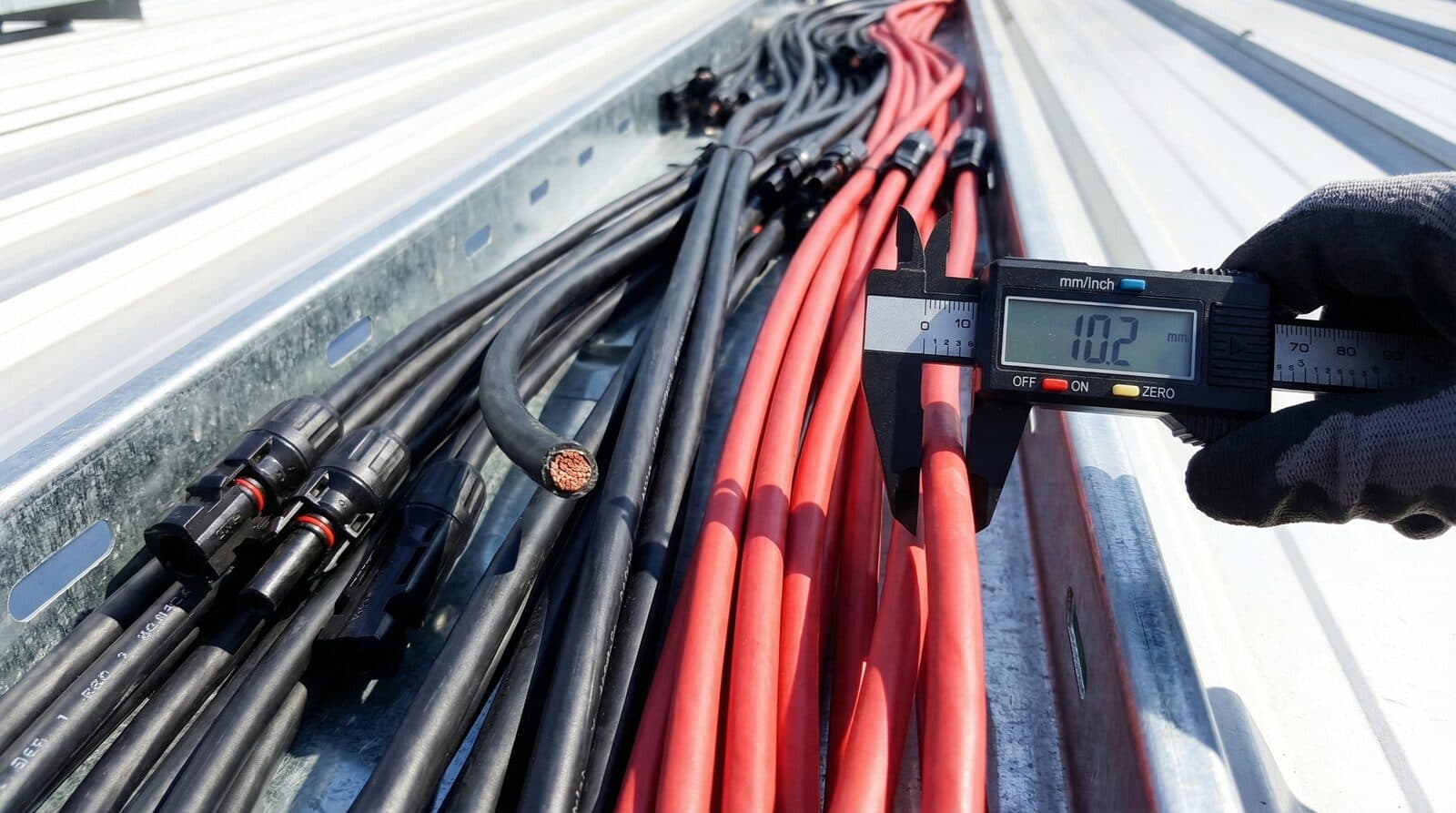
Why solar cable sizing matters
Solar cable sizing — also called PV cable sizing — determines whether your solar investment delivers power to the inverter or bleeds it away as heat. Every meter of undersized DC cable wastes energy as resistive heating instead of reaching the inverter. At 15 A through a 2.5 mm² cable over 20 m, you lose roughly 3.5% of your power to that heating — and the cable runs hot enough to degrade its own insulation over time. That degradation creates a fire hazard that gets worse with every passing year.
The fix is straightforward: match your cable cross-section to your actual current and distance. This guide gives you the formula, a reference table, and a worked example so you can pick the right cable with confidence. After sizing your strings with our calculator, come back here to select the cable that keeps your system safe and efficient.
Cable sizing is a safety requirement
The voltage drop formula
Voltage drop is the energy lost as current pushes through the resistance of the cable. The longer the cable, the thinner the wire, or the higher the current — the more voltage you lose. The solar industry standard is to keep total DC cable voltage drop below 2% from panels to inverter. Below 1% is ideal for short runs.
Voltage drop (%)
V_drop(%) = (2 × L × I × ρ) / (A × V_string) × 100

L = one-way cable length (m)
I = operating current (A) — use Impp
ρ = resistivity of copper = 0.0175 Ω·mm²/m
A = cable cross-section (mm²)
V_string = string operating voltage (V) — use Vmpp × N_panels
Try it with your numbers
Voltage drop
0.51%
The factor of 2 accounts for both the positive and negative conductors — current flows out to the inverter and back through the return wire. A 20 m run means 40 m of total conductor length. Aim for 1% or less on short runs under 15 m, and keep it at or below 2% for longer runs up to 40 m. If your calculation exceeds 2%, go up one cable size.
Cable sizing table: which gauge for your system
This table shows the maximum recommended one-way cable length at 2% voltage drop for common solar configurations. Current values assume a typical string of modern 550 W panels (Impp around 13 A), a 335 V string and a hot-roof conductor at 85 °C — the same conservative basis as our cable size calculator.
| Cable (mm²) | Max current (A) | Max length at 13A / 2% drop | Typical use case |
|---|---|---|---|
| 2.5 mm² | 21A | ~29m | Short runs, microinverter connections |
| 4 mm² | 32A | ~47m | Rooftop to inverter, standard residential |
| 6 mm² | 40A | ~70m | Most common choice — residential and commercial |
| 10 mm² | 55A | ~117m | Long runs, ground-mount systems |
| 16 mm² | 73A | ~188m | Very long runs, commercial systems |
6 mm² is the sweet spot for residential
Calculate your exact cable size
Pick your panel from the database — the calculator returns mm², voltage drop, yearly losses and the safety check.
As an Amazon Associate, Solar Stack earns from qualifying purchases.
Worked example: sizing a 15m cable run
Setup: an 8-panel string with Impp = 13.12 A, Vmpp per panel = 41.95 V, and a string Vmpp of 335.6 V. The cable run is 15 m one-way from the roof junction box to the inverter in the garage. Which cable size do we need?
Voltage drop calculation
V_drop = (2 × 15 × 13.12 × 0.0175) / (A × 335.6) × 100For 4 mm²: (2 × 15 × 13.12 × 0.0175) / (4 × 335.6) × 100 = 6.885 / 1342.4 × 100 = 0.51%. For 6 mm²: 6.885 / 2013.6 × 100 = 0.34%. Both are well under the 2% threshold. The 4 mm² cable works technically for this 15 m run, but 6 mm² provides extra margin for safety and makes future expansion easier if you add panels or increase current.
Result
4 mm² → 0.51% voltage drop ✓
6 mm² → 0.34% voltage drop ✓ (recommended)
2.5 mm² → 0.82% voltage drop ✓ (tight, not recommended for 15m)
MC4 connectors: what you need to know
MC4 (Multi-Contact 4 mm) connectors are the universal standard for solar panel DC connections. They click together and form a weatherproof, UV-resistant seal rated for 30+ years of outdoor exposure. Every modern solar panel ships with MC4-compatible connectors already crimped onto its leads, so you only need to buy connectors for extension cables.
Four rules to follow: (1) Use genuine MC4-compatible connectors from established manufacturers — cheap knockoffs corrode within a few years and create arc faults. (2) Always crimp connections with the correct MC4 crimping tool — hand-crimped connections are the number one source of high-resistance joints in solar installations. (3) Never mix MC4 brands within a single connection pair — different manufacturers' tolerances may prevent a proper seal. (4) MC4 connectors are rated for specific cable sizes, typically 4 mm² to 6 mm².
MC4 cable compatibility
DC and AC cables: can they share a conduit?
In most jurisdictions, the answer is no. IEC 60364-7-712 and NEC 690.31 require DC and AC wiring to be physically separated. This means separate conduits, separate cable trays, or at minimum separate compartments within a shared tray. The reason is practical: DC arcs are much harder to extinguish than AC arcs because the current never crosses zero, and mixing DC and AC circuits creates confusion during maintenance and increases the risk of accidental contact.
Some codes allow exceptions for specific cable types — double-insulated DC cables may share a cable tray with AC conductors in certain configurations. But the safest and most universally accepted approach is always separate routing. Label all DC conduits clearly with warnings such as 'SOLAR DC — DO NOT DISCONNECT UNDER LOAD' to prevent accidents during maintenance or emergencies.
DC cables remain live when the sun is out
How string configuration affects cable sizing
This is where string sizing and cable sizing connect directly. Series strings (more panels wired in series) produce higher voltage at the same current. Parallel strings produce the same voltage but multiply the current. Higher current demands thicker cables. This means series wiring not only helps you reach the inverter's MPPT minimum voltage — it also lets you use thinner, cheaper cables for the same power level.
Example: 12 panels at 13 A each. As a single series string of 12: current is 13 A, and 4 mm² cable is sufficient for a 20 m run. As 2 parallel strings of 6: current doubles to 26 A, requiring 6 mm² or 10 mm². As 3 parallel strings of 4: current triples to 39 A, requiring 10 mm². The cable cost difference is significant for long runs — 10 mm² cable costs roughly twice as much per meter as 4 mm². This is another reason professional installers prefer longer series strings over multiple parallel strings whenever the inverter voltage window allows it.
Calculate your string current first
Use our calculator to determine your string configuration, then size cables based on the resulting current and your cable run distance.
5 common cable sizing mistakes
- Using household cable for solar DC
Standard household cable (NYM, TPS, or Romex) is not rated for outdoor UV exposure, the wide temperature cycling on a rooftop, or the high DC voltages present in solar strings (often 400–600 V). Always use purpose-built solar cable rated to EN 50618 or USE-2/PV Wire. Solar cable has double insulation, UV stabilizers, and temperature ratings designed for decades of rooftop conditions.
- Ignoring the return conductor
Current flows through both the positive and negative conductors, and both contribute resistance. The voltage drop formula uses '2 times length' because you must account for both legs of the circuit. Forgetting this doubles your actual voltage drop compared to what you calculated — a 1% calculation becomes a 2% reality.
- Using AWG tables for metric installations
AWG (American Wire Gauge) and mm² are completely different measurement systems. 10 AWG is approximately 5.26 mm², not 10 mm². Mixing these up leads to dangerously undersized cables. In Europe, Australia, and most of the world, use mm². In the United States, use AWG. If your components use one system but your reference table uses the other, convert before selecting cable.
- Not accounting for temperature derating
Published cable current ratings assume 30°C ambient temperature. On a rooftop in summer, the air temperature inside conduits can reach 50–60°C. At 50°C, a 6 mm² cable rated for 40 A at 30°C is derated to approximately 34 A. Always apply temperature correction factors from EN 50618 or NEC Table 310.15 for exposed outdoor installations.
- Running DC cables too close to the edge of the roof
Cables exposed to foot traffic, weather damage, or rodents must be protected inside conduit — cable clips alone are not sufficient for exterior cable runs. Route conduit along roof rafters or building walls, and use UV-rated conduit material. Standard PVC conduit that is not UV-stabilized becomes brittle and cracks after 2–3 years of sun exposure.
Series vs parallel wiring guide
Understanding how your wiring configuration affects current and cable requirements — our complete guide explains the trade-offs.
Frequently asked questions
What size cable for solar panels?
For most residential systems, 6 mm² solar cable is the standard choice. It handles up to 40 A (more than enough for a single string of any standard panel) and keeps voltage drop under 2% for runs up to about 88 m at typical string current. For very long runs, step up to 10 mm² (up to ~147 m). For shorter runs, 4 mm² is acceptable (up to ~59 m).
Can I use 4mm² cable for solar panels?
Yes, for cable runs up to about 59 m at 13 A and for single-string systems. 4 mm² is common in compact rooftop installations where the inverter is mounted directly below the panels. For longer distances or higher currents from parallel strings, upgrade to 6 mm² or larger.
How do I calculate voltage drop for solar cables?
Use the formula: V_drop(%) = (2 × L × I × 0.0175) / (A × V) × 100, where L is one-way cable length in meters, I is operating current (use Impp from the panel datasheet), A is cable cross-section in mm², and V is string voltage (Vmpp × number of panels). Keep the result below 2%. Our string calculator provides the current and voltage values you need.
What is the maximum length for 6mm² solar cable?
At 13 A (a typical single string of 550 W panels), 6 mm² cable keeps voltage drop under 2% for runs up to approximately 88 m one-way. At lower currents around 8 A, it extends to roughly 143 m. At higher currents like 26 A from two parallel strings, it is limited to about 44 m. Always calculate for your specific current and voltage.
Can I run solar DC and AC cables in the same conduit?
Generally no. IEC 60364-7-712 and NEC 690.31 require physical separation of DC and AC wiring. Use separate conduits or cable trays. This prevents DC arc faults from affecting AC circuits and eliminates confusion during maintenance. Some codes allow exceptions for double-insulated DC cables in shared cable trays — check your local regulations for specifics.
Do I need special cable for solar panels?
Yes. Solar DC cable must be rated for outdoor use with UV resistance, double insulation, and a voltage rating that matches your system — typically 1000 V or 1500 V DC. Standard indoor cable like NYM or TPS degrades rapidly in sunlight and lacks the necessary insulation for high DC voltages. Look for cables certified to EN 50618 (Europe) or listed as USE-2/PV Wire (US).
What are MC4 connectors and do I need them?
MC4 connectors are the standard snap-together plugs used on every modern solar panel. They form a weatherproof, UV-resistant connection that lasts the lifetime of your system. You need MC4-compatible connectors for any extension cables between panels and the inverter. Always use a proper MC4 crimping tool — hand-crimped connections are the leading cause of high-resistance joints in solar systems.
Does cable size affect energy production?
Yes, directly. A 2% voltage drop means 2% of your solar energy is wasted as heat in the cables every day. Over 25 years, that adds up significantly. For a 6 kW system producing 7,000 kWh per year, a 2% loss equals 140 kWh lost annually — or 3,500 kWh over the system lifetime. The cost of upgrading from 4 mm² to 6 mm² cable is typically recovered within 1–2 years through reduced losses.


Discussion
Sign in to join the discussion
We require a quick sign-in to keep this thread free of spam.
No comments yet. Be the first to share your experience.