On-Grid vs Hybrid vs Off-Grid Inverters (2026)
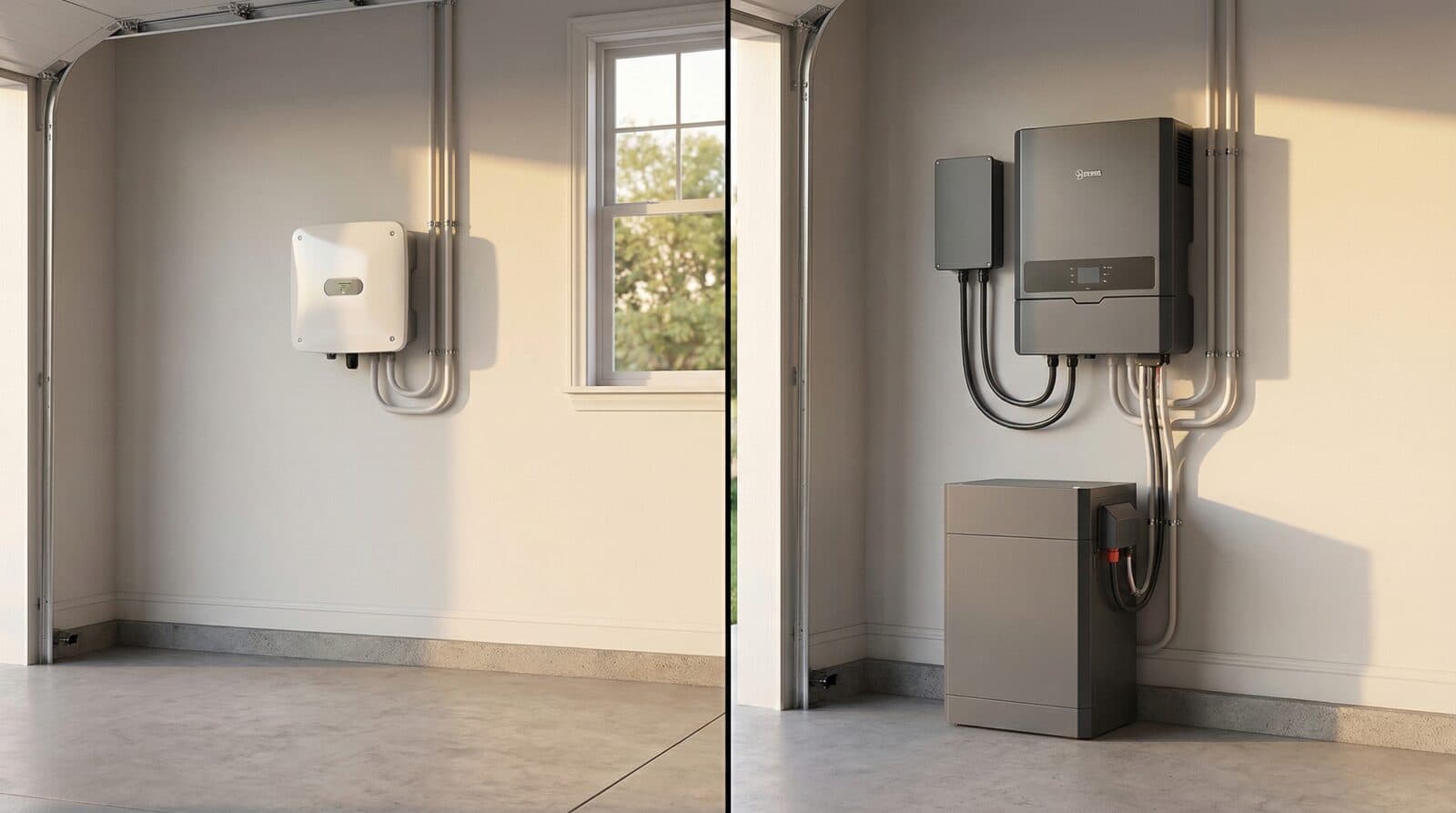
On-grid, hybrid, and off-grid: three solar inverter types
Every solar installation needs an inverter — the device that converts DC electricity from your panels into AC electricity your home can use. But not all inverters are created equal. There are three fundamentally different types, and choosing the wrong one is one of the most expensive mistakes you can make in solar. Each type is designed for a different relationship between your solar panels, the electricity grid, and battery storage.
All three types share the same core function: DC-to-AC conversion. They all connect to solar panels, they all produce AC power, and they all have MPPT trackers that optimize panel output. The differences lie in what else they can do — whether they support batteries, whether they can export power to the grid, and whether they need the grid (or a battery) to operate at all. Understanding these differences before you buy saves you from costly replacements later.
The most important question
On-grid (grid-tied) inverters
An on-grid inverter is the simplest type. It converts solar DC power to AC and feeds it directly into your home and the grid. When your panels produce more than your home uses, the excess goes to the grid (and you may receive credit or payment, depending on local net metering rules). When your panels produce less than you need — at night or on cloudy days — you draw from the grid as usual.
On-grid inverters have no battery connection and no backup capability. They are designed to synchronize perfectly with the grid's voltage and frequency. This synchronization requirement means they must shut down when the grid fails — a safety feature called anti-islanding protection. Without it, your inverter could feed electricity into power lines that utility workers assume are dead, creating a lethal hazard.
Hybrid solar inverters (on-grid + battery backup)
A hybrid inverter does everything an on-grid inverter does, plus it charges and discharges batteries. It contains a built-in battery charger, a transfer switch for backup power, and logic that manages energy flow between panels, batteries, grid, and home loads. When the grid fails, a hybrid inverter disconnects from the grid and continues powering your home from solar and batteries — automatically, typically within 10–20 milliseconds on a dedicated backup (EPS) output, fast enough that routers and computers keep running.
The word "hybrid" refers to the combination of grid-tied and off-grid capabilities in one device. During normal operation, a hybrid inverter works exactly like an on-grid unit: panels power the home, excess is exported to the grid. At the same time it manages battery charging — storing energy for evening use, peak shaving, or backup. When the grid drops, it switches to backup mode and powers essential loads from batteries and solar.
Hybrid inverters come in two battery voltage classes. Low-voltage (LV) models use 40–60 V battery banks — the classic 48 V format, flexible and easy to expand. High-voltage (HV) models use battery stacks from roughly 80 to 800 V — slightly more efficient, but usually locked to specific battery models from a compatibility list. Check which class your inverter belongs to before buying batteries: an LV inverter cannot use an HV battery, and vice versa.
Adding a battery to an existing solar system?
Our guide compares AC and DC coupling — the two ways to retrofit storage without replacing everything.
Off-grid inverters
A classic off-grid inverter creates its own independent electrical system from solar and batteries. It is used where grid connection is unavailable or prohibitively expensive: remote cabins, farms, boats, RVs, and telecom towers. The system must be sized to cover all your energy needs, including several days of autonomy without sunshine, and the inverter must handle your peak load — there is no grid to help during demand spikes.
The mass-market reality is broader than the textbook definition. Most off-grid inverters sold today are inverter-chargers with an AC input: you can connect the grid or a generator to that input, and the unit will charge batteries from it and pass power through to your loads (bypass mode). What they never do is export power back to the grid — they do not synchronize with it and have no anti-islanding certification. Popular examples in our database include Growatt SPF, Must, EASUN, PowMr, Anern, and MPP Solar models. These units are often 2–3 times cheaper than genuine hybrid inverters of the same power.
Two practical constraints follow from this design. First, most off-grid inverters require a battery to start and operate — the battery is the heart of the system, not an option. Second, when grid power is present, your loads run through the inverter's transfer switch, and switching between grid and battery takes 10–20 milliseconds or longer depending on the model — most home electronics ride through it, but it is slower than the seamless transfer of a good hybrid.
"Pseudo-hybrids": how to tell a real hybrid from an off-grid unit
Marketplaces and sellers routinely list off-grid inverter-chargers as "hybrid inverters" — after all, they accept both solar and grid power, which sounds hybrid. This mislabeling is the single most common source of confusion we see. The price difference is large, and so is the functional difference: a real hybrid can export solar power to the grid and earn feed-in credit; a pseudo-hybrid cannot. Four datasheet checks reveal what you are actually buying:
- Look for a grid-tie (feed-in) operation table
A real hybrid datasheet specifies grid export parameters: nominal output current to grid, power factor (usually >0.99), and THD limits. An off-grid manual lists only an AC input for charging and bypass — no export figures anywhere.
- Check for anti-islanding and grid certificates
Real hybrids list grid codes: IEC 62116, EN 50549, VDE-AR-N 4105, G98/G99, CEI 0-21. No grid certificates means the unit cannot legally connect for export — it is off-grid class regardless of what the listing title says.
- "Max. solar charge current" instead of PV input current
Off-grid platforms specify a battery-side charging current — 60–120 A at 24/48 V. Real hybrids specify PV input current per MPPT tracker, typically 13–27 A. If the headline current looks huge, it is a battery spec, not a PV spec.
- Maximum PV voltage tells the class
Budget off-grid units accept 145–500 V from panels (one or two short strings). Genuine hybrids accept 500–1,100 V. A "hybrid" with a 450 V PV limit and a 60–115 V MPPT window is a Voltronic-class off-grid unit.
Verify the type in our database
On-grid vs hybrid vs off-grid: side-by-side comparison
This table summarizes the key differences between the three inverter types across nine features. Use it as a quick reference when evaluating your options.
| Feature | On-Grid | Hybrid | Off-Grid |
|---|---|---|---|
| Battery support | No | Yes (optional) | Yes (required) |
| Backup during outage | No — shuts down | Yes — automatic, 10–20 ms | Yes — via transfer switch |
| Exports power to grid | Yes | Yes | No — never |
| Works without grid | No | Yes (with battery) | Yes — designed for it |
| Works without battery | Yes | Yes (grid-tied mode) | Usually no |
| Typical max PV voltage | 600–1,100 V | 500–1,100 V | 145–500 V |
| Relative cost | Lowest (baseline) | +30–60% vs on-grid | Unit often cheapest, but battery is mandatory |
| Peak efficiency | 97–98.5% | 95–97.5% | 93–96% |
| Installation complexity | Simple | Moderate (battery wiring) | Complex (full system design) |
Decision guide: 5 steps to choose your inverter
Answer these five questions in order. Each answer narrows your choice until only one inverter type remains.
- Step 1: Is grid power available at your location?
If no — you need an off-grid inverter with a battery bank. There is no alternative. If yes — continue to step 2.
- Step 2: Do you need backup power during outages?
If outages are frequent or extended, you have two paths: a hybrid inverter (seamless backup plus grid export) or an off-grid inverter-charger with the grid on its AC input (cheaper, but no export and slower switching). If your grid is stable and outages are rare and brief, an on-grid inverter may be sufficient. Continue to step 3.
- Step 3: Do you want batteries now or later?
If you want batteries now: choose a hybrid inverter and size the battery bank for your backup needs. If you want batteries later (1–3 years): choose a hybrid inverter now and add batteries when ready — it works as grid-tied in the meantime. If you never want batteries: an on-grid inverter gives you the best value.
- Step 4: What is your budget?
On-grid is the cheapest full-system option if you just want to reduce electricity bills. Hybrid without batteries is a moderate step up for future flexibility. Hybrid with batteries adds significant cost but provides seamless energy independence. An off-grid inverter-charger plus a small battery is often the cheapest backup solution of all — if you can live without grid export.
- Step 5: What is your system size?
For small systems (3–5 kW), the price difference between on-grid and hybrid is relatively small — going hybrid may be worthwhile even if you are unsure about batteries. For larger systems (10–30 kW), the hybrid premium is more significant, so make sure you have a clear reason for the extra cost. Commercial systems often mix inverter types: hybrid for critical loads, on-grid for the rest.
The simplest rule
Popular inverter brands by category
Our equipment database currently holds over 1,200 verified inverters: roughly 530 hybrid models from more than 30 brands, about 360 on-grid string models, and about 270 off-grid inverter-chargers from 11 brands. Every record is checked against the manufacturer datasheet, including the actual type classification.
In the hybrid category, Deye has the largest lineup, followed by Luxpower, Growatt, Sigenergy, Solis, and Fronius GEN24. The on-grid segment is led by Fronius, Huawei, SMA, SolarEdge, and GoodWe. Off-grid is dominated by Voltronic-platform brands: Must, PowMr, Growatt SPF, Anern, EASUN, Anenji, and MPP Solar. Victron Energy spans both hybrid and off-grid with a modular system approach. Each brand has distinct strengths — compare real specs in our database before deciding.
Check real specs before buying
Browse inverters by type
Use our matcher tool to filter inverters by type, brand, and specifications — and find compatible panels for each one.
String sizing still applies — especially to off-grid inverters
Whichever type you choose, the DC side follows the same physics: panel voltage rises in cold weather, and the string's open-circuit voltage must never exceed the inverter's maximum PV voltage. This check matters most for off-grid units, because their PV voltage limits are far lower — often 450 or 500 V, sometimes as low as 145 V — so the safe panel count is reached much sooner than DIY builders expect.
Cold-weather open-circuit voltage
Voc_cold = Voc_STC × (1 + (TC_Voc / 100) × (T_min − 25))Worked example: a typical 430 W panel has Voc = 39.1 V and a temperature coefficient of −0.25 %/°C. On paper, 11 panels fit a 450 V off-grid inverter: 11 × 39.1 = 430.1 V. Now check the coldest morning your site can see, −10 °C:
Voc_cold = 39.1 × (1 + (−0.25/100) × (−10 − 25)) = 42.52 V → 11 × 42.52 = 467.7 V > 450 V ✗Eleven panels exceed the limit by 18 V and can permanently damage the MPPT stage — cold-morning overvoltage is one of the most common ways budget off-grid inverters die. The safe maximum is 10 panels: 10 × 42.52 = 425.2 V. Note the margin is only about 25 V, which is why our calculator also checks the string against the top of the MPPT operating window, not just the absolute limit.
Array-to-inverter power ratio also differs by type. Our calculator warns above 1.5× oversizing for on-grid string inverters, but allows up to 2.0× for hybrid and off-grid units — excess DC power charges the battery instead of being clipped, so a larger array is normal and often sensible.
The 145 V trap
Check your string in 30 seconds
Pick your panel and inverter in our calculator — it verifies cold-weather voltage, MPPT range, current, and power ratio automatically.
5 common mistakes when choosing an inverter type
- Buying a hybrid inverter without ever adding batteries
If you buy a hybrid inverter "just in case" but never actually install batteries, you paid a 30–60% premium for nothing. A hybrid inverter without batteries offers no backup power — it behaves identically to an on-grid inverter. Be honest about your plans: if batteries are not in your 3-year roadmap, save the money and go on-grid.
- Oversizing the inverter for backup instead of sizing the battery
Backup duration depends on battery capacity, not inverter power. A 10 kW hybrid inverter with a 5 kWh battery provides only 30 minutes of backup at full load — the same as a 5 kW hybrid with the same battery. If long backup is your priority, invest in a larger battery bank, not a larger inverter.
- Ignoring grid code requirements
Different countries and utilities have different rules about which inverter types are allowed, what certifications are required, and whether you can export power to the grid. Some utilities prohibit hybrid inverters entirely, others require specific grid codes (VDE-AR-N 4105, G99, EN 50549). Check your local regulations before purchasing — an incompatible inverter cannot be legally connected.
- Buying a marketplace "hybrid" that is actually off-grid
The most expensive version of the pseudo-hybrid trap: you plan to export solar power and earn feed-in credit, but the bargain "hybrid" you bought has no grid-export capability at all. Before paying, run the four datasheet checks from this article — feed-in table, grid certificates, PV input current, and maximum PV voltage. If any of them fails, you are looking at an off-grid inverter-charger.
- Not checking single-phase vs three-phase compatibility
A three-phase hybrid inverter cannot properly back up a single-phase home, and a single-phase inverter cannot be connected to a three-phase grid in some jurisdictions. This is a fundamental compatibility issue that must be verified before purchase. Check both your home's electrical supply type and the inverter's phase configuration.
Frequently asked questions
Can I add batteries to an on-grid inverter later?
Not directly. On-grid inverters have no battery management circuitry, so you cannot simply plug in a battery. The practical retrofit path is AC-coupling: a separate battery inverter works alongside your existing on-grid unit. It works well but adds cost and complexity compared to having a hybrid inverter from the start — see our battery retrofit guide for the full comparison. If batteries are in your future plans, buy a hybrid inverter now.
Is a hybrid inverter less efficient than an on-grid inverter?
Slightly. Hybrid inverters typically achieve 95–97.5% peak efficiency, compared to 97–98.5% for the best on-grid inverters. The 1–2% difference comes from the additional battery management electronics that are always present in the circuit, even when batteries are not connected. Over a year, this means roughly 1–2% less energy production — a small trade-off for the flexibility batteries provide.
Do I need a hybrid inverter if I have stable grid power?
Not necessarily. If your grid is genuinely stable (fewer than 2–3 outages per year, each under an hour), an on-grid inverter is the most cost-effective choice. However, consider future plans: will electricity prices make self-consumption valuable? Might battery costs drop enough to make storage worthwhile? If the answer to either is yes, a hybrid inverter today avoids replacing the entire inverter later.
Can a hybrid inverter work without batteries?
Yes. Most hybrid inverters operate perfectly as grid-tied inverters without batteries connected. Solar power flows directly to your home and excess is exported to the grid, exactly like an on-grid inverter. You lose the backup function (no batteries means no stored energy during outages), but all other functions work normally. This makes hybrid a safe "future-proof" choice.
What is the real difference between hybrid and off-grid inverters?
Grid export. A hybrid inverter synchronizes with the grid, exports surplus solar power, and carries grid certificates (EN 50549, VDE-AR-N 4105, G99). An off-grid inverter never exports — its AC input only charges batteries and feeds bypass. Off-grid units also accept much lower PV voltage (145–500 V vs 500–1,100 V) and usually require a battery to operate. If a listing says "hybrid" but the datasheet fails these checks, it is an off-grid unit.
Can I use a three-phase hybrid inverter with a single-phase home?
No. A three-phase inverter distributes power across three phases. In a single-phase home, two of those three phases have no load, creating a severe imbalance that can damage the inverter and violate grid codes. Always match the inverter's phase configuration to your home's electrical supply. If you have single-phase power, buy a single-phase inverter.
How long will batteries last during a blackout?
It depends on your battery capacity and the load you are running. A simple formula: backup hours = battery capacity (Wh) ÷ load (W). For example, a 10 kWh battery powering a 2 kW load (fridge, lights, router, phone charging) lasts about 5 hours. With solar panels generating during the day, a hybrid system can extend backup significantly — potentially indefinitely if daily solar production exceeds daily consumption.
Can I start with on-grid and switch to hybrid later?
You would need to replace the inverter entirely. On-grid and hybrid are fundamentally different hardware — there is no upgrade path from one to the other. The only way to add battery capability to an existing on-grid system is AC-coupling with a separate battery inverter, which is less efficient and more complex than a single hybrid unit. If there is any chance you will want batteries, start with a hybrid inverter.
Can an off-grid inverter export power to the grid?
No. Off-grid inverters do not synchronize with grid frequency and have no anti-islanding protection, so they physically cannot and legally must not feed power into the grid. Their AC input is one-directional: it charges batteries and passes grid power through to your loads. If you want feed-in credit or net metering, you need a certified hybrid or on-grid inverter.
Can I use an off-grid inverter if I have grid power?
Yes — this is a popular budget backup setup. The grid connects to the inverter's AC input, your critical loads connect to its output, and a battery sits in between. When the grid is up, it powers the loads and keeps the battery charged; when it fails, the inverter switches to battery within tens of milliseconds. You get no solar export and no feed-in credit, but the hardware costs a fraction of a hybrid system — just make sure the unit and battery are sized for your peak load.


Discussion
Sign in to join the discussion
We require a quick sign-in to keep this thread free of spam.
No comments yet. Be the first to share your experience.