LiFePO4 Cell Terminals: Types, Torque, Internal Resistance
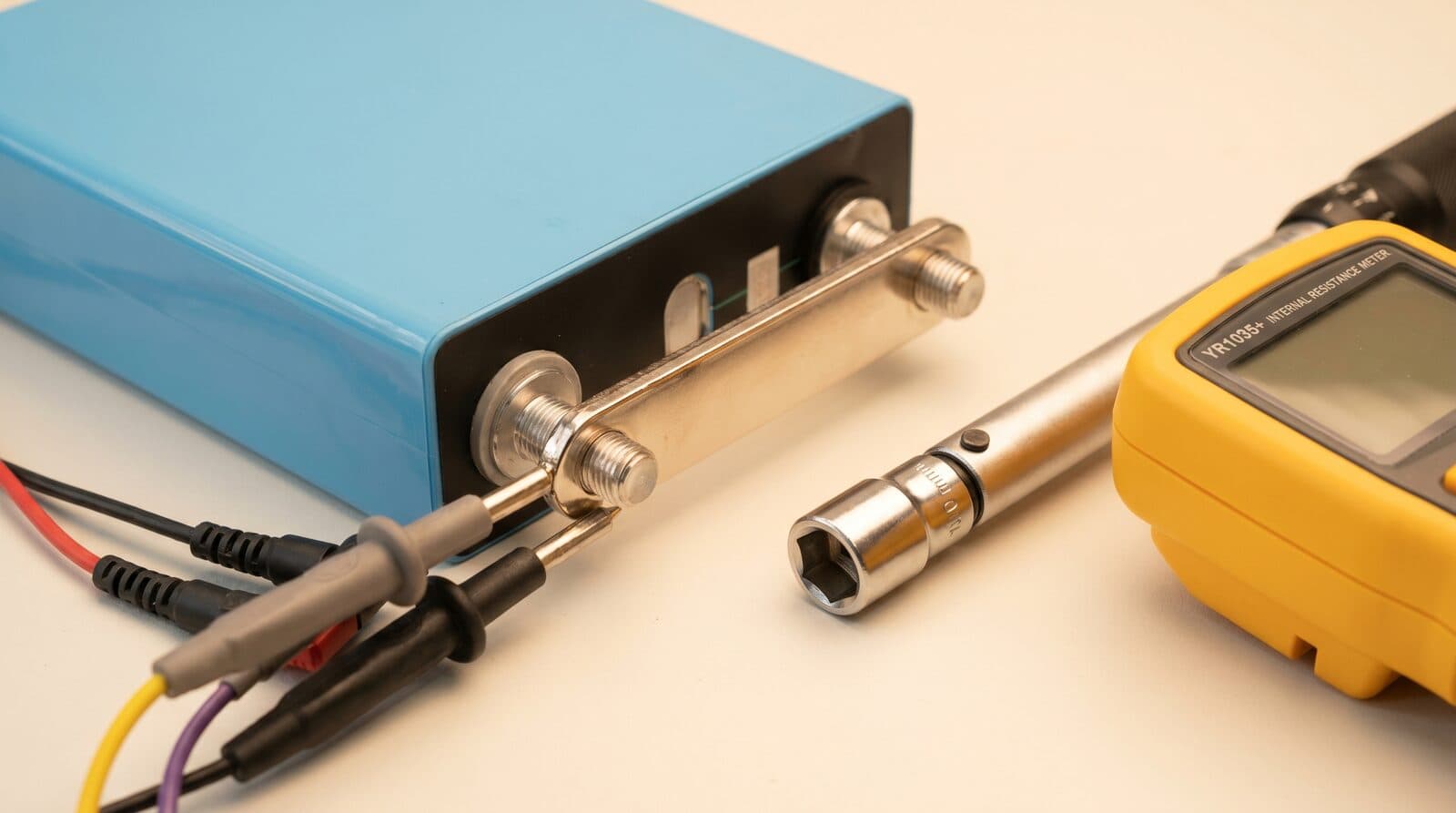
A LiFePO4 cell terminal is more than a threaded post — it is the zone that decides whether your 16S pack runs for ten years or burns down in its third. A loose contact raises the transition resistance, the resistance heats the aluminium terminal, the hot terminal melts the busbar insulation, and the chain ends in an arc and a fire. For a 48 V pack you intend to ride out a grid outage on, that chain should start at the right terminal type and the right torque, not at the smoke detector on the wall.
This guide covers the four terminal types found on prismatic LiFePO4 cells from 100–320 Ah, a torque table from M4 to M8, how to measure cell internal resistance with the YR1035+ meter or the dV/dI method, a tier comparison of manufacturers (EVE, CATL, CALB, Lishen, REPT), and an assembly checklist. The numbers come from manufacturer datasheets, diysolarforum.com community consensus, and our own practice building a 2×16S1P bank on EVE LF105 cells.
Terminal Types on Prismatic LiFePO4 Cells
Prismatic LiFePO4 cells ship with four industrial terminal types: welded stud (type A), threaded insert in an aluminium block (type B), punched hole threaded directly in the pole (type D), and flat tab for laser welding. The first three are what the DIY builder works with — flat tabs need a welder and effectively never appear in 280–320 Ah retail orders.
The terminal type decides three things at once: how much torque you can apply without stripping the thread, how much current the contact face can carry without heating, and whether you can dismantle the busbar later for maintenance. Roughly 99 % of a DIY build's risk sits in those three numbers.
Welded stud (type A)
A zinc-plated steel stud ultrasonically welded to an aluminium pole base. Most common size: M6 × 10 mm. The contact face is small (stud + washer + busbar), so type A handles moderate continuous current (up to ~150 A) and survives repeated disassembly well. Torque: 6–9 Nm, typical 7 Nm. Found on 50–150 Ah cells, including the EVE LF105 and Great Power 100 Ah cells we work with.
Threaded insert (type B)
The pole carries a welded-on solid aluminium block with an M6 thread roughly 11 mm deep. The contact face is large (the whole top of the block), so this terminal carries 300–500 A continuous, resists vibration, and takes up to 10 Nm (typical 8 Nm). This is the current standard on 280/304/314/320 Ah cells — EVE LF280K, MB31, CATL 280/314, REPT 280/314/320, CALB 280. If you are building a 16S pack at 280 Ah or above in 2025–2026, you almost certainly receive this type.
Punched hole (type D)
An M6 thread cut straight into the aluminium pole body, depth ≤5 mm. Cheap, easy to machine — but the thread is weak, and you can strip it at 5 Nm if the bolt bottoms out. Found on budget 100–200 Ah cells and on older EVE and CALB generations. Never exceed 3–4 Nm on this type, and pick a bolt length that only engages 3–4 mm of thread with headroom to the bottom.
Flat tab
An aluminium or nickel tab with no thread, intended for laser or spot welding to the busbar. Used in factory modules (Pylontech, EG4), irrelevant for DIY — you would need a welder and cannot easily dismantle the joint. If you received cells like these, you probably bought a finished module, not raw cells.
| Terminal Type | Thread | Material | Torque, Nm | Continuous current | DIY fit | Cost |
|---|---|---|---|---|---|---|
| Welded stud (A) | M6 × 10 mm | Zn-plated steel, Al base | 6–9 | up to 150 A | High | Medium |
| Threaded insert (B) | M6 × 11 mm (in block) | Solid aluminium | up to 10 | 300–500 A | High (current standard) | Higher |
| Punched hole (D) | M6, depth ≤5 mm | Pole aluminium | 3–4 max | up to 100 A | Low (strips easily) | Low |
| Flat tab | — | Al / Ni | — | per module design | Not suitable | — |
Loose contacts cause most DIY pack fires
Choosing Terminals for Your DIY Build
The cell manufacturer chooses the terminal type, not you. Your job is matching bolts, washers, and torque to what arrived in the box. A miss here costs you either a stripped thread (then Helicoil or a replacement cell) or an under-torqued contact (then heating after six months of service).
Below are two typical scenarios: small 16S packs at 100 Ah and the 2025–2026 standard at 280–314 Ah. If your build sits somewhere between, trust the datasheet of your specific batch over generic internet tables.
Small 2×16S1P pack at 100–105 Ah
EVE LF105, Great Power 100 Ah, CATL 100 — all ship with welded stud M6 × 10 mm, more rarely with punched hole. Torque: 6–8 Nm for welded stud, and no more than 4 Nm for punched hole. Pick M6 cable lugs with 6.4 mm inner diameter (not 7), so the washer rests on the contact face instead of sinking through. A 2×16S1P build needs 32 M6 bolts, 64 washers (flat + Nord-Lock per contact), and 16 busbars — either 3×20 mm copper laminate or flexible 50 mm² copper braid in PVC sleeving.
Large 16S pack at 280–314 Ah
EVE LF280K / LF304 / MB31, CATL 280 / 314, REPT 280 / 314 / 320, CALB 280 — almost always threaded insert M6 in a solid aluminium block. Torque: 8–10 Nm (8 is safe, 10 is the upper limit in the EVE datasheet). Busbars come in the box (typically nickel-plated copper 20×3 mm), or you fabricate your own from 25×3 mm copper. M6 bolts 12–14 mm long are the most common choice; 16 mm and above risk bottoming out in the thread.
Bolt length and Helicoil
The rule is simple: the bolt must engage the full thread but never bottom out. If it bottoms, you will think you are torquing the contact while you are actually stripping the thread on the next turn. For threaded insert 11 mm deep, 10 mm bolt engagement under the washer is optimal; for welded stud 10 mm, the same length or 1–2 mm shorter. If you did strip the thread, an M6 Helicoil (coiled steel insert) saves the cell in 90 % of cases. For welded stud, replacing the stud is workshop work, not a kitchen-table fix.
Colour-mark bolt lengths before assembly
Size your battery bank
Before you buy cells, check the capacity matches your daily load. Full calculation with formula, DoD, round-trip efficiency, and worked examples.
LiFePO4 Cell Manufacturer Tiers
The 2025–2026 prismatic LiFePO4 market splits into two tiers. Tier 1 — CATL and BYD — serves automotive OEMs and rarely appears in retail; when it does, it is surplus or counterfeit. Tier 2 — EVE, CALB, Lishen, REPT — delivers stable quality, documented cycle life, and realistic Grade A availability through retail channels.
For a solar DIY battery, Tier 2 is the sensible choice. Tier 1 costs more in this segment without giving you cycle life you can actually use in a home pack that sees 200–300 cycles per year — your cells will hit calendar aging limits before they hit cycle limits.
Tier 1 — CATL, BYD
CATL is formally present in the market with 280 and 314 Ah cells, but Grade A only reaches you through a vetted broker with serial QR codes and a per-batch test report. Counterfeits are common enough that buying unverified 'CATL Grade A' is not prudent. BYD rarely shows up in retail — their cells go into BYD's own products (Blade Battery) and large OEM contracts.
Tier 2 — EVE, CALB, Lishen, REPT
EVE LF280K and MB31 (314 Ah) are the most common DIY choice in 2025–2026 — price/quality/availability balance is hard to beat. CALB 280 advertises 9000 cycles at 70 % DoD; in our tests no meaningful difference from EVE, but the EU price is typically 10–15 % higher. Lishen and REPT are younger players; REPT with Wending-rolling technology packs 320 Ah into a 280 Ah footprint (+15 % energy density), which makes them interesting for compact packs. Cycle and stability data 2022–2024 is solid, but the brand history is shorter than EVE — factor that in if planning for 10 years.
Grade A vs Grade B — how to tell
Grade A has a QR code on the case, a per-batch test report from the manufacturer (SOH, capacity, internal resistance, date of manufacture), and at most 3–6 months of calendar age by the time you receive it. Grade B is line reject (usually for capacity, IR, or cosmetic defects); you can still build with it, but service life is visibly shorter and pack drift is higher. The top counterfeit markers: no QR, serial-number/batch mismatch, date of manufacture older than a year. If the seller dodges the test report, it is Grade B or something unknown.
| Tier | Manufacturer | Models | Energy density | Retail availability | Counterfeit risk |
|---|---|---|---|---|---|
| 1 | CATL | 280, 314 Ah | Standard | Limited | High |
| 2 | EVE Energy | LF105, LF280K, LF304, MB31 (314) | Standard / high (MB31) | Good | Low |
| 2 | CALB | L135N58A, L148N58A, 280 Ah | Standard | Medium | Low |
| 2 | Lishen | 272, 280, 310 Ah | Standard | Medium | Medium |
| 2 | REPT | 220, 280, 314, 320 (Wending) Ah | +15 % (Wending) | Good | Low |
Proper Terminal Torque
Torquing is the dullest and most safety-critical step of the build. An under-torqued contact adds a few tenths of a milliohm to the transition resistance; at 100 A that is dozens of watts dissipated with nowhere to go. Our YR1035+ readings on live packs show that moving from 4 Nm to 8 Nm on an EVE LF280K terminal drops contact resistance from about 0.3 mΩ to about 0.05 mΩ. Five out of six terminal failures we have seen in friends' builds began with a bolt that was not fully torqued.
Below are the torque table, a five-step HowTo procedure, and separate notes on tooling, washer stacks, surface prep, and re-torque schedule. Treat these as defaults — always verify against the datasheet of your specific cell batch, because manufacturer numbers shift between revisions.
| Size / Type | Terminal type | Torque, Nm |
|---|---|---|
| M4 | Any | 2–3 |
| M5 | Any | 4–5 |
| M6 stud (A) | Welded stud | 6–9 (typ. 7) |
| M6 threaded (B) | Thread in Al block | up to 10 (typ. 8) |
| M6 punched (D) | Hole in pole | 3–4 max |
| M8 stud | Welded stud | 11–13 |
Torque wrench — not optional
Without a torque wrench, 32 bolts in a 2×16S1P pack will not reach uniform tightness — freehand 'feel' scatters ±2–3 Nm easily. We recommend a click-type wrench in the 2–25 Nm range (Wera 7400 or Proxxon MicroClick at around $60–80); beam-type is cheaper but needs constant attention to the scale, which is awkward in a cramped battery enclosure. Verify each torque twice: once at assembly, once again about 30 seconds later, to make sure the bolt did not slip past the click on the first pass.
Washer stack: Nord-Lock, Belleville, split
Ideal stack for a LiFePO4 terminal: flat washer under the bolt head, Nord-Lock pair between the flat washer and the busbar, busbar, terminal. Nord-Lock is a pair of wedge-locking washers that mechanically block reverse rotation via wedge pressure. When Nord-Lock is unavailable, a Belleville (disc-spring) washer is acceptable; an ordinary split-ring spring washer is the worst choice — it relaxes under thermal cycling and effectively stops working by year two or three.
Lightly grease Nord-Lock pairs before assembly
Surface prep: film, oxide, acetone
A new LiFePO4 cell ships with a thin protective film on the terminal — not oxide, but factory corrosion protection for transport. Remove it with Scotch-Brite or 600–800 grit abrasive in a circular motion without pressure; the goal is to lift the film, not to take microns of aluminium off. Wipe with acetone or 99 % isopropyl alcohol. Hard scratching is a mistake — microscratches seed new oxidation within weeks.
Noalox and Loctite — where they belong
Noalox (ZnO in a neutral carrier) is an anti-oxidation paste. A thin smear on the contact face between terminal and busbar is mandatory in humid or dusty rooms; in a clean, dry enclosure, good surface prep alone is enough. Never apply Noalox to the thread — it acts as a hydraulic lubricant and you will not reach correct preload. Blue Loctite 242 is fine on the thread for anti-vibration; red Loctite 271 is not — it can only be disassembled by heating to 250 °C, which damages the cell. Never apply any Loctite to the contact face.
Re-torque schedule: 1 week → 1 month → 3 months
The aluminium pole base 'settles' under the bolt during the first weeks of service — this is normal aluminium creep under sustained load. The plan: re-check torque after 1 week (touch the wrench to each bolt, bring to 8 Nm; if the bolt turns another 5–10°, that is normal), again at 1 month, again at 3 months, then annually. In our practice, 70 % of packs need one or two re-checks in the first week and stabilise after the first month.
Step-by-step torque procedure
- Clean the contact surface
Remove the protective film with Scotch-Brite or 600–800 grit abrasive in circular motions. Wipe with acetone or 99 % isopropyl. Do not scratch deeper than a few microns into the aluminium. - Apply Noalox to the contact face
Thin layer of anti-oxidation paste on the terminal top and the busbar bottom. Keep the thread dry. In clean, dry rooms Noalox is optional but not harmful. - Assemble the washer stack
Bottom-up order: terminal — busbar — Nord-Lock pair (lightly greased) — flat washer — M6 bolt, 10–14 mm long. Verify the bolt does not bottom out: hand-thread first and feel for the stop. - Torque with a calibrated wrench
Click-type wrench, 8 Nm for threaded insert M6 or 7 Nm for welded stud M6. Tighten in one smooth motion until click. Verify twice with about 30 s between — first click, pause, second click. - Re-torque at one week and one month
After 7 days, touch the wrench to each bolt and bring it to spec torque. A 5–10° additional rotation is normal aluminium creep, not a failure. Repeat at 1 month and at 3 months, then annually.
Common beginner mistakes
Four mistakes we keep seeing: (1) over-torquing a punched-hole pole and stripping the thread — usually from the 'tightened and done' habit; (2) forgetting to remove the protective film, which inflates transition resistance 10×; (3) mixing steel bolts with copper washers between cells without isolation — not a contact problem (current flows through the busbar, not the bolt), but bad for joint thermal analysis; (4) skipping the one-week re-torque and letting the bolt 'set' forever. None of these is obvious at assembly time; all of them show up 2–6 weeks later as heating.
Measuring Cell Internal Resistance
Internal resistance (IR) is the second number — after capacity — that characterises a healthy LiFePO4 cell. Distinguish two variants: AC IR (1 kHz sine-wave impedance) and DCIR (true DC resistance under load). AC IR is what the YR1035+ measures and what the datasheet quotes; DCIR is typically 20–40 % higher because it includes all electrochemical effects. Both are useful for different tasks.
Typical AC IR for a healthy EVE LF280K: 0.12–0.18 mΩ (datasheet cap ≤0.25 mΩ); spread within a batch should not exceed ±15–20 %. A cell at 0.35 mΩ is a reject candidate or at least a cell to watch carefully during top balance.
Typical AC IR values for common cells
EVE LF280K: 0.12–0.18 mΩ; EVE MB31 (314 Ah): 0.10–0.15 mΩ; EVE LF105: 0.6–0.9 mΩ (smaller cell → higher resistance); CATL 280: 0.12–0.20 mΩ; CALB 280: 0.15–0.22 mΩ; REPT 280/314: 0.13–0.20 mΩ; REPT 320 Wending: 0.11–0.17 mΩ. Great Power 100 Ah high-rate: 0.8–1.2 mΩ. A value 30 % higher than typical means you check contacts first, the cell second.
YR1035+ — the de facto DIY standard
The YR1035+ is a Chinese-made portable milliohmmeter with a true 4-wire Kelvin connection and 1 kHz AC measurement, and the de facto standard in the DIY community. Before any session, 'Hold Zero' calibration is mandatory: short the probes, press ZR, wait for '0 mΩ'. Without this step, you add parasitic lead resistance (~0.2–0.5 mΩ) to every cell reading and inflate all numbers.
Critical: the terminal surface must be bare before you measure. The factory protective film inflates IR 10–15×; we have seen '2.5 mΩ' on a fresh LF280K drop to 0.16 mΩ after a pass with Scotch-Brite. YR1035+ lead colour convention: white to white terminal, red to black (a frequent beginner mix-up — the case icons are mirrored). And: press the probes on the terminal itself, not on the busbar — the busbar's resistance is not what you want at this step.
Hold Zero before every session, not once a week
dV/dI method — real DC resistance with contacts
When you want to know total resistance in actual operation (cell + contacts + busbar + BMS shunt), use dV/dI: measure resting voltage U_rest, apply a controlled 20–50 A load (electronic load or resistor bank), measure loaded voltage U_load, divide the drop by the current. The result is the real DC resistance at that operating point.
DCIR formula (dV/dI method)
DCIR = (U_rest − U_load) / I_load

Example: U_rest = 3.305 V, U_load at 50 A = 3.278 V → DCIR = 0.027 V / 50 A = 0.54 mΩ
DCIR is usually 1.5–2.5× higher than AC IR (here 0.15 mΩ → 0.54 mΩ — plausible)
Busbar contact resistance — hunt outliers
The same YR1035+ with 4-wire Kelvin is excellent for measuring a 'bolt + washer + busbar + terminal' joint. The absolute value matters less (a few tenths of a milliohm is normal); what matters is finding outliers. If 15 joints read 0.10–0.15 mΩ and one reads 0.40 mΩ, that joint is a disassemble-and-rebuild candidate regardless of what the torque wrench said. Contact resistance is a better indicator of torque quality than torque itself.
Pack resistance and fuse selection
Total resistance of a 48 V DIY pack (cells + busbars + BMS shunt + power cables to terminals) is normally 2–5 mΩ. This matters for short-circuit current estimation (Isc ≈ U / R ≈ 51 V / 3 mΩ ≈ 17 000 A peak) and Class T fuse sizing. A fuse's AIC (Ampere Interrupting Capacity) must exceed this calculated Isc — for 48 V DIY that typically means Class T 20 000 AIC at 150–250 A continuous. Cheap ANL or MEGA fuses with AIC 6 000–10 000 A may fail to open a real fault and become the new short instead.
Assembly Checklist
Follow this order from the first cell in the door to the BMS turning on. Skipping a step costs you time at best, safety at worst.
- Receiving and visual inspection: case without dents, poles without scratches, terminals without impact marks. Verify the QR code and date of manufacture — no older than 6 months for Grade A.
- Resting voltage at receipt: all cells in a batch should sit at 3.25–3.35 V (storage voltage) with spread ≤±0.02 V. A cell below 3.10 V is potentially deep-discharged — set aside.
- AC IR of each cell with YR1035+ after Hold-Zero calibration. Record values; expected spread ±15–20 % from the median.
- Top balance: bridge all cells in parallel (35 mm² busbars), connect a bench power supply set to 3.65 V / 20–50 A, and hold until current drops to ≤0.5 A. Minimum 12–24 hours.
- Assemble into 16S configuration: terminal prep (Scotch-Brite + acetone), Noalox application, washer stack, torque to 8 Nm for threaded insert or 7 Nm for welded stud.
- Re-measure contact resistance at every joint with YR1035+ (4-wire Kelvin, probes directly on terminal and busbar). Normal 0.05–0.15 mΩ; outliers (≥0.30 mΩ) get disassembled and rebuilt.
- Install the BMS and connect balance leads. Verify B0–B16 cell order (B0 = minus of first cell, B16 = plus of sixteenth). A mistake here destroys the BMS instantly on power-up.
- After 7 days of service: re-torque every bolt. Repeat at 30 days. Repeat at 90 days. Annually thereafter.
FAQ
What torque spec for EVE LF280K?
For an M6 threaded insert on the EVE LF280K, 6–8 Nm per the EVE Energy datasheet. We use 8 Nm as the working torque — reliable contact with margin to the 10 Nm upper limit. Same for LF304 and MB31 (314 Ah). Always verify against the datasheet of your specific batch; EVE sometimes updates numbers for new revisions.
Can I use steel bolts on LiFePO4?
Yes. Stainless steel (A2-70 or A4-70) or zinc-plated steel is the standard choice. Current in a LiFePO4 joint flows through the 'busbar ↔ terminal' contact face, not through the bolt thread. The bolt only supplies the clamping force. Note: in humid environments, do not mix steel with copper washers without isolation — galvanic pairs can corrode; in a dry electrical cabinet that is not a concern.
What if I stripped the terminal thread?
For threaded insert M6 (aluminium block): install an M6 Helicoil — a coiled steel insert from a standard kit (~$30), which restores the thread to original strength. For welded stud: replace the stud, which requires cell disassembly and welding — only worth it on expensive large cells. For punched hole (shallow hole in the pole), there is often not enough depth for a Helicoil — then cell replacement is easier.
Do I need a YR1035+ for a small 16S 100 Ah build?
Useful but not mandatory. For top balance, a bench power supply and a 0.01 V-precision multimeter are enough. For verifying contact resistance at every joint, however, the YR1035+ is the best tool at its price point (~$50). Without it you rely entirely on the torque wrench — and the first heating event arrives six months later, when disassembly is hard.
REPT or EVE — which one?
EVE is proven, stable, best documented, and has enough long-term field data on diysolarforum to predict behaviour in year ten. REPT is younger but delivers +15 % energy density with Wending-rolling (320 Ah in a 280 Ah footprint) and is often 5–10 % cheaper per Ah. For a first build, we recommend EVE LF280K or MB31. For a second or third build, when you know what you are doing, REPT 320 Wending is worth trying.
How often should I re-torque?
First check at 7 days, second at 30 days, third at 90 days, annually thereafter. Aluminium creeps under sustained load during the first weeks — this is normal physics, not a defect. In our experience, 70 % of bolts rotate a further 5–10° on the first re-check — that is fine, provided you catch it in time.
Can I apply Loctite to the terminal thread?
Blue Loctite 242 (removable) — yes, a thin bead on the thread against self-loosening. Appropriate for DIY packs in vibration-prone settings (vehicles, boats). Red Loctite 271 — no, you cannot disassemble without heating to 250 °C, which damages the cell. Critically: never apply any Loctite to the terminal-to-busbar contact face — it is an insulator and creates transition resistance and heating.
What internal resistance is healthy?
For LF280K: 0.12–0.18 mΩ AC IR; EVE datasheet caps at 0.25 mΩ. For MB31 (314 Ah): 0.10–0.15 mΩ. For 100 Ah cells (EVE LF105, Great Power): 0.6–0.9 mΩ (smaller cell — higher resistance, normal). DCIR runs 1.5–2.5× AC IR. Values more than 30 % above typical are a cue to check contact quality before blaming the cell.
Check string compatibility with your inverter
Once your battery is done, the next step is matching solar panels and a hybrid inverter. Solar Stack's calculator verifies six string safety checks in seconds.


Discussion
Sign in to join the discussion
We require a quick sign-in to keep this thread free of spam.
No comments yet. Be the first to share your experience.