Solar Battery Sizing Guide for Hybrid & Off-Grid (2026)
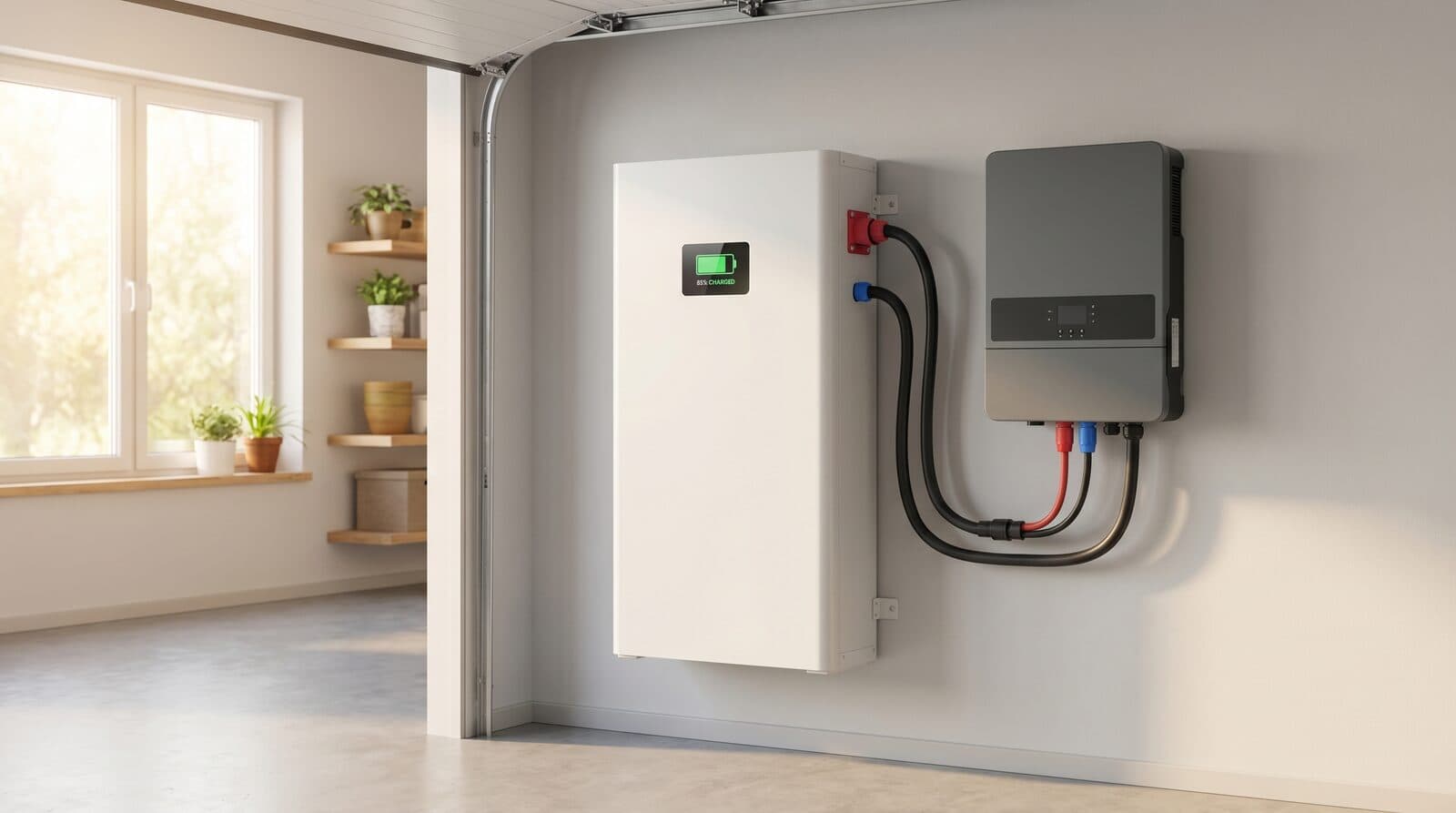
Why battery sizing makes or breaks your solar system
An undersized battery bank dies in two years instead of ten. An oversized bank wastes thousands of dollars on storage you never use. Both mistakes are expensive, and both come from skipping the math at the start. Battery sizing is the single most consequential decision in any hybrid or off-grid solar build, because the battery is usually the most expensive component, the shortest-lived, and the hardest to retrofit later.
The good news: sizing a battery correctly is one formula and three honest numbers. You need your daily energy use in kWh, the days of autonomy you want, and the depth of discharge your chemistry allows. This guide walks through each input, gives you the formula, and shows a worked example with real LiFePO4 batteries from Pylontech, EG4, and Huawei. By the end you will know exactly how many kWh of storage to buy.
Most DIY battery banks fail from sizing errors, not bad cells
Step 1: measure your daily energy demand in kWh
Battery sizing starts from one number: how much energy do you actually use per day, in kilowatt-hours? There are three ways to find it. Easiest is your utility bill — divide your monthly kWh by 30 for an average daily figure. More accurate is a kill-a-watt meter or smart-plug log over a typical week. Most accurate is a load list: write down every device, its wattage, and the hours per day it runs. Sum the products and divide by 1000.
Daily energy from a load list
Daily_kWh = Σ (Power_W × Hours_per_day) / 1000

Example: fridge 150W × 24h = 3600 Wh; LED lights 60W × 5h = 300 Wh; laptop 65W × 8h = 520 Wh; pump 800W × 1h = 800 Wh
Total = 5220 Wh = 5.2 kWh/day
Now decide what fraction of that load the battery actually needs to cover. A hybrid system that stays grid-connected only needs to back up critical loads during outages — typically 20-40% of total daily use, since fridges and lights matter but air conditioning usually does not. A true off-grid system needs to cover 100% of your consumption, plus a margin for cloudy days. This single decision changes your battery cost by 3-5×.
The core sizing formula: turning kWh into battery capacity
Once you know your daily energy demand, the sizing formula has two divisors that protect your battery from early failure: depth of discharge (DoD) and round-trip efficiency. DoD is the percentage of rated capacity you can use before damaging the cells. Efficiency is the energy you get back out compared to the energy you put in — the rest is lost as heat in the BMS, inverter, and cell internal resistance.
Battery capacity formula
Battery_kWh = (Daily_kWh × Days_Autonomy) / (DoD × Round_Trip_Efficiency)

DoD: LiFePO4 = 0.90, AGM lead-acid = 0.50, gel = 0.65
Round-trip efficiency: LiFePO4 = 0.92, AGM = 0.80, flooded = 0.75
Notice how chemistry choice cascades through the formula. LiFePO4 lets you discharge 90% of capacity at 92% efficiency, so the divisor is 0.83. Lead-acid AGM only allows 50% DoD at 80% efficiency, giving a divisor of 0.40 — meaning you need over 2× more nameplate capacity to deliver the same usable energy. That cost difference often makes lithium cheaper per usable kWh despite a higher sticker price.
Worked example: 10 kWh/day, 2 days autonomy, LiFePO4
Days of autonomy: how much backup do you actually need?
Days of autonomy is the number of days your battery can run your loads with zero solar input. It is the single biggest cost driver in off-grid systems and the single most over-engineered number in DIY builds. Hybrid systems usually need 0.5-1 day — just enough to cover a single overnight outage or a cloudy afternoon — because the grid is your real backup. Going beyond 1 day on a hybrid is wasted money in 95% of locations.
Off-grid systems are different. The standard recommendation is 2-3 days for sites with daily sun and a backup generator, 3-5 days for cloudy climates without a generator, and 5+ days only for remote installations where a generator visit is impractical. The cost penalty is steep: doubling autonomy doubles battery cost but only adds maybe 10% real-world value, because most weather gaps are short.
Generators are cheaper than extra battery days
Battery chemistries compared: LiFePO4 vs lead-acid vs NMC
Three battery chemistries dominate residential solar in 2026: LiFePO4 (lithium iron phosphate), lead-acid (AGM, gel, or flooded), and NMC (lithium nickel manganese cobalt). The right choice depends on cycle life, usable capacity, cost over the system lifetime, and your operating temperature range. The table below shows the practical differences that matter for sizing.
| Chemistry | Cycle life | Usable DoD | Cost/kWh (2026) | Operating temp | Lifespan |
|---|---|---|---|---|---|
| LiFePO4 | 6,000–8,000 | 80–100% | $200–350 | −20 to +55°C | 10–15 yr |
| AGM lead-acid | 800–1,200 | 50% | $100–150 | 0 to +50°C | 3–5 yr |
| NMC lithium | 3,000–4,000 | 70–80% | $150–250 | −10 to +45°C | 8–10 yr |
LiFePO4 wins on every metric except sticker price, and even that gap closed dramatically in 2025-2026 — wholesale LiFePO4 cell prices fell roughly 20% year-over-year. On a cost-per-cycled-kWh basis, LiFePO4 runs $0.016-0.025 versus $0.04-0.06 for lead-acid. Unless you have a strict $1,500 budget and only need short-term storage, LiFePO4 is the right choice for any new build in 2026.
System voltage and C-rate: pick the right battery shape
Battery banks come in standard nominal voltages — 12V, 24V, and 48V. The right choice depends on system size. For small builds under 1.5 kW continuous (RVs, cabins, boats), 12V is fine. From 1.5-3 kW, you can use 24V but most installers skip directly to 48V. For any system above 3 kW, 48V is the professional standard — it cuts cable cost, reduces resistive losses, and is what every serious hybrid inverter uses. The formula below converts your kWh target into amp-hours at your chosen voltage.
Battery bank Ah from kWh and voltage
Required_Ah = (Battery_kWh × 1000) / System_Voltage

Example: 10 kWh at 51.2V = 195 Ah
Same 10 kWh at 12V = 833 Ah (massive copper, 5× cable cost)
C-rate is the second voltage-related parameter that catches DIY installers off guard. C-rate is the discharge rate expressed as a fraction of capacity. A 100 Ah battery discharged at 100A is 1C (one-hour discharge). At 50A it's 0.5C (two hours). LiFePO4 cells handle 1C continuous comfortably. Lead-acid degrades fast above 0.2C — meaning a 100 Ah lead-acid battery can only deliver 20A continuously without losing capacity. If your inverter can pull 5 kW from a 48V bank, that's about 100A — well within LiFePO4 limits but disastrous for lead-acid.
Match your C-rate to your inverter's continuous draw
Hybrid inverter BMS compatibility: protocols and voltage windows
A hybrid inverter does not just connect to your battery — it talks to it. The Battery Management System (BMS) inside the battery reports state of charge, cell temperatures, and voltage to the inverter, and the inverter uses that data to adjust charging current, prevent over-discharge, and protect against thermal runaway. The two communication protocols you'll encounter are RS485 (older, simpler, shorter cable runs) and CAN (newer, more reliable, longer runs, better noise immunity). Almost every modern hybrid inverter supports both, but each one has a closed list of approved batteries — the inverter firmware contains protocol mappings only for batteries on that list.
The voltage window is equally important. A 48V nominal LiFePO4 bank actually operates between roughly 44V (empty) and 58V (full). Your inverter must accept that entire range. Most quality hybrid inverters list 40-60V as their battery input range, but cheap or older units may have narrower windows that cut off your battery's usable capacity. Always cross-reference: pick a battery from your inverter's approved list and verify the voltage window matches. Mainstream pairings that work in 2026 include Deye + Pylontech US3000C, Growatt + EG4 LL-S, Sungrow + BYD HVM, and Huawei SUN2000 + LUNA2000.
Browse hybrid inverters with battery support
Filter our equipment database for inverters with hasBatteryPort=true to see real models, voltage windows, and approved battery lists.
5 common battery sizing mistakes
- Treating LiFePO4 and lead-acid the same
The single most expensive sizing mistake. Lead-acid only delivers 50% of nameplate capacity per cycle without damage, while LiFePO4 delivers 80-100%. If you size a lead-acid bank using LiFePO4 math, you get half the autonomy you planned and the bank dies in 2 years from chronic over-discharge. Always plug the right DoD and efficiency for your chosen chemistry into the formula — never copy a sizing answer from a lithium guide into a lead-acid build.
- Ignoring cold-temperature derating
At 0°C, AGM lead-acid loses roughly 50% of usable capacity. LiFePO4 only loses 10-15%. If you live in a climate with sub-zero winters and your battery sits in an unheated garage or shed, you must apply a temperature derating factor of 1.2-1.4× to your sized capacity. A 10 kWh winter requirement becomes 14 kWh nameplate with lead-acid in cold conditions. LiFePO4 cells also refuse to charge below 0°C without internal heaters, so look for self-heating models if your enclosure freezes.
- Using a lead-acid charger profile on LiFePO4
Lead-acid chargers use a multi-stage profile (bulk, absorb, float, equalize) with voltage targets that are too high for LiFePO4 cells. Connecting LiFePO4 to a lead-acid-only charger overcharges the cells, accelerates degradation, and in worst cases triggers BMS shutdown that bricks the battery. Every modern hybrid inverter has a LiFePO4 charging profile built in — verify it is selected in the firmware menu before connecting your battery. If you're upgrading from lead-acid to LiFePO4, also check your solar charge controller supports lithium profiles.
- Undersizing the inverter for surge loads
Battery capacity tells you how much energy you can store. Inverter wattage tells you how much power you can pull at once. These are independent. A 10 kWh battery pack with a 3 kW inverter cannot start a 5 kW air conditioner even though the energy is there — surge loads (motors, pumps, compressors) draw 3-5× their running wattage for the first second. Always size your inverter for peak surge, not just continuous load, and verify your battery's pulse C-rate supports that surge.
- Skipping the BMS protocol verification
Picking a battery and a hybrid inverter from different brands without checking the approved-battery list is a recipe for a 2-week support ticket nightmare. Even when CAN voltage levels match, register mappings differ between manufacturers — Pylontech CAN frames are not the same as BYD CAN frames. The inverter firmware needs a specific decoder for each battery family. Always cross-reference both the inverter's published compatibility list and the battery brand's approved-inverter list before purchase.
Match panels to your hybrid inverter
Once you know your hybrid inverter, use our matcher to find compatible solar panels with verified Voc/MPPT compatibility for your climate.
Frequently asked questions
How do I calculate battery capacity for solar?
Use the formula Battery_kWh = (Daily_kWh × Days_Autonomy) / (DoD × Efficiency). For LiFePO4 at 90% DoD and 92% efficiency, divide your daily kWh × autonomy days by 0.83. Example: 8 kWh/day with 1 day backup needs 8 / 0.83 = 9.6 kWh of LiFePO4. For lead-acid at 50% DoD and 80% efficiency, divide by 0.40 instead — the same load needs 20 kWh of lead-acid nameplate capacity.
12V vs 24V vs 48V: which battery voltage is best?
48V is the professional standard for any system above 3 kW. It cuts cable cross-section, reduces resistive losses, and is required by every serious hybrid inverter (Deye, Growatt, Sungrow, Huawei, EG4). Use 12V only for systems under 1.5 kW — small RVs, boats, and cabins. 24V is rarely the right answer in 2026; if your build has outgrown 12V, jump straight to 48V.
What is depth of discharge and why does it matter?
Depth of discharge (DoD) is the percentage of rated capacity you can use per cycle before damaging the cells. LiFePO4 supports 80-100% DoD safely. Lead-acid AGM is limited to 50% — discharging deeper kills the cells in months, not years. DoD directly affects your sizing math: a battery with lower DoD needs more nameplate capacity to deliver the same usable energy.
How does cold weather affect battery capacity?
Lead-acid loses about 50% of usable capacity at 0°C. LiFePO4 loses only 10-15% at the same temperature. Below freezing, LiFePO4 cells also refuse to charge without internal heaters — discharge still works, but you need self-heating cells if your enclosure goes below 0°C. Apply a temperature derating factor of 1.2-1.4× to your sized capacity if you live in a climate with cold winters and an unheated battery location.
What is C-rate and why does it matter?
C-rate is the discharge current as a fraction of capacity. 1C means full discharge in one hour (a 100 Ah battery delivering 100A). LiFePO4 cells handle 1C continuous comfortably. Lead-acid AGM degrades fast above 0.2C, meaning a 100 Ah lead-acid battery can only deliver 20A continuously. If you need high continuous output, LiFePO4 is the only practical choice.
Can I use a lead-acid charger with LiFePO4 batteries?
No. Lead-acid chargers use voltage targets that overcharge LiFePO4 cells, accelerating degradation and risking BMS shutdown. Use a charger or hybrid inverter with a LiFePO4-specific profile — every modern hybrid inverter has one in firmware, but you must select it explicitly in the menu. Older solar charge controllers may not support lithium profiles at all.
Do I need a Battery Management System (BMS)?
Yes, always — for lithium batteries. Modern LiFePO4 packs have a built-in BMS that monitors cell voltage, temperature, and current, balances cells during charging, and protects against over-charge, over-discharge, short circuit, and thermal runaway. The BMS also communicates with your hybrid inverter via CAN or RS485. Lead-acid does not need a BMS but does require manual maintenance (fluid checks for flooded types, voltage monitoring, periodic equalization).
How long do solar batteries last?
LiFePO4 lasts 10-15 years or 6,000-8,000 cycles at 80-90% DoD — typically the longest-lived component in a modern solar system. Lead-acid AGM lasts 3-5 years or 800-1,200 cycles. NMC lithium falls in between at 8-10 years and 3,000-4,000 cycles. Lifespan depends heavily on operating temperature, depth of discharge per cycle, and avoiding chronic over-discharge from undersizing.


Discussion
Sign in to join the discussion
We require a quick sign-in to keep this thread free of spam.
No comments yet. Be the first to share your experience.