Solar Panel Datasheet: Every Spec Explained
What is a solar panel datasheet?
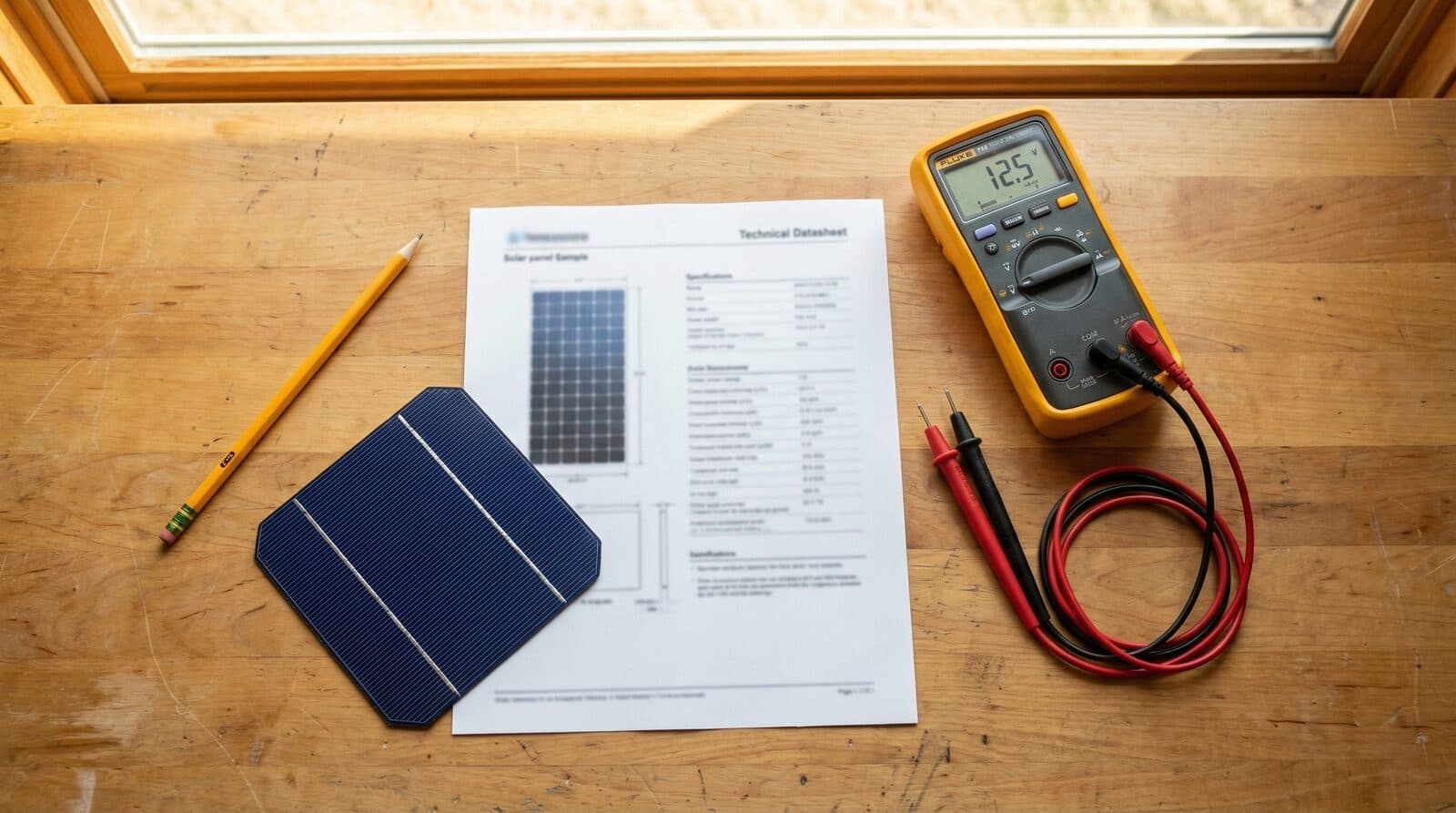
A solar panel datasheet is a one or two-page document from the manufacturer that lists every electrical and physical specification of the panel. It is the single source of truth for how the panel performs — not marketing claims, not installer estimates, not online reviews.
You need the datasheet for two critical tasks: verifying that your panels are compatible with your inverter, and comparing panels from different manufacturers on an apples-to-apples basis. Every spec on the datasheet feeds directly into the compatibility calculations that determine whether your system is safe and efficient.
Where to find your datasheet
STC and NOCT: the two testing conditions
Every number on a datasheet is measured under specific laboratory conditions. Two sets of conditions are standard across the industry, and understanding the difference is essential for interpreting the specs correctly.
STC — Standard Test Conditions
STC is the primary benchmark: cell temperature 25°C, irradiance 1000 W/m² (bright midday sun), and air mass 1.5 (a standard solar spectrum). All headline specs — Pmax, Voc, Vmpp, Isc, Impp — are measured at STC. The catch: real-world conditions almost never match STC. On a sunny day your panel cells reach 50–70°C, not 25°C, which significantly changes voltage and power output.
NOCT — Nominal Operating Cell Temperature
NOCT tells you how hot the cells get under more realistic conditions: 800 W/m² irradiance, 20°C ambient air, and 1 m/s wind speed. Most panels have NOCT between 42°C and 46°C. A lower NOCT means the panel runs cooler in the same environment — translating to higher voltage and more power. NOCT specs (Pmax at NOCT, Voc at NOCT) give you a better picture of typical daytime performance.
Why STC specs are still useful
Pmax — maximum power output (watts)
Pmax is the panel's rated power at STC — the headline number you see in marketing (e.g., '550W panel'). It equals the voltage at maximum power multiplied by the current at maximum power. This is the maximum instantaneous power the panel can produce under perfect lab conditions.
Maximum power
Pmax = Vmpp × Impp (e.g., 41.7V × 13.19A = 550W)In practice, your panel will rarely hit its Pmax rating. Real-world output is typically 80–90% of STC due to higher cell temperatures, suboptimal sun angles, dirt, and cable losses. But Pmax is still the right number for system sizing — it lets you calculate your array's total DC power and the DC/AC ratio with your inverter.
What does the ±tolerance mean?
Voc — open-circuit voltage
Voc (open-circuit voltage) is the maximum voltage the panel produces when no current is flowing — when the panel is disconnected or the inverter is off. Think of it as the 'pressure' the panel can generate with nothing connected. It is always the highest voltage the panel can produce.
Voc is the most safety-critical spec on the datasheet. When panels are wired in series (a 'string'), the voltages add up. If the total string Voc exceeds your inverter's maximum DC voltage limit, you risk permanent damage. This is especially dangerous in cold weather, when voltage rises above the STC value.
String Voc at cold temperature
Voc_cold = N_panels × Voc_stc × (1 + (TcVoc / 100) × (T_min − 25))For example, a panel with Voc = 49.6V and TcVoc = −0.27%/°C in a string of 10 at −15°C: Voc_cold = 10 × 49.6 × 1.108 = 549.6V. Those 53.6 extra volts above STC could push a 500V inverter over its limit.
The cold-weather trap
Vmpp — voltage at maximum power point
Vmpp (voltage at maximum power point) is the voltage where the panel produces the most power. It is always lower than Voc — typically 80–85% of Voc. This is the voltage your inverter's MPPT tracker targets during normal operation.
Vmpp matters for your inverter's MPPT voltage range. If the string Vmpp drops below the MPPT minimum (typically in hot weather when voltage falls), the inverter can't track maximum power and your output drops sharply. If it rises above the MPPT maximum (in cold weather), the tracker loses efficiency.
MPPT range check
MPPT min < N_panels × Vmpp_hot < N_panels × Vmpp_cold < MPPT maxFind your panel in the database
Skip the manual entry — pick your panel in the calculator and Voc, Vmpp, Isc, Impp and the temperature coefficients are filled in from its datasheet.
Isc — short-circuit current
Isc (short-circuit current) is the maximum current the panel produces when positive and negative terminals are directly connected — zero voltage, maximum current. It is the opposite extreme from Voc. You will never operate at Isc during normal use, but it matters for safety calculations.
Unlike voltage, current increases slightly in hot weather (the temperature coefficient of Isc is positive, typically +0.04% to +0.06%/°C). When multiple strings are connected in parallel to one MPPT input, the currents add up. The total Isc must stay below the inverter's max short-circuit current rating to prevent protection faults.
Total Isc at hot temperature
Isc_hot = N_strings × Isc_stc × (1 + (TcIsc / 100) × (T_cell_hot − 25))Isc vs max input current
Impp — current at maximum power point
Impp (current at maximum power point) is the current flowing when the panel operates at its peak power output. It is always lower than Isc — typically 90–95% of Isc. This is the actual operating current during normal generation.
Relationship to Pmax
Impp = Pmax / Vmpp (e.g., 550W / 41.7V = 13.19A)Impp determines your real-world cable sizing and how much current your inverter processes during peak production. When Impp exceeds the inverter's max input current per MPPT, the inverter clips — it limits current to its maximum and wastes the excess. This is energy loss but not damage.
Temperature coefficients: how specs change with heat and cold
Temperature coefficients tell you how much each electrical parameter changes per degree Celsius away from 25°C (the STC reference). They are the key to translating lab specs into real-world performance. Three coefficients appear on every datasheet:
| Parameter | PERC | TOPCon | HJT |
|---|---|---|---|
| TcVoc (%/°C) | −0.27 to −0.29 | −0.26 to −0.28 | −0.23 to −0.25 |
| TcIsc (%/°C) | +0.04 to +0.06 | +0.04 to +0.05 | +0.03 to +0.04 |
| TcPmax (%/°C) | −0.34 to −0.38 | −0.29 to −0.32 | −0.24 to −0.27 |
The negative sign on TcVoc means voltage increases when temperature drops below 25°C. A panel with TcVoc = −0.27%/°C gains 0.27% voltage for every degree colder. At −15°C, that is a 10.8% voltage increase — enough to push a borderline string over the inverter's DC voltage limit.
Temperature-adjusted voltage
V_adjusted = V_stc × (1 + (TcVoc / 100) × (T_cell − 25°C))The positive TcIsc means current rises slightly in hot weather — but the change is small (about 1–2.5% at 65°C cell temperature). TcPmax combines both effects: since voltage drops faster than current rises, panels lose total power in heat. A PERC panel at 65°C loses about 14% of its rated power; an HJT panel loses only 10%.
Check your panel-inverter compatibility
Our calculator applies temperature coefficients automatically — enter your equipment and climate, and it runs all voltage and current checks at your temperature extremes.
Cell count and technology type
The datasheet lists the number of cells and the cell technology. Common configurations are 54, 60, 72, 78, 108, 120, and 144 cells. More cells in series means higher voltage — a 144 half-cut cell panel has the same voltage as a 72 full-cell panel (cells are split in half and reconnected). The cell count directly determines Voc and Vmpp, so it affects how many panels you can fit per string.
Cell technology — PERC, TOPCon, or HJT — affects efficiency, temperature coefficients, and degradation rate. TOPCon has become the mainstream choice in 2026, offering better temperature performance than PERC at near-identical prices. HJT delivers the best thermal performance but at a 10–20% price premium.
Same wattage, different voltage
Frequently asked questions
Can I calculate power from Voc × Isc?
No. Voc × Isc gives a theoretical maximum that the panel can never actually reach. Real power equals Vmpp × Impp, which is always lower. The ratio Pmax / (Voc × Isc) is called the fill factor and is typically 75–82% for modern panels.
What does +5W/−0W tolerance mean?
It means your 550W panel will produce between 550W and 555W at STC. Positive-only tolerance is standard for modern panels — you get at least the rated power, usually slightly more. This also means Voc could be up to 1–2% higher than the datasheet value.
Why does my panel produce less than its rated watts?
The rated power (Pmax) is measured at STC: 25°C cell temperature and perfect 1000 W/m² sunlight. In reality, your cells run 30–40°C hotter than ambient air, reducing voltage and power. Dirt, suboptimal angle, cable losses, and inverter efficiency each take another 1–3%. Typical real-world output is 80–90% of STC rating.
Which spec matters most for string sizing?
Voc and TcVoc together. Voc determines the base voltage, and TcVoc determines how much it rises in cold weather. Multiply Voc × number of panels × temperature correction factor — this is the value that must stay below your inverter's max DC voltage. Get this wrong and you risk damaging equipment.
What is a good temperature coefficient?
For TcVoc: −0.24%/°C or better (lower absolute value = less voltage swing). For TcPmax: −0.30%/°C or better. HJT panels have the best coefficients, followed by TOPCon, then PERC. Better coefficients mean more panels per string in cold climates and less power loss in hot climates.
Do I need both STC and NOCT specs?
STC specs are essential — they are what you use for all compatibility calculations with your inverter. NOCT specs are useful for estimating real-world energy production and comparing panels in hot climates. If you only look at one set, use STC.
How do I find my panel's temperature coefficients?
Look on the datasheet under 'Temperature Characteristics' or 'Thermal Coefficients'. TcVoc is listed in %/°C (negative for voltage), TcIsc in %/°C (positive for current). If your panel is in our equipment database, these values are already loaded and the calculator applies them for you.
Is higher Voc better or worse?
It depends. Higher Voc means you need fewer panels to reach your inverter's MPPT minimum voltage — good for small arrays. But it also means fewer panels fit per string before exceeding the max DC voltage — a constraint for large systems or cold climates. The key is matching your panel's Voc to your inverter's voltage window.


Discussion
Sign in to join the discussion
We require a quick sign-in to keep this thread free of spam.
No comments yet. Be the first to share your experience.