Inverter Clipping: How Much Energy You Really Lose
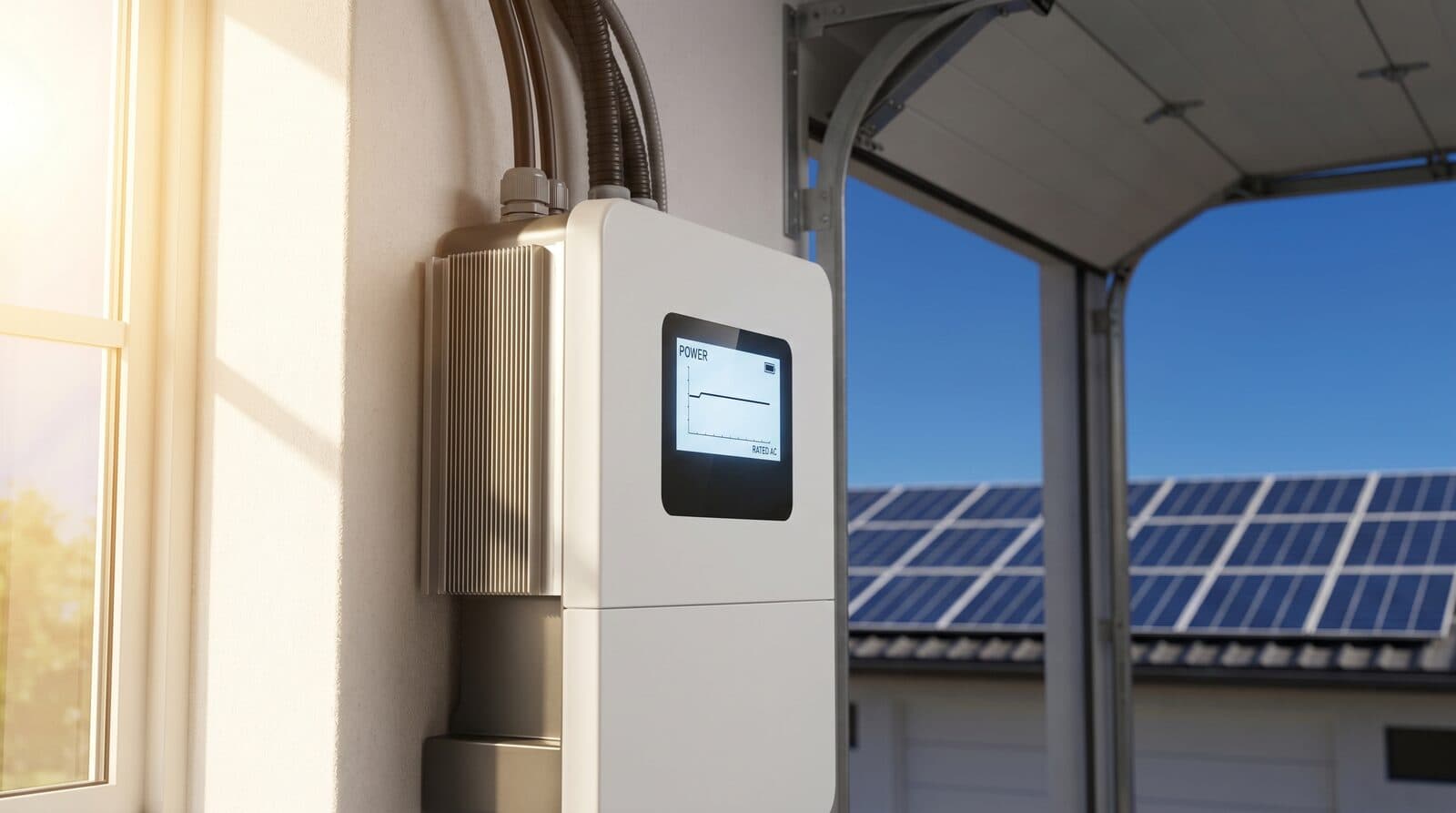
What clipping is — in 30 seconds
Clipping happens when your panels can produce more DC power than the inverter can convert to AC. The inverter caps its output at the rated AC power — say 8 kW — and any DC surplus above that is simply not harvested. On a sunny noon you see a flat plateau on the power curve instead of a peak.
It is not a fault, not a warranty issue, and not damage to your panels or inverter. Modern inverters spend years operating with intentional clipping. The real question is how much energy you trade away — and that is what this guide answers in numbers, not opinions.
Clipping ≠ damage
Why panels almost never hit nameplate
A 460 W panel is rated under STC: 1000 W/m² of irradiance, 25 °C cell temperature, AM1.5 spectrum. Real rooftops rarely see all three at once. On a typical summer noon the cell sits at 55-65 °C, knocking 8-12 % off Pmax. In winter the irradiance drops to 200-400 W/m² for most of the day.
Across an entire year, an unshaded array in central Europe averages roughly 14-16 % of nameplate power. That is why it makes economic sense to oversize the DC side: the panels you add only clip during the brief midday peak, but they put out their full share for thousands of low-light hours when the inverter is idling.
DC/AC ratio: the single number that matters
The DC/AC ratio is the array's nameplate power (under lab-rated STC conditions) divided by the inverter's rated AC output. Plain-language version: 'how many kilowatts of panels per kilowatt of inverter'. NREL studies and most installer guides build the entire sizing decision around this one number.
DC/AC ratio
DC/AC = P_dc_stc / P_ac_nominalA 14.72 kWp array on an 8 kW inverter is 1.84. Below 1.0 the inverter is oversized and wasted. From 1.0 to ~1.3 the array is conservative — almost no clipping. From 1.3 to 1.5 you are in the residential sweet spot. Beyond 1.5 you start trading meaningful summer kWh for cheaper morning/evening yield and lower per-watt inverter cost.
How much energy you actually lose
Annual clipping losses depend on climate, orientation and inverter type — but the shape is well known. The table below uses temperate-climate field data (NREL, Sandia, BloombergNEF 2024 reviews). Add ±0.5 percentage points for hot deserts or far-northern sites.
| DC/AC ratio | Annual clipping loss | Practical note |
|---|---|---|
| 1.00 | 0 % | No clipping — but you are paying for inverter capacity you never use |
| 1.10 | <0.1 % | Imperceptible. Inverter still has headroom for cold-weather peaks |
| 1.20 | 0.5-1 % | Minor. A few summer noon hours per year |
| 1.30 | 1-2 % | Residential sweet spot for grid-tied string inverters |
| 1.40 | 3-5 % | Visible plateau every clear summer day |
| 1.50 | 5-8 % | Upper limit for plain string inverters (NREL default cap) |
| 1.70 | 8-12 % | Only sensible for hybrid + battery — surplus charges storage |
| 2.00 | 12-18 % | Hybrid/off-grid maximum. Works because clipped energy goes into the battery |
Clipping is asymmetric
Clipping by inverter type
Not every inverter wastes the surplus. Solar Stack's calculator uses different DC/AC ratio limits per inverter type because the topology decides what happens to clipped DC. Here are the warning thresholds we apply, with the physical reason behind each.
| Inverter type | Warn above | What happens to surplus DC |
|---|---|---|
| String (grid-tied) | 1.5 | Clipped — energy is permanently lost |
| Hybrid (battery-coupled) | 2.0 | Stored in battery, exported, or self-consumed |
| Off-grid | 2.0 | Stored in battery — no grid export needed |
| Modular C&I (PCS + battery) | 2.5 | DC-coupled storage absorbs all surplus |
| Microinverter | 1.3 | Each unit clips its own panel — no shared headroom |
| Power optimizer | 1.5 | Optimizer + string inverter — same operating limits as a plain string inverter |
A hybrid with no battery installed behaves like a string inverter for clipping purposes. The 2.0 limit only makes sense when the surplus has a place to go. Plan storage and PV array together, not in two separate decisions.
Worked example: 8×4 on Deye SUN-8K
Let's walk through a realistic Kyiv setup with verifiable numbers from the Solar Stack equipment database. We pair an 8 kW Deye hybrid with mid-tier 460 W TOPCon panels in a 32-module array.
Equipment
Inverter: Deye SUN-8K-SG05LP1-EU-AM2-P, 8 kW hybrid, 2 MPPTs × 2 strings each. Panels: Jinko JKM460N-48QL6-DV, 460 W TOPCon. Wiring: 8 panels per string × 4 strings (2 strings on each MPPT) = 32 panels total = 14.72 kWp. Site: Kyiv (50.45° N, 30.52° E), rooftop, fixed south-facing tilt 35°.
DC/AC ratio
14 720 W ÷ 8 000 W = 1.84Peak DC power on a sunny day
P_peak ≈ 14 720 × 0.92 (temp loss at 35 °C ambient) ≈ 13.5 kWAnnual clipping loss
At ratio 1.84 in a temperate Kyiv climate, expect 8-11 % of theoretical annual yield lost to clipping. Most of it concentrates between May and August, in 2-4 hour midday plateaus on clear days. A 14.72 kWp array near Kyiv produces roughly 16 500 kWh/year before clipping, so you forfeit 1300-1800 kWh annually if the inverter has no battery.
What it costs in money
At a self-consumption tariff of 4.32 UAH/kWh, that is 5600-7800 UAH/year that the inverter never delivers to your loads or export meter. With a battery installed the same surplus charges storage during the noon peak and discharges in the evening — clipping loss collapses to 1-2 %.
Open this exact 8×4 setup in the calculator
Pre-loaded for Kyiv: Deye SUN-8K-SG05LP1 + 32 × Jinko 460 W. Tweak panels per string, strings, or temperatures to see how the verdict changes.
When clipping is good
A DC/AC ratio above 1.0 is not a sign of bad design — it is a deliberate trade. You buy a smaller, cheaper inverter and accept a few percent of clipping in exchange for full output during the thousands of hours per year when conditions are not ideal.
- Morning, evening, and overcast hours: the extra panels deliver real kWh while the inverter still has headroom — no clipping at all.
- Battery-coupled systems: clipped surplus charges storage instead of being wasted. Hybrid inverters routinely run 1.7-2.0× because of this.
- Export limits: if your grid contract caps you at 8 kW AC anyway, an 8 kW inverter is the right choice regardless of array size.
- Winter performance: panels temperature-corrected for cold weather can briefly exceed nameplate. Some headroom on the array side smooths the year.
When clipping is a problem
Clipping turns into real money lost when the surplus has nowhere to go and the plateau is long. Watch for these red flags:
- Plain grid-tied string inverter at ratio > 1.5 in sunny climates — annual losses creep into double digits.
- Hybrid inverter sized at 2.0 but installed without a battery — behaves like a string inverter, but you paid hybrid prices.
- Daily plateau exceeds 2-3 hours from May through August. That is a sign the inverter is the bottleneck, not the array.
- Manufacturer warranty caps that limit DC oversizing — some legacy inverters void coverage above 1.3 even though they tolerate it electrically.
Heat is the second-order risk
Already considering more panels?
Read the safety-and-warranty side of the same decision in our oversizing guide.
How to measure clipping on a live system
If you already have a system installed, you can quantify your clipping loss in 10 minutes using the data your inverter already logs. Solarman, Deye Cloud, Solis Cloud, Growatt ShinePhone, and any MQTT-enabled inverter export the same metrics.
- Pull a 1-minute power log for one clear-sky day
Use a recent cloudless summer day. Export AC power vs time at 1-minute resolution.
- Look for a flat plateau at the rated AC limit
On a clipped system the curve flattens around your inverter's rated power. Note the start and end times — that is the clip window.
- Compute the clipped energy
Multiply the plateau duration by the difference between the modeled DC peak (your kWp × irradiance × temperature factor) and the inverter limit. That is your daily loss.
- Scale to the year
Multiply by the count of clear-sky days in your climate (PVGIS gives 80-120 for central Europe). That is your annual clipping loss in kWh.
- Compare against expected loss for your DC/AC ratio
Use the table in section 4. If your measured loss is materially higher than the expected band for your ratio, check for shading or MPPT distribution issues — they masquerade as clipping in the data.
Five common mistakes
- Sizing for STC instead of realistic peak
Cells run 25-40 °C above ambient on a roof. Subtract roughly 8-12 % from nameplate before comparing to the inverter limit; otherwise you overestimate clipping by a wide margin.
- Ignoring cold-weather Voc
More panels per string raises the cold open-circuit voltage. The DC/AC limit may be fine, but at -25 °C the array can blow past the inverter's max DC voltage. Check both limits, not just the AC one.
- Double-sided panels add invisible watts
Double-sided (bifacial) panels deliver 5-15 % extra DC from light hitting their rear surface. If you size only against the front-face rating, your real DC/AC ratio is higher than you calculated and clipping is worse than expected.
- A 2.0× hybrid without a battery is no longer a 'hybrid'
The 2.0× hybrid limit only holds because storage absorbs the surplus. Without a battery, a 2.0× hybrid clips just like a plain 2.0× string inverter — a worse outcome than a 1.4× string inverter would deliver.
- Inverters quietly throttle themselves in heat
Most inverters automatically reduce their AC output above 40-45 °C ambient — a built-in protection against overheating. The plateau on a hot August day can sit below the inverter's nameplate. That is real lost energy, not a measurement error.
FAQ
Does clipping damage the inverter?
No. The inverter operates within its rated power range — that is what 'rated' means. Clipping is a normal operating mode, not a fault. The MPPT tracker simply moves the panel array off its maximum power point until DC input matches AC output capacity.
What is the ideal DC/AC ratio for a residential system?
For a plain grid-tied string inverter, target 1.2-1.4 in sunny climates and 1.3-1.5 in cloudier regions. For a hybrid with a battery, 1.5-1.8 is usually optimal. Use Solar Stack's calculator to test your exact equipment and climate.
Can I retrofit more panels onto an existing inverter?
Yes, as long as you stay below the inverter's max DC input current per MPPT, max DC voltage at cold extreme, and the manufacturer's documented DC oversizing limit. The 7 compatibility checks in our calculator catch all three.
How is clipping different in summer vs winter?
In summer you have long peaks of high irradiance + high cell temperatures. The DC peak is reduced by heat, but irradiance is high enough that you still hit the AC ceiling for hours. In winter the irradiance is too low for clipping in most climates, but cold-induced voltage spikes can push the array above the MPPT or DC voltage limit.
Is intentional oversizing worth it?
For self-consumption tariffs and battery systems — almost always yes. For pure grid-export with a feed-in tariff that pays per AC kWh — only up to about 1.3, after which clipping eats your gain.
How does clipping interact with double-sided (bifacial) panels?
Double-sided panels add power from their rear face, so your real DC/AC ratio is 5-15 % higher than the front-only rating suggests. Plan for this when picking the inverter, especially on ground-mount sites or over light-coloured surfaces where rear-side gain is largest.
Where do the per-type DC/AC limits come from?
They reflect industry sources: NREL residential study (1.5 for string), Dynapower / energy-storage.news (2.0 for hybrid and off-grid), commercial DC-coupled storage practice (2.5 for modular C&I), microinverter manufacturer guidance (1.3 per panel). The full list lives in the Solar Stack calculator.
Test your own configuration in the calculator
Start from the Kyiv 8×4 setup and modify any field — panels per string, strings per inverter, temperature range, location. The verdict updates instantly with all 7 compatibility checks.


Discussion
Sign in to join the discussion
We require a quick sign-in to keep this thread free of spam.
No comments yet. Be the first to share your experience.