MC4 Solar Connectors: Types, Brands & Selection
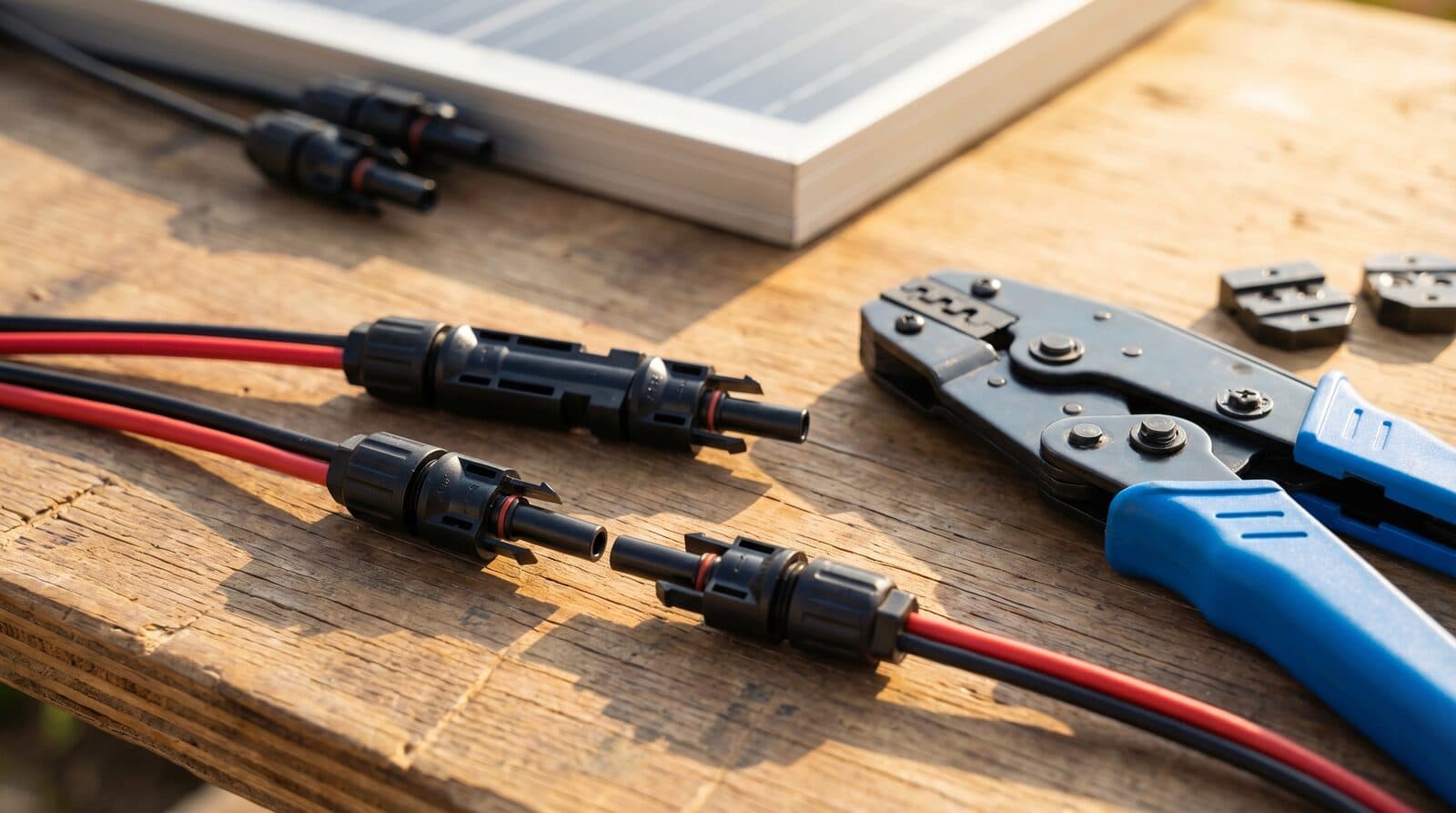
What Are MC4 Connectors
MC4 stands for Multi-Contact 4 mm — the name comes from the Swiss company Multi-Contact (now Stäubli) and the 4 mm diameter contact pin inside the connector. Introduced in the early 2000s, MC4 connectors quickly became the universal standard for solar panel DC wiring worldwide. Today, virtually every residential and commercial solar panel ships with MC4-compatible leads pre-attached to its junction box.
The MC4 system replaced its predecessor, the MC3, by adding a locking mechanism that prevents accidental disconnection — critical for rooftop installations where a loose cable carrying 30-40 A of direct current is a serious fire hazard. The design is governed by IEC 62852, the international standard for DC connectors in photovoltaic systems.
The global MC4 connector market reached $3.7 billion in 2024 and is projected to grow at 12 % CAGR through 2030. Whether you are building a 3 kW rooftop system or a 100 MW solar farm, you will encounter MC4 connectors at every cable junction. Understanding how they work, which brands to trust, and how to install them correctly can save you from costly failures.
MC4 Anatomy: How They Work
Every MC4 connection consists of two halves: a male connector (pin) and a female connector (socket). The male side holds a solid 4 mm copper-alloy pin; the female side contains a spring-loaded contact sleeve that grips the pin when inserted. A plastic locking ring on the outer shell clicks into place and requires a special unlocking tool (or two flat-head screwdrivers) to separate — this prevents wind, vibration, or accidental pulling from breaking the connection.
The cable enters through a compression gland at the back of the connector. This gland creates a watertight seal around the insulation and provides strain relief so mechanical force on the cable does not reach the crimp joint inside. When properly assembled, the mated pair achieves IP67 protection — completely dust-tight and waterproof against temporary submersion up to 1 m. Contact resistance on a quality connector is below 0.5 mΩ, meaning virtually no power is lost at the junction.
MULTILAM contact technology
Types & Modifications of MC4 Connectors
The original MC4 design has evolved into a family of specialized connectors. Each type serves a specific role in the solar wiring system. Here is what's available:
| Type | Voltage | Current | Typical Use |
|---|---|---|---|
| Standard MC4 | 1000 V DC | 30–40 A | Panel-to-panel and panel-to-inverter connections |
| MC4-EVO2 | 1500 V DC | 40–70 A | Utility-scale and modern residential systems |
| T-Branch | 1000–1500 V | 30 A | Splitting one line into two parallel paths |
| Y-Branch | 1000–1500 V | 30 A | Merging two parallel strings into one input |
| In-Line Fuse | 1000 V DC | 15–30 A | Per-string overcurrent protection without a combiner box |
| Extension Cable | 1000–1500 V | 30 A | Bridging distance between panels and inverter |
| Panel-Mount | 1000 V DC | 30 A | Pre-installed on panel junction boxes |
MC4-EVO2 connectors are backward-compatible with standard MC4 from the same manufacturer, but only up to 1000 V. If your system voltage exceeds 1000 V (common in commercial installations with long strings), every connector in the circuit must be rated for 1500 V. Branch connectors (T and Y) are essential for parallel wiring — they let you merge or split strings without separate combiner boxes.
Top 5 MC4 Connector Brands
Not all MC4 connectors are equal. These five manufacturers lead the global market in quality, certifications, and installed base. Choosing a connector from this list means your system meets insurance and code requirements in virtually every jurisdiction:
| Brand | Country | Key Product | Max Voltage | Max Current | Certifications |
|---|---|---|---|---|---|
| Stäubli | Switzerland | MC4 / MC4-EVO2 | 1500 V DC | 70 A | TUV, UL, JET |
| Amphenol | USA | Helios H4 | 1500 V DC | 40 A | TUV, UL |
| Phoenix Contact | Germany | SUNCLIX | 1500 V DC | 40 A | TUV, UL |
| TE Connectivity | Switzerland | SOLARLOK | 1500 V DC | 40 A | TUV, UL |
| Weidmüller | Germany | PV-STICK | 1500 V DC | 40 A | TUV, UL |
All five manufacturers offer connectors rated to 1500 V DC and carry TUV and/or UL certifications. Stäubli dominates the market with over 800 GW of connected capacity worldwide — more than half of all solar installations on the planet use original MC4 connectors.
Why Stäubli leads the market
Chinese Connectors: Quality Tiers & Risks
China produces the vast majority of MC4-compatible connectors sold worldwide. The quality spectrum is enormous — from premium manufacturers with full TUV and UL certification to unnamed clones sold in bulk on marketplaces. Understanding the tiers helps you avoid the dangerous low end without overpaying.
Premium Chinese brands (QC Solar, Renhe, PNTECH) invest in proper certification and use tin-plated copper contacts with UV-stabilized PPO housings. Their connectors pass IEC 62852 testing and are used by panel manufacturers like JA Solar and Trina. Mid-range brands often hold only partial certifications — they may pass TUV but not UL, or test to 1000 V but not 1500 V. Budget clones at the bottom of the market use nickel-plated steel contacts, inferior plastics that become brittle under UV exposure, and have contact resistance 10-20 times higher than originals.
The practical risk is straightforward: high contact resistance generates heat. A connector running at 10 mΩ instead of 0.5 mΩ dissipates 20 times more power as heat at the junction. Over months of exposure to sun, rain, and thermal cycling, the plastic housing degrades, the seal fails, moisture enters, corrosion accelerates, and the connector becomes an ignition point. This is not theoretical — connector fires are among the most common causes of solar installation failures worldwide.
Cross-mating voids your warranty
Matching Connectors to Your Solar Panels
The connector you buy must match your panel's cable output in three ways: cable cross-section, current rating, and voltage rating. Most residential panels ship with 4 mm² (12 AWG) leads, which is the standard MC4 cable size. If your panel uses 6 mm² leads (common on higher-current modules above 15 A Isc), make sure the connector accepts 6 mm² cable — not all standard MC4 bodies do.
Current rating is the next check. The connector's rated current must exceed the panel's short-circuit current (Isc) with a safety margin. For a panel with 18 A Isc, a 30 A connector provides adequate headroom. For high-current bifacial panels pushing 20+ A, consider 40 A connectors or MC4-EVO2.
Voltage rating matters at the system level, not the panel level. A single 580 W panel produces around 50 V, but a string of 15 panels reaches 750 V. If your system voltage exceeds 1000 V DC (which is possible with strings of 21+ panels on a cold day), you need 1500 V-rated connectors throughout the entire string — not just at the inverter end.
As an Amazon Associate, Solar Stack earns from qualifying purchases.
DC Cable Sizing Guide
Learn how to choose the right wire gauge for your solar string — voltage drop formulas, cable sizing tables, and MC4 compatibility.
Calculate your exact cable size
Pick your panel from the database — the calculator returns mm², voltage drop, yearly losses and the safety check.
Ordering Connectors Before Your Panels Arrive
You can — and should — order connectors before your panels are delivered. The key is knowing what to look for on the panel's datasheet or product listing. Every reputable manufacturer publishes the connector type (usually 'MC4' or 'MC4-compatible'), cable cross-section (4 mm² or 6 mm²), and cable length in the mechanical specifications section of the datasheet.
Once you know the connector type and cable size, calculate the quantity you need. Here is a practical ordering checklist:
- Check the datasheet for connector type and cable size
Look for 'Connector type: MC4' and 'Cable: 4 mm²' (or 6 mm²) in the mechanical specs. If the datasheet says a specific brand (e.g., 'Stäubli MC4'), buy the same brand for your extensions. - Count connector pairs for inter-panel connections
In a series string, each panel connects to the next via its pre-installed MC4 leads — you only need additional connectors for cable extensions or replacement. Count one pair (male + female) per extension cable you plan to make. - Add extension cables for the inverter run
The cable from the last panel in the string to the inverter is usually the longest. Measure the distance and order pre-made extension cables or buy connectors + cable to crimp your own. Add 10-15 % extra length for routing around obstacles. - Add branch connectors for parallel strings
If you are connecting two or more strings to a single inverter MPPT input, you need Y-branch connectors — one pair per parallel junction. For three strings, you need two Y-branch pairs. - Order 2-3 spare pairs
Connectors occasionally fail during crimping (overcompressed, misaligned pin), and having spares avoids project delays. Spares cost under $5 but a week of waiting costs much more.
Crimping Tools & Installation
A ratcheting MC4 crimp tool is the only correct way to attach a connector to a cable. These tools accept 2.5, 4, and 6 mm² cables and apply precisely calibrated pressure to deform the metal crimp barrel around the stripped conductor. The ratchet mechanism prevents you from releasing the tool before the crimp is complete — this is what separates a reliable 25-year connection from one that fails in two years.
Quality crimp tools cost $25-50 — a worthwhile investment considering a loose crimp on a 600 V string can cause an arc fault fire. Never substitute pliers, a vise, or a generic crimp tool — these cannot apply the uniform radial pressure that MC4 crimp barrels require.
Follow these four steps for every connection:
- Strip the cable insulation
Remove exactly 7-8 mm of insulation from the cable end using a solar cable stripper or sharp knife. Do not nick the copper strands — damaged strands reduce the cross-section and create hotspots. - Insert the contact pin
Slide the stripped conductor into the crimp barrel of the metal contact (pin or socket). Push until the conductor is fully seated — you should see copper flush with the inspection window on some contact designs. - Crimp with the ratcheting tool
Place the contact into the correct die size (4 mm² or 6 mm²) and squeeze the handles until the ratchet releases. Do not open the tool prematurely. The crimp must be uniform around the entire barrel circumference. - Assemble and lock the housing
Push the crimped contact into the plastic connector body until it clicks and locks in place. Then thread the compression gland nut over the cable and tighten it to seal the entry point against water. Pull-test the cable with moderate force — it should not slide out.
Never solder MC4 connections
Common Mistakes & Safety
Most MC4-related failures trace back to a small number of repeated installation errors. Avoid these five mistakes and your connectors will outlast the panels they serve:
- Mixing connector brands
Cross-mating a Stäubli pin with a QC Solar socket (or any other brand combination) creates an imperfect metal-to-metal contact. The slight difference in pin diameter, contact pressure, and plating material leads to elevated resistance, heat generation, and eventually arcing or fire. Always use connectors from the same manufacturer within a single connection pair. - Relying on hand-tightening instead of proper crimping
Pushing the wire into the contact pin and squeezing with pliers gives an unreliable connection. Without calibrated crimp pressure, the barrel does not deform uniformly — some strands make contact while others do not. The effective cross-section drops, resistance rises, and the joint overheats under load. - Breaking the IP67 seal
Every MC4 connector achieves IP67 only when the compression gland is properly tightened and the correct cable diameter fills the gland opening. Using undersized cable (e.g., 2.5 mm² in a gland designed for 4 mm²) leaves gaps that let moisture in. Leaving connectors unmated during installation without protective caps exposes the contacts to rain and corrosion. - Undersized cables cause hot connectors
If your cable cross-section is too small for the current flowing through it, the cable itself becomes a resistor. The heat travels to the connector, accelerates plastic aging, and compromises the seal. Always size your DC cable to handle the full short-circuit current of the string with margin. - No strain relief on cable runs
MC4 connectors are designed to hang freely between panels, not to support cable weight over long vertical drops. Without cable clips or ties securing the run, wind vibration and gravity gradually fatigue the cable at the gland entry point, eventually cracking the insulation or loosening the crimp.
Check your string compatibility
Use the Solar Stack calculator to verify that your panel-inverter combination is safe — voltage limits, current ratings, and MPPT range in one check.
Frequently Asked Questions
What does MC4 stand for?
MC4 stands for Multi-Contact 4 mm. 'Multi-Contact' is the Swiss company that invented the connector (now part of Stäubli), and '4' refers to the 4 mm diameter of the contact pin inside.
Are all MC4 connectors compatible with each other?
No. While most MC4-compatible connectors share the same form factor, connectors from different manufacturers must never be cross-mated. The pin tolerances, spring pressure, and plating materials differ between brands, leading to increased contact resistance and fire risk. Always use the same brand for both halves of a connection.
Can I mix MC4 and MC4-EVO2 connectors?
Yes, but only if they are from the same manufacturer (Stäubli) and the system voltage stays below 1000 V DC. Stäubli MC4 and MC4-EVO2 are officially certified as a compatible pair by TUV and UL up to 1000 V. Above 1000 V, use MC4-EVO2 throughout.
How do I know which connector type my panels use?
Check the mechanical specifications section of your panel's datasheet — it will list the connector type (e.g., 'MC4', 'MC4-EVO2', 'QC4'). If the datasheet is unavailable, look at the connector body itself for brand markings or model numbers stamped into the plastic housing.
How many MC4 connectors do I need for my system?
For a series string, panels connect to each other using their pre-installed MC4 leads — you only need additional connectors for extension cables (panel-to-inverter run) and branch connectors (parallel strings). Count one pair per extension cable, one Y-branch pair per parallel junction, and add 2-3 spare pairs.
Do I need a special tool for MC4 connectors?
Yes — a ratcheting MC4 crimp tool ($25-50) is essential for reliable connections. The ratchet ensures correct crimp pressure every time. You also need a solar cable stripper and optionally MC4 assembly/disassembly spanners for tightening or separating mated pairs.
Can I reuse old MC4 connectors?
It is not recommended. Once a connector has been crimped onto a cable, the crimp barrel is permanently deformed. Re-crimping onto a new cable gives an inconsistent joint. The contact springs also relax over time, especially on cheaper connectors. New MC4 pairs cost $1-3 each — always use fresh connectors.
How long do MC4 connectors last?
Quality MC4 connectors from top-tier manufacturers (Stäubli, Amphenol, Phoenix Contact) are rated for 25-30 years — matching the warranty period of most solar panels. Budget clones may fail within 5-10 years due to UV degradation of the housing plastic and corrosion of the contacts.


Discussion
Sign in to join the discussion
We require a quick sign-in to keep this thread free of spam.
No comments yet. Be the first to share your experience.