Solar Fuses and Breakers: DC and AC Sizing Guide
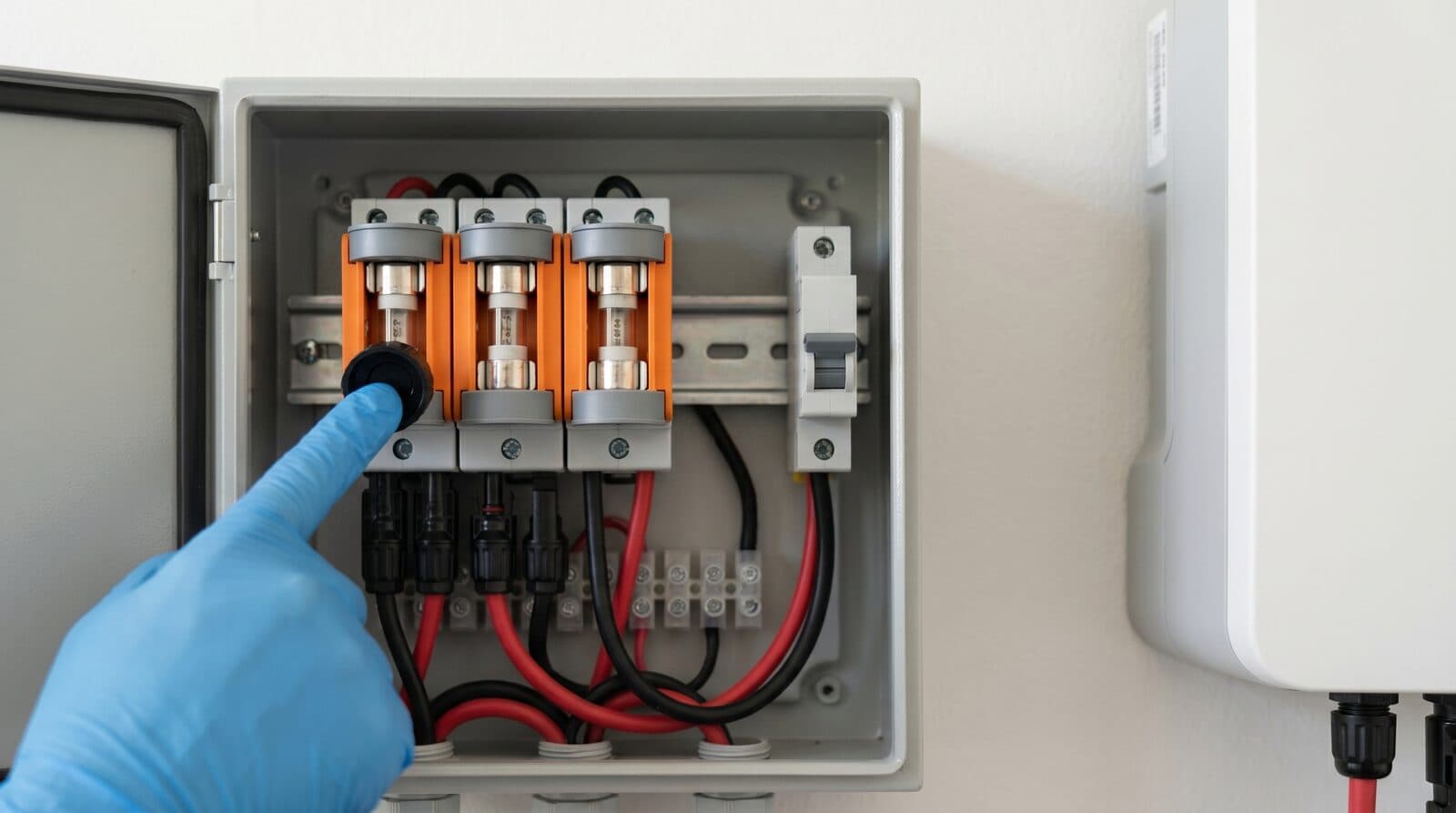
Why protection devices save lives
Every solar fire investigation report tells a similar story: a string of panels feeding back into a fault, a connector arcing for hours, and no protective device to interrupt the current. Solar Energy UK reported 38 photovoltaic fires across 2023–2024 in domestic systems, with roughly half traced to DC-side faults that should have tripped a fuse but didn't.
Fuses and breakers are not optional accessories. They are the one component between a fault current and a roof fire. Choosing the right type, sizing it correctly, and installing it on the correct side of the system (DC or AC) is how a small fault stays small instead of becoming a structural problem.
Two sides, two rule books
DC vs AC: two different worlds
The same wire carries current in both directions on AC and in only one direction on DC. That difference changes everything about how a protective device works. A standard household fuse will happily extinguish a 230 V AC arc 100 times per second (because the current crosses zero each half-cycle), but the same fuse on a 600 V DC string can hold an arc indefinitely. The arc keeps burning until something melts.
| Aspect | DC side (panels → inverter) | AC side (inverter → grid/load) |
|---|---|---|
| Device | gPV fuse (IEC 60269-6) or DC-rated MCB | MCB type B or C (IEC 60898) or breaker type CA |
| Arc behaviour | No zero crossing — arc must be physically blown out | Self-extinguishes at zero crossing (100/120 Hz) |
| Polarity | Polarised — wrong way around = no protection | Bidirectional — orientation doesn't matter |
| Voltage rating | Typically 1000–1500 V DC | 230 V (EU), 240 V (US split-phase), 400 V (3-phase) |
| Primary role | Protect modules and cables from backfeed current | Protect grid wiring and isolate the inverter |
Never use AC components on DC
Sizing DC string fuses
DC string fuses protect each parallel string from receiving fault current from the other strings. A single string with no other parallel strings cannot backfeed itself, so it doesn't need a string fuse. Once you have three or more strings in parallel — or two strings whose combined Isc exceeds the panel's Maximum Series Fuse rating — fuses become mandatory.
IEC 62548:2023 gives you both a lower and an upper bound for the fuse rating. The lower bound stops nuisance trips at hot Isc; the upper bound stops the panel from being damaged before the fuse opens.
DC string fuse rating (IEC 62548)
1.4 × Isc_STC ≤ I_fuse_rating ≤ min(2.4 × Isc_STC, Imod_max_OCPR)Imod_max_OCPR is the panel datasheet field labelled "Maximum Series Fuse" or "Maximum Overcurrent Protection Rating" — it is the largest fuse the cell strings inside the panel can survive. Typical values are 20 A, 25 A, or 30 A. NEC 690.9 in the US uses a single 1.56 × Isc rule (1.25 for continuous duty × 1.25 for outdoor conditions), which always lands inside the IEC band.
gPV not gG — the type letter matters
Sizing AC breakers for inverter output
On the AC side, you are not protecting against backfeed — you are isolating the inverter from the grid during a fault and stopping the wires between the inverter and the consumer unit from overheating. The continuous current the breaker sees is the inverter's rated AC output divided by the grid voltage.
AC breaker rating
I_breaker ≥ 1.25 × (P_inverter / V_grid)Round up to the next standard breaker size (10, 13, 16, 20, 25, 32, 40, 50, 63 A in the IEC range). A type B or C MCB is the standard choice; type B trips faster on low-magnitude short circuits, type C tolerates the inverter's brief start-up surge better.
For 230 V single-phase systems used in most of Europe, the UK, and Ukraine, divide the inverter watts by 230. For US 240 V split-phase systems, divide by 240. For 3-phase 400 V systems, divide by (√3 × 400) ≈ 693 to get the per-phase current.
RCD or RCBO on the inverter AC line
Breaking capacity explained
Breaking capacity (sometimes written as Icu or Icn, measured in kA) tells you the largest fault current the device can interrupt without exploding. It is a separate spec from the current rating — a 32 A breaker with 3 kA breaking capacity will trip fine on a 100 A overload but may rupture violently if a true short circuit pushes 8 kA through it.
Residential breakers typically come in 3 kA, 6 kA, or 10 kA breaking capacity. The prospective short-circuit current (PSCC) at your consumer unit is set by the grid impedance and is usually 1.5–6 kA for a domestic supply — your distributor can confirm. As a safe default, choose 6 kA Icu for typical UK/EU residential installations and 10 kA Icu for commercial or anywhere the grid is stiff.
On the DC side, gPV fuses are rated by interrupting capacity in kA at the device's DC voltage rating. A typical 1000 V DC gPV fuse is rated at 10 kA, far above any current a residential PV array can produce, so DC breaking capacity is rarely the binding constraint — voltage rating is.
Worked example: 6 kW system end-to-end
Three parallel strings of 12 × 450 W TOPCon panels (Isc 13.9 A, Imod_max_OCPR 25 A), feeding a 6 kW single-phase string inverter at 230 V grid. Two protection devices to size: DC string fuses and AC output breaker.
DC string fuse (per string)
1.4 × 13.9 = 19.5 A ≤ I_fuse ≤ min(2.4 × 13.9, 25) = 25 A → 20 A gPV at 1000 V DCAC output breaker
I_continuous = 6000 / 230 = 26.1 A → 1.25 × 26.1 = 32.6 A → 32 A type C MCB at 230 V AC, 6 kA IcuYou install three 20 A gPV fuses inside the DC combiner (one per string, on the positive conductor) and one 32 A type C MCB on the inverter AC output before it joins the consumer unit. A 30 mA Type A RCD sits between the MCB and the rest of the household circuit, unless the inverter datasheet mandates Type B.
Match fuse holders to fuse class
Standards comparison
Three regulatory frameworks dominate residential PV installations worldwide. The numbers move slightly between them, but the safety logic is identical.
| Topic | NEC 690 (US) | IEC 62548 (Europe, intl.) | AS/NZS 5033 (AU/NZ) |
|---|---|---|---|
| DC fuse sizing | I_fuse ≥ 1.56 × Isc (690.9) | 1.4 × Isc ≤ I_fuse ≤ 2.4 × Isc | 1.5 × Isc ≤ I_fuse ≤ 2.4 × Isc |
| Required fuse type | UL 248-13 PV fuse | gPV per IEC 60269-6 | gPV per IEC 60269-6 |
| AC breaker sizing | 1.25 × I_inv_continuous, NEMA | 1.25 × I_inv_continuous, IEC 60898 | 1.25 × I_inv_continuous, AS/NZS 3000 |
| DC disconnect required | Within 3 m of the array (690.13) | Rooftop or pre-inverter | Rooftop and pre-inverter (both) |
| Array grounding | Equipment ground required | Optional, depends on inverter | Equipment ground mandatory |
Australia and New Zealand keep the strictest DC isolation requirement (a disconnect at both the array and the inverter). The US enforces the tightest electrical compliance via UL listing, while IEC is the most flexible on system topology. Whichever applies to you, the underlying physics of fuse sizing barely moves.
Tools and related guides
Two Solar Stack tools and one companion article cover the rest of the protection-design workflow.
Calculate string voltage and current
Get the temperature-corrected Isc and string Voc you need before sizing fuses. Worst-case hot Isc is what feeds the DC fuse formula.
Match panels to a real inverter
Browse inverters and read their AC continuous current spec directly — that's the number you multiply by 1.25 to pick a breaker.
Pair fuses with the right cable size
A correctly sized fuse only protects the cable if the cable is sized for the current. Read our DC cable sizing guide.
Calculate your exact cable size
Pick your panel from the database — the calculator returns mm², voltage drop, yearly losses and the safety check.
Common mistakes that start fires
- Using a gG fuse on the DC side
gG fuses are made for AC distribution boards and physically cannot extinguish a DC arc above ~24 V. The fuse opens, the arc holds, and the holder melts. Always specify gPV (IEC 60269-6) for any DC protection.
- Sizing the breaker to the inverter wattage, not the AC current
A "6 kW" inverter doesn't need a 6 A breaker — it needs a breaker sized to its AC current, which is 26 A at 230 V. Always divide watts by grid voltage first, then multiply by 1.25.
- Skipping fuses on three or more parallel strings
Two strings cannot backfeed each other to a dangerous level, but three can. The combined fault current from two healthy strings flowing into a shorted third string will exceed the Imod_max_OCPR of the failing panel within seconds.
- Ignoring the panel's Imod_max_OCPR limit
If the calculated fuse range upper bound (2.4 × Isc) is larger than the panel datasheet's Maximum Series Fuse rating, you must use the panel's rating as the ceiling. Otherwise the panel internals fail before the fuse trips.
- Forgetting breaking capacity (Icu/Ics)
A 32 A breaker with 3 kA breaking capacity is not the same as a 32 A breaker with 10 kA breaking capacity. Match Icu to the prospective short-circuit current at your installation point — your DNO or utility can supply this number.
Frequently asked questions
Do I need fuses for a single-string solar system?
No. A single string cannot backfeed itself, so the IEC 62548 logic does not apply. You still need a DC disconnect (isolator) before the inverter, but no string fuse is required. Add fuses the moment you go from one string to two or three in parallel.
Can I use the same breaker for AC and DC?
Only if it is explicitly dual-rated. A few high-end MCBs (e.g. ABB S800 series) carry both an AC and a DC rating, but the DC rating is usually for a lower voltage than the AC rating. Read the device's nameplate — if it does not show a DC voltage rating, treat it as AC-only.
What does "gPV" mean on a fuse?
gPV is the IEC 60269-6 designation for photovoltaic fuses. The "g" means "general purpose" (full-range protection from small overloads up to short-circuit), and "PV" means it is rated for the steep, no-zero-crossing DC current curve produced by a solar array. Always specify gPV for DC string protection.
How do I find the prospective short-circuit current for my home?
Ask your DNO (UK), utility (US), or grid operator (EU). They publish a PSCC value for each connection point. Typical UK residential is 6 kA; US residential is often 10 kA; rural lines can be lower. If you cannot get a number, use 10 kA Icu as a safe default for the inverter AC breaker.
Can I oversize the AC breaker?
Slightly, but not by much. The breaker is also there to protect the cable feeding it. If the cable is sized for 32 A and you fit a 40 A breaker, a 35 A overload will overheat the cable without tripping the breaker. Always pair the breaker, cable, and inverter spec together.
What happens if a gPV fuse blows on one string?
That string drops out of the array. The other strings keep producing power normally, the inverter sees a small drop in DC current, and the system continues running at reduced output. You will only notice from your monitoring app showing one string at zero — physically, nothing else changes. Replace the fuse after diagnosing the fault that blew it.
Is an RCD/RCBO mandatory on the inverter AC line?
In most of the EU, UK, and Australia, yes — a 30 mA Type A RCD or RCBO is required on every final circuit, including the inverter feed. In the US, GFCI/AFCI requirements apply differently and are governed by NEC 690.41 and 690.11. Check your local code. Transformerless inverters may require a Type B RCD because they can inject smooth DC fault current into the AC side, which Type A cannot detect.
Where do the fuses physically go?
DC string fuses sit inside a DC combiner box (sometimes called a string combiner or DC junction box), located between the strings and the inverter — usually on the same wall as the inverter or on the roof. AC breakers live in the consumer unit or in a dedicated PV sub-board next to the inverter. Never put a DC fuse inside the AC distribution board, even if it physically fits.


Discussion
Sign in to join the discussion
We require a quick sign-in to keep this thread free of spam.
No comments yet. Be the first to share your experience.