Can You Mix Different Solar Panels? Rules & Losses
The short answer
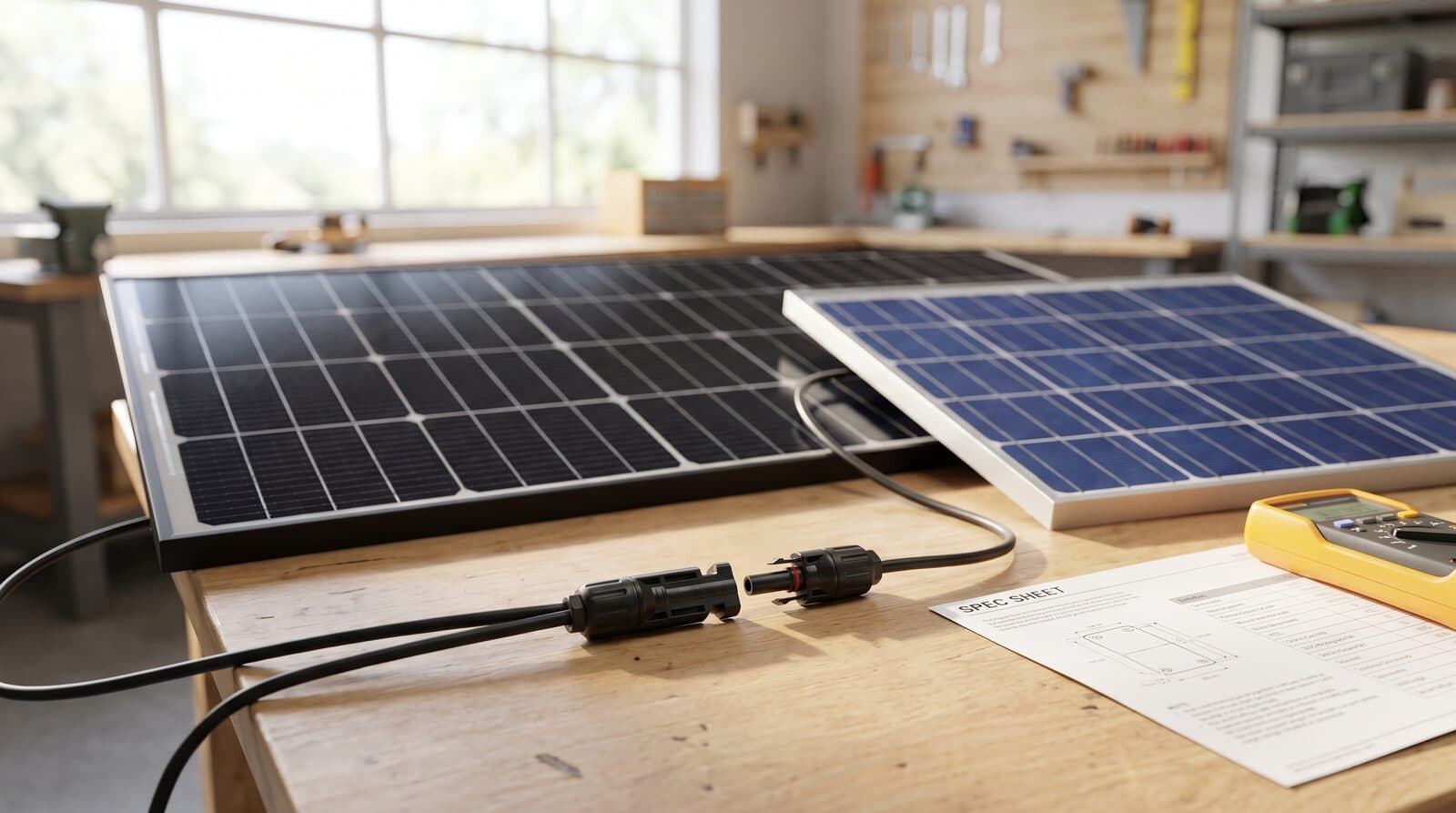
Yes, you can mix solar panels of different wattage, brand, or age — but how you wire them decides whether you lose almost nothing or a fifth of your power. The rule is simple: in a series string, all panels are forced to share one current, so a mismatch in current drags everyone down. In a parallel group, all panels share one voltage, so a mismatch in voltage is what hurts.
The safest way to combine very different panels is to keep them apart — on separate MPPT inputs, or on microinverters — so a weak panel can never pull a strong one down. Here is the whole topic at a glance.
| How you connect them | What must match | Typical power loss |
|---|---|---|
| Series (same string) | Current (Impp / Isc) | 0% to 20%+ |
| Parallel (same MPPT input) | Voltage (Vmpp / Voc) | 0% to 15% |
| Separate MPPT inputs | Nothing between inputs | ~0% |
| Microinverters / optimizers | Nothing (each panel is independent) | ~0% |
Why mixing causes losses
A solar panel is not a battery that simply dumps its rated wattage onto a wire. Its output is set by where it sits on its current-voltage (I-V) curve, and when you connect panels together, the wiring forces them all onto a shared operating point. That shared point is rarely the best point for every panel at once.
In a series string, the same current flows through every panel — like cars in a single-lane tunnel, the whole line moves at the speed of the slowest car. So the string current can never exceed the weakest panel's current. In a parallel group, every branch sits at the same voltage, and a panel forced away from its ideal voltage gives up power. The bigger the mismatch, the bigger the loss.
This is also why our compatibility calculator asks for one panel and multiplies it by the number of modules: it assumes every panel in the string is identical. That assumption is what keeps the simple math (add the voltages, add the currents) honest. The moment your panels are not identical, you have to think about which spec is being shared — and that is exactly what this guide is about.
The one-sentence version
New to series and parallel wiring?
Start with our plain-language guide to how series and parallel connections change voltage and current.
Mixing in series: match the current
When panels are wired in series (one after another, the most common layout for grid-tied strings), their voltages add up but they all carry the same current. The string can only push as much current as its lowest-current panel allows. A stronger panel does not get to run at its full current — it is throttled down to match the weakest one.
Series string
V(string) = V1 + V2 + V3 + ... | I(string) = the LOWEST of (I1, I2, I3, ...)Here is what that costs when the mismatch is large. Imagine putting a 400 W panel and a 550 W panel — same voltage class, very different current — into one series string.
Setup
Panel A: 400 W, Vmpp 41 V, Impp 9.8 A. Panel B: 550 W, Vmpp 41 V, Impp 13.4 A. Wired in series.
What happens
String voltage = 41 V + 41 V = 82 VString current = lowest of (9.8 A, 13.4 A) = 9.8 AString power ≈ 82 V × 9.8 A ≈ 804 W (vs 950 W rated)Result
You installed 950 W of panels but get about 804 W — roughly a 15% loss. The 550 W panel is throttled to behave like a 400 W one, because the string current is capped at 9.8 A. Voltage mixing was fine here; current mixing was the problem.
When a panel is badly current-starved, its bypass diodes can switch on and route current around it entirely, so in extreme cases the weak panel contributes almost nothing. The takeaway: in series, keep the panels' current ratings (Impp and Isc) within a few percent of each other.
Never put very different currents in one string
Mixing in parallel: match the voltage
Parallel connections are the mirror image. When you connect panels (or whole strings) in parallel, their currents add up but they are all pinned to the same voltage. Current differences are tolerated — you simply add them. Voltage differences are the killer, because the controller can only hold one voltage, and any panel whose ideal voltage is far from that point loses power.
Parallel group
I(total) = I1 + I2 + I3 + ... | V(group) = one shared value (the lowest tends to win)The classic parallel mistake is connecting two strings of different length to the same MPPT input — say a 10-panel string (about 410 V) and a 12-panel string (about 492 V). The input can only track one voltage, so the longer string is dragged roughly 80 V below its best point and bleeds power all day. Two panels with the same voltage but different current, on the other hand, parallel happily: the voltages match and the currents simply add.
So the parallel rule is the reverse of the series rule: match the voltage (number of panels per string, and their Vmpp/Voc), and let the current differ. If two parallel strings must share one input, give them the same number of identical panels.
Keep parallel strings the same length
The golden rule
Almost everything about mixing panels collapses into one sentence: match the current for series, match the voltage for parallel. The spec you match is the one being shared; the spec that is allowed to differ is the one that adds up.
| Connection | Must match (within ~5%) | Can differ freely |
|---|---|---|
| Series (same string) | Current — Impp and Isc | Voltage (it just adds up) |
| Parallel (same input) | Voltage — Vmpp and Voc | Current (it just adds up) |
A few percent of mismatch is normal — even identical panels off the same production line vary slightly, and a well-built system loses only 1-2% to mismatch. The goal is not perfection; it is staying inside that small band so you are not throwing away whole panels' worth of power.
Different wattage panels
Mixing different wattages is the case people ask about most, and it is often fine — because two panels from the same product family (for example a 430 W, 440 W, and 450 W version of one series) usually share almost the same current and differ mainly in voltage, or vice versa. The wattage number on the box tells you nothing on its own; you have to look at how that wattage is split between volts and amps.
So do not match by wattage — match by the spec that matters for your wiring. Open both datasheets and compare Impp and Isc if the panels will go in series, or Vmpp and Voc if they will go in parallel. Two panels labelled '400 W' and '410 W' might be a perfect series match (near-identical current) or a poor one (very different current), and only the datasheet tells you which.
Read the amps and volts, not the watts
Different brands and cell types
Electrically, the brand on the frame is irrelevant — two panels from different manufacturers with matching current (for series) or voltage (for parallel) will work together just fine. The label does not flow through the wire; the I-V specs do. Compare datasheets, not logos.
Cell technology is a subtler matter. PERC, TOPCon, and HJT panels have different temperature coefficients, which means their voltages drift apart as the weather changes. Mix a PERC and an HJT panel in one string and they may match at 25 °C but diverge on a freezing morning, when voltages are highest and string-voltage headroom matters most for your inverter.
| Cell type | Voc temp. coeff. (%/°C) | Pmax temp. coeff. (%/°C) |
|---|---|---|
| PERC | ≈ −0.28 | ≈ −0.34 |
| TOPCon | ≈ −0.25 | ≈ −0.29 |
| HJT | ≈ −0.24 | ≈ −0.26 |
For most installs the temperature-coefficient difference is a second-order effect, but it adds up in cold climates and in long strings. If you are mixing cell types, the cleanest approach is to keep each technology on its own string so their voltages rise and fall together.
Mixing old and new panels
Solar panels lose roughly 0.4-0.6% of their output per year, so an eight-year-old panel might produce 5-6% less current than its nameplate. That matters because adding a brand-new panel into an existing series string does not lift the string — the string is still limited by the weakest, oldest panel's current, and the new panel is simply throttled down to match.
Picking a replacement with a slightly higher current rating can help offset an aged string, but it cannot exceed the limit set by the original panels in series. The honest reality is that a fresh panel can never out-perform the tired ones it shares a string with.
If you are expanding or repairing an older array, the better moves are: put the new panels on a separate MPPT input, give them their own microinverters, or replace the whole string at once with matched panels. Adding one new panel to an old series string is the configuration that disappoints people most often.
A new panel won't rescue an old string
The clean ways to mix
Every mismatch problem above comes from panels being forced to share one operating point. Remove the sharing and the problem disappears. That is exactly what modern equipment lets you do.
A multi-MPPT inverter tracks each input independently, so you can put Brand A on input one and Brand B on input two — different wattage, different current, even different orientation — and each runs at its own best point with no loss between them. This is the simplest way to mix on a grid-tied system: group identical panels per input, and let the inputs differ.
Microinverters and power optimizers go one step further, giving every single panel its own tracker. With them you can mix wattages, brands, ages, and orientations almost freely — each panel performs to its own ability — as long as every panel stays inside its unit's input voltage and current window. That freedom is the main reason people choose module-level electronics for tricky roofs.
Separate the trackers, mix what you like
How MPPT tracking actually works
See why an independent MPPT input lets each group of panels run at its own peak, regardless of what the others are doing.
Warranty, safety and code
Mixing panels is not against electrical code in itself — but every string still has to obey the same limits as any other. The cold-weather open-circuit voltage must stay under your inverter's maximum input voltage and under the panels' own system-voltage rating, and the combined current must stay within the inverter's and the wiring's limits. Mixing does not change those checks; it just makes them easier to get wrong, because your panels no longer share one set of numbers.
Overcurrent protection is sized to the array's short-circuit current, so when currents differ across parallel branches the fuse and conductor sizing has to be based on the right worst-case figure. If you are unsure, run each group through the calculator and size protection to the highest current present.
Finally, warranties. Product and performance warranties are set per manufacturer, and some terms can be affected by how panels are combined or by adding modules from another brand. Mixing will not damage the hardware, but check each manufacturer's conditions before you rely on a future claim.
Each string must still pass every limit
How to check your combination
You do not have to guess. Here is the practical method for deciding whether two panels can share a connection — and confirming the whole string still fits your inverter.
- Pull both datasheets
Write down Vmpp, Impp, Voc, and Isc for each panel. These four numbers, not the wattage, decide everything.
- Decide the wiring
Are these panels going in the same series string, or in parallel branches on one input? That tells you which spec has to match.
- Match the right spec
For series, the currents (Impp and Isc) should agree within about 5%. For parallel, the voltages (Vmpp and Voc) should agree within about 5%.
- Enter the limiting panel
Run the calculator with the weakest panel — lowest current for a series string, lowest voltage for a parallel group — plus your real string size and local temperatures.
- Check each group separately
If you have several groups of identical panels, run each one. The array is only as compatible as its worst group.
Worked example: replacing one panel
You have a 10-panel string of discontinued 400 W modules (Vmpp 41 V, Impp 9.8 A, Voc 49.5 V). One panel failed. A 410 W module (Vmpp 41.5 V, Impp 9.88 A, Voc 49.8 V) is available. Current differs by under 1% and voltage by about 1% — well inside the 5% band — so mismatch loss is negligible. Drop the new Voc into the calculator to confirm the cold-morning string voltage still fits your inverter, and you are done.
Check your exact combination
Enter your panels and inverter and see all seven compatibility checks at your real temperatures.
Find a compatible replacement
Need a panel that matches an existing string? Search by the specs that have to line up.
Frequently asked questions
Can you mix solar panels of different wattage?
Yes. Match the current if they go in series, or the voltage if they go in parallel. Panels from the same product family usually mix with little loss; combining very different wattages in one series string can cost 15-20%.
Can you mix different brands of solar panels?
Electrically the brand does not matter — the I-V specs do. Two different brands with matching Impp/Vmpp work together fine. Compare both datasheets rather than trusting the logo, and check the warranty terms.
Can I add new panels to an old solar array?
Adding a new panel into an existing series string is risky, because the string stays limited by the older, degraded panels' current. Put the new panels on a separate MPPT input or give them their own microinverters instead.
Does mixing solar panels void the warranty?
It can affect product and performance warranties, which are set per manufacturer. Mixing does not harm the hardware, but read each manufacturer's terms before you count on a future claim.
Can you mix mono and poly, or PERC and TOPCon panels?
Electrically yes, if the I-V specs match. But different cell types have different temperature coefficients, so their voltages drift apart in heat and cold — keep each technology on its own string where you can.
How much power do you lose by mixing panels?
Anywhere from near 0% (well-matched specs) to over 20% (badly matched in series). Series current mismatch and parallel voltage mismatch are the big losers; matching the right spec keeps loss in the 1-2% range.
Can microinverters mix any panels?
Microinverters and power optimizers give each panel its own tracker, so mismatch cannot spread. Different wattages, brands, and even orientations all work — as long as each panel stays inside its unit's input voltage and current window.
Can you mix 12 V and 24 V panels?
Do not put different nominal-voltage panels in the same string or parallel group. Use a separate charge controller or MPPT input for each voltage class so neither is forced off its ideal point.
Run your numbers now
Check any panel-and-inverter combination in seconds — free, no sign-up.


Discussion
Sign in to join the discussion
We require a quick sign-in to keep this thread free of spam.
No comments yet. Be the first to share your experience.