Adding a Battery to Existing Solar (AC vs DC)
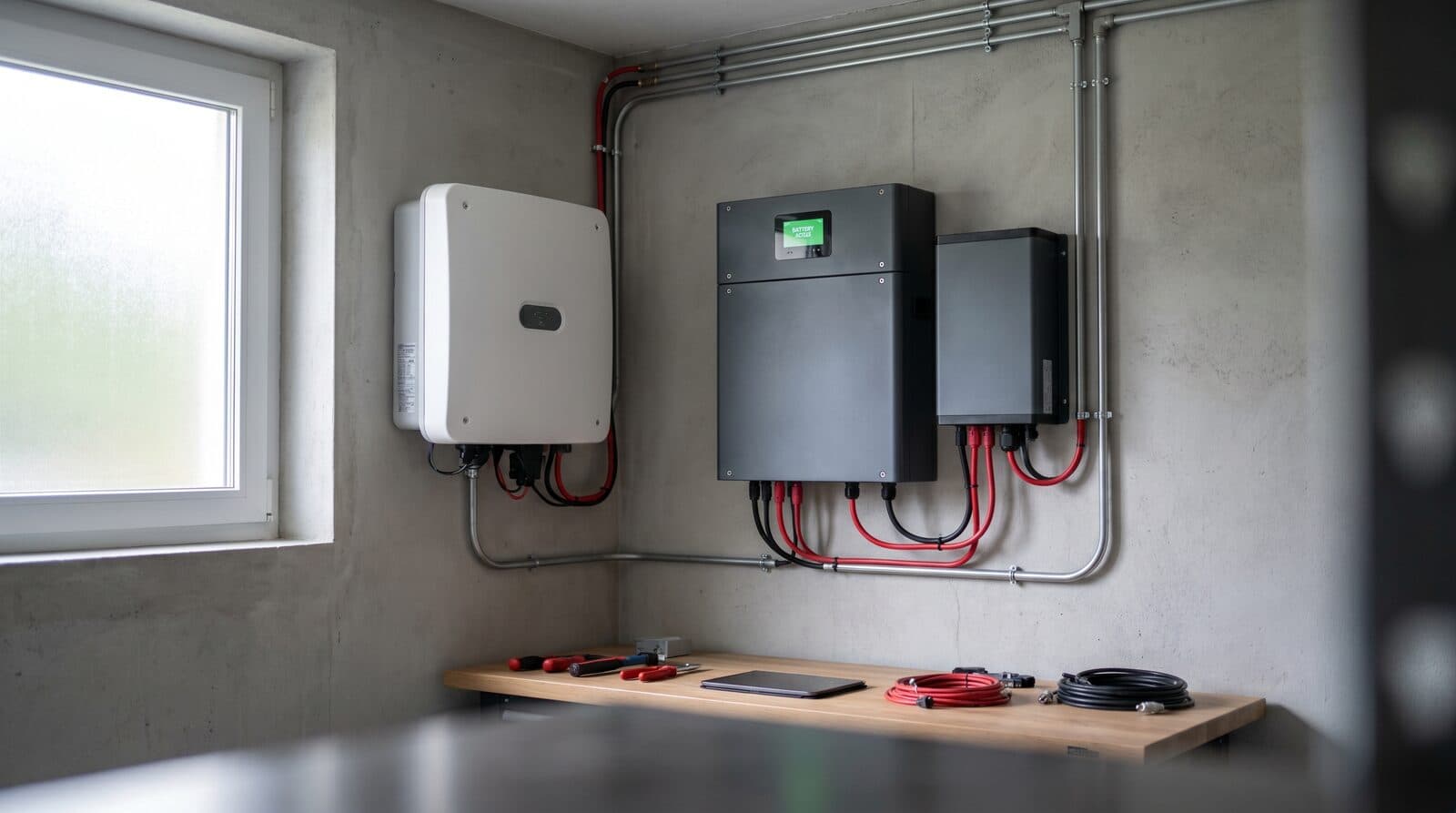
Can you add a battery to an existing solar system?
Yes — you can almost always add battery backup to an existing grid-tied solar system, and millions of homeowners are doing exactly that. There are two ways to do it: AC-coupling, where you keep your existing solar inverter and add a separate battery inverter beside it, and DC-coupling, where you replace your solar inverter with a single hybrid inverter that handles both panels and batteries. Which one is right depends on the age of your inverter, your budget, and how much efficiency you want to squeeze out of the system.
This question has become urgent. In Ukraine, where rolling blackouts are a daily reality, the reason people buy solar has flipped — from earning money on the green tariff to simply keeping the lights, fridge, internet, and water pump running when the grid goes down. The same shift is happening worldwide: 2026 is the year of the storage boom, and a huge share of it is retrofitting batteries onto systems that were installed without them. This guide walks through both retrofit paths in plain language so you can choose the one that fits your home.
The one decision that drives everything
Why grid-tied solar goes dark when the grid fails
Here is the surprise that catches most people off guard: a standard grid-tied solar system shuts down completely during a blackout, even at noon on a sunny day. This is not a fault — it is a deliberate safety feature called anti-islanding. A plain grid-tied (on-grid) inverter has no battery and uses the grid's own voltage and frequency as its reference signal. When the grid disappears, the inverter loses that reference and switches off within milliseconds, so it cannot feed electricity into power lines that utility crews believe are dead.
A battery is what breaks this dependency. Add storage with a battery-capable inverter and the system can form its own stable island — a local mini-grid that powers your home from the battery and panels while staying safely disconnected from the utility lines. That is the whole point of a retrofit: not just to store cheap daytime energy, but to keep essential loads alive when the grid is down. The hardware that creates the island is either a dedicated battery inverter (AC-coupling) or a hybrid inverter (DC-coupling).
Not every battery-ready system is backup-ready
AC-coupling vs DC-coupling: the two retrofit paths
Every battery retrofit is either AC-coupled or DC-coupled, and the names describe where the battery connects. In an AC-coupled system the battery has its own inverter and joins on the household AC side, alongside your existing solar inverter — nothing about your panels changes. In a DC-coupled system the battery sits on the DC side and is managed by a hybrid inverter that replaces your old solar inverter entirely. The table below compares the two on the points that actually affect your decision.
| Aspect | AC-coupled | DC-coupled (hybrid) |
|---|---|---|
| Existing inverter | Keep it | Replace with a hybrid |
| Install effort | Lower — add one box | Higher — swap + rewire |
| Typical added cost | Lower for a retrofit | Higher (new inverter) |
| Round-trip efficiency | ~90–94% | ~96–98% |
| Recovers clipped solar | No | Yes |
| Best for | Newer inverter, simple add-on | Old inverter, max efficiency |
A quick rule of thumb
AC-coupling: keep your inverter, add a battery inverter
AC-coupling is the simplest way to add storage to a system that was never designed for it. Your existing solar inverter keeps doing its job — converting panel DC into household AC. You add a second device, a battery inverter/charger (such as a Victron MultiPlus, Sol-Ark, or an AC-coupled Deye unit), that sits on the AC side. It charges the battery from surplus solar or the grid, and during an outage it disconnects from the utility and powers your home from the battery.
The AC-coupled energy path (and why it costs a little efficiency)
DC panels → AC (solar inverter) → DC (charger) → battery → AC (battery inverter) → home ≈ 90–94%Each conversion between DC and AC loses a little energy as heat, which is why an AC-coupled round trip lands around 90–94%. In exchange you get the easiest possible retrofit: your panels, wiring, and solar inverter are untouched, your existing warranty stays intact, and you can even add storage in phases. AC-coupling also works for systems you cannot easily change — including microinverter arrays, where each panel has its own inverter on the roof.
The trade-offs are the extra box on the wall, two inverters to maintain instead of one, and that efficiency penalty. There is also a sizing rule unique to AC-coupling: the battery inverter must be able to absorb the solar inverter's output during an outage, because in island mode the solar inverter has nowhere else to send its power. As a rough guide, the battery inverter's continuous rating should be at least as large as the solar inverter it is backing up.
AC-coupling is the natural fit for microinverters
DC-coupling: replace your inverter with a hybrid
DC-coupling takes a different approach: you remove your existing solar inverter and install a single hybrid inverter (such as a Deye SUN, Growatt SPH, Sungrow SH, or Huawei SUN2000 with a battery module) that manages panels and battery together. Because the battery charges directly from the panels' DC output — with only one DC-to-AC conversion when you actually use the energy — round-trip efficiency is higher, typically 96–98%. A DC-coupled battery can also capture solar energy that a plain inverter would clip and throw away on sunny days, storing it instead of wasting it.
The catch is that you are replacing a working inverter, which means more cost, more rewiring, and usually a new permit and grid-connection approval. There is also a compatibility step that is easy to miss — and this is where it bites: your panels were sized to your old inverter's voltage window, but the new hybrid almost certainly has a different MPPT and maximum-voltage range. Before you commit, you must re-check that your existing string still fits the new inverter at temperature extremes.
Re-verify your existing string against the new hybrid
Voc(coldest day) × panels ≤ hybrid Vmax AND Vmpp(hottest day) × panels ≥ hybrid MPPT minIf your string's cold-morning open-circuit voltage exceeds the new inverter's maximum, you can destroy it the first frosty sunrise. If the hot-day operating voltage drops below the hybrid's MPPT floor, you lose production every summer afternoon. This is exactly the check Solar Stack's calculator runs — drop in your existing panel and the new hybrid model and it confirms the string still fits before you buy.
DC-coupling shines when your inverter is already aging
Re-check your string fits the new hybrid
Swapping to a hybrid? Enter your existing panel and the new inverter — the calculator verifies Voc, Vmpp, and MPPT range at your local temperatures.
Which coupling should you choose? A 4-step guide
Run through these four questions in order. Each one narrows the choice until a clear winner emerges for your home.
- Step 1: How old is your solar inverter?
If it is 7+ years old or out of warranty, lean DC-coupled — you will need a new inverter soon anyway, so make it a hybrid. If it is recent and healthy, lean AC-coupled to protect that investment.
- Step 2: Do you have microinverters or a string inverter?
Microinverter arrays (panel-level inverters on the roof) are almost always AC-coupled — there is no central DC bus to connect a battery to. A single string inverter can go either way.
- Step 3: How much do you value efficiency and clipping recovery?
If your array regularly out-produces your inverter on sunny days (a high DC-to-AC ratio) or you want the highest round-trip efficiency, DC-coupling recovers energy AC-coupling cannot. For modest arrays the 4–6% efficiency gap is minor.
- Step 4: How disruptive a job can you accept?
AC-coupling adds one box and rarely touches your existing wiring or permit. DC-coupling means swapping the inverter, re-running cables, and usually a fresh grid-connection approval. If minimal disruption and keeping your warranty matter most, AC-coupling wins.
The simplest rule
How much battery (and inverter) do you actually need?
For most retrofits the goal is backup, not total independence — so you size the battery around your critical loads, the handful of circuits that must stay alive during an outage: refrigerator, lights, internet router, phone charging, and in many homes a water pump or gas-boiler controller. Backing up only the essentials, rather than the whole house, is what keeps a retrofit affordable. The duration a battery delivers comes from one simple relationship:
Backup duration
Backup hours = usable battery capacity (Wh) ÷ average load (W)Battery capacity sets how long you last; inverter power sets how much you can run at once — they are independent. A big battery behind a small inverter still cannot start a well pump or air conditioner, and a big inverter behind a small battery dies in minutes. Size both: the battery for the hours of autonomy you want, and the backup inverter for your peak simultaneous load, including the surge that motors and pumps draw on startup.
A worked example for an overnight blackout
Size your battery bank properly
Our battery sizing guide walks through daily energy, days of autonomy, depth of discharge, and chemistry — with the full formula and worked examples.
What does a battery retrofit cost in 2026?
Battery prices fell sharply through 2025–2026, but a retrofit is more than just the battery — it includes the inverter (or battery inverter), electrical work, and permits. The table below shows typical United States ranges; figures are lower across much of Europe and vary widely in Ukraine, where many installs are driven by resilience rather than payback. Use it to understand the components, not as an exact quote.
| Component | Typical cost (USD, 2026) | Notes |
|---|---|---|
| Battery (10 kWh LiFePO4) | $4,000–8,000 | Largest line item; scales with kWh |
| Battery or hybrid inverter | $1,000–3,000 | AC-coupling adds one; DC-coupling replaces yours |
| Electrical & wiring | $500–2,000 | Backup panel, rewiring; older homes cost more |
| Permit & inspection | $300–1,000 | Varies by region; some areas waive it for storage |
| Total after incentives | $6,000–12,000 | With the U.S. 30% federal tax credit applied |
In Ukraine, the math is about resilience, not just ROI
Backup power vs full off-grid autonomy
It is worth being precise about what you are buying, because two very different goals get blurred together. Backup power keeps you grid-connected and uses the battery to ride through outages, covering critical loads for hours; it needs a modest battery and is what most retrofits aim for. Full autonomy (going off-grid) means disconnecting from the utility entirely and meeting 100% of your needs from solar and storage through every cloudy stretch — which demands a much larger battery, a generator for backup, and far more money.
For a home that already has a grid connection, backup is almost always the right target. A retrofit that covers your essentials through a typical blackout costs a fraction of a true off-grid build and still delivers the security people actually want. You can always expand later — both AC- and DC-coupled systems let you add battery modules as your budget and needs grow. Chasing full autonomy on a grid-connected home usually means paying several times more for a few extra hours you will rarely use.
Most people want backup, and think they want off-grid
Choosing a hybrid inverter? Start here
Our inverter guide covers sizing, types, MPPT inputs, and how to match an inverter to your panels and battery plans.
5 common battery retrofit mistakes
Most retrofit regrets come from a short list of avoidable errors. Check your plan against these before you spend anything.
- Forgetting to re-check the string after a hybrid swap
The most dangerous DC-coupling mistake. Your panels were sized to the old inverter; the new hybrid has a different voltage window. Skip the re-check and a cold, sunny morning can push your string's open-circuit voltage past the new inverter's limit and destroy it. Always re-verify Voc and Vmpp at your local temperature extremes before powering up.
- Sizing the inverter for backup instead of the battery
Backup duration comes from battery capacity, not inverter power. A 10 kW inverter with a 5 kWh battery still only delivers about 30 minutes at full load. If you want longer backup, buy more kWh of battery — not a bigger inverter.
- Pairing a battery the inverter does not support
Hybrid and battery inverters only talk to batteries on their approved list. Even when voltages match, the BMS communication protocol (CAN or RS485) must be a recognised match, or the battery and inverter will not coordinate charging and protection. Always cross-check both the inverter's approved-battery list and the battery's approved-inverter list.
- Skipping the backup port on an AC-coupled battery inverter
AC-coupling spares you the MPPT re-check, but it has its own trap: buying a battery inverter without a backup / EPS output, or one too small to absorb your solar inverter in island mode. Confirm the battery inverter has a backup output and a continuous rating at least equal to the solar inverter it backs up.
- Ignoring permits and grid-code rules for storage
Adding a battery usually requires utility notification or a permit, and many regions have specific rules for energy storage (anti-islanding certification, backup wiring, disconnects). Skipping this can void insurance or force an expensive redo. Check local requirements before installation, not after.
Find a hybrid inverter for your panels
Use the matcher to filter inverters by type and battery support, and confirm they are compatible with your existing panels.
Frequently asked questions
Can I add a battery to any existing solar system?
Almost always, yes. String-inverter systems can be AC-coupled (add a battery inverter) or DC-coupled (replace the inverter with a hybrid). Microinverter systems are AC-coupled with a dedicated battery inverter or a matched AC battery. The rare exceptions are very old or proprietary inverters with no compatible battery path — but even then, AC-coupling a separate battery inverter usually works.
Do I have to replace my inverter to add a battery?
No. With AC-coupling you keep your existing solar inverter and add a separate battery inverter beside it — the simplest and often cheapest retrofit. You only replace the inverter if you choose DC-coupling (a hybrid), which makes sense mainly when your current inverter is old or you want maximum efficiency.
Is AC-coupling or DC-coupling better for a retrofit?
For most retrofits onto a healthy, recent inverter, AC-coupling is better: it is simpler, keeps your warranty, and avoids replacing working hardware. DC-coupling (a hybrid) is better when your inverter is near end-of-life, when you want the highest round-trip efficiency (96–98% vs 90–94%), or when you want to recover clipped solar on a high-ratio array.
How much does it cost to add a battery to solar in 2026?
In the United States, a typical retrofit runs $9,000–18,000 before incentives and about $6,000–12,000 after the 30% federal tax credit, including the battery, inverter, electrical work, and permits. Costs are generally lower across Europe. The battery itself is the largest line item and scales with capacity.
Will my solar work during a blackout after I add a battery?
Yes — provided the battery inverter or hybrid has a backup (EPS/UPS) output. The battery lets the system form a safe local island that powers your home while staying disconnected from the grid, so your panels keep charging the battery by day. Without a backup output, the system stores energy but still shuts down during outages, so confirm this feature before buying.
How much battery do I need for blackout backup?
Size it around your critical loads. A common essentials load — fridge, lights, internet, phone charging, and a cycling water pump — is roughly 300–400 W, which a usable 5 kWh LiFePO4 battery powers for about 12–16 hours and recharges from solar the next day. Add heating, cooking, or air conditioning and you need far more. See our battery sizing guide for the full method.
Can I add a battery to a microinverter system?
Yes, with AC-coupling. Microinverters convert to AC on the roof, so there is no central DC bus for a hybrid. You add a battery inverter on the AC side, or a matched AC battery designed for microinverter systems (for example, the Enphase IQ Battery for Enphase arrays). DC-coupling is not an option for microinverter homes.
Does adding a battery pay for itself?
It depends on why you are adding it. Where electricity is cheap and the grid is reliable, the financial payback can be long. But where power is expensive, time-of-use rates are steep, or — as in Ukraine — blackouts are frequent, the value is resilience and self-consumption rather than pure ROI. Under export schemes like Net Billing that credit surplus at market price, storing and using your own energy is usually worth more than exporting it.


Discussion
Sign in to join the discussion
We require a quick sign-in to keep this thread free of spam.
No comments yet. Be the first to share your experience.