Solar Panel Dimensions and Weight Explained
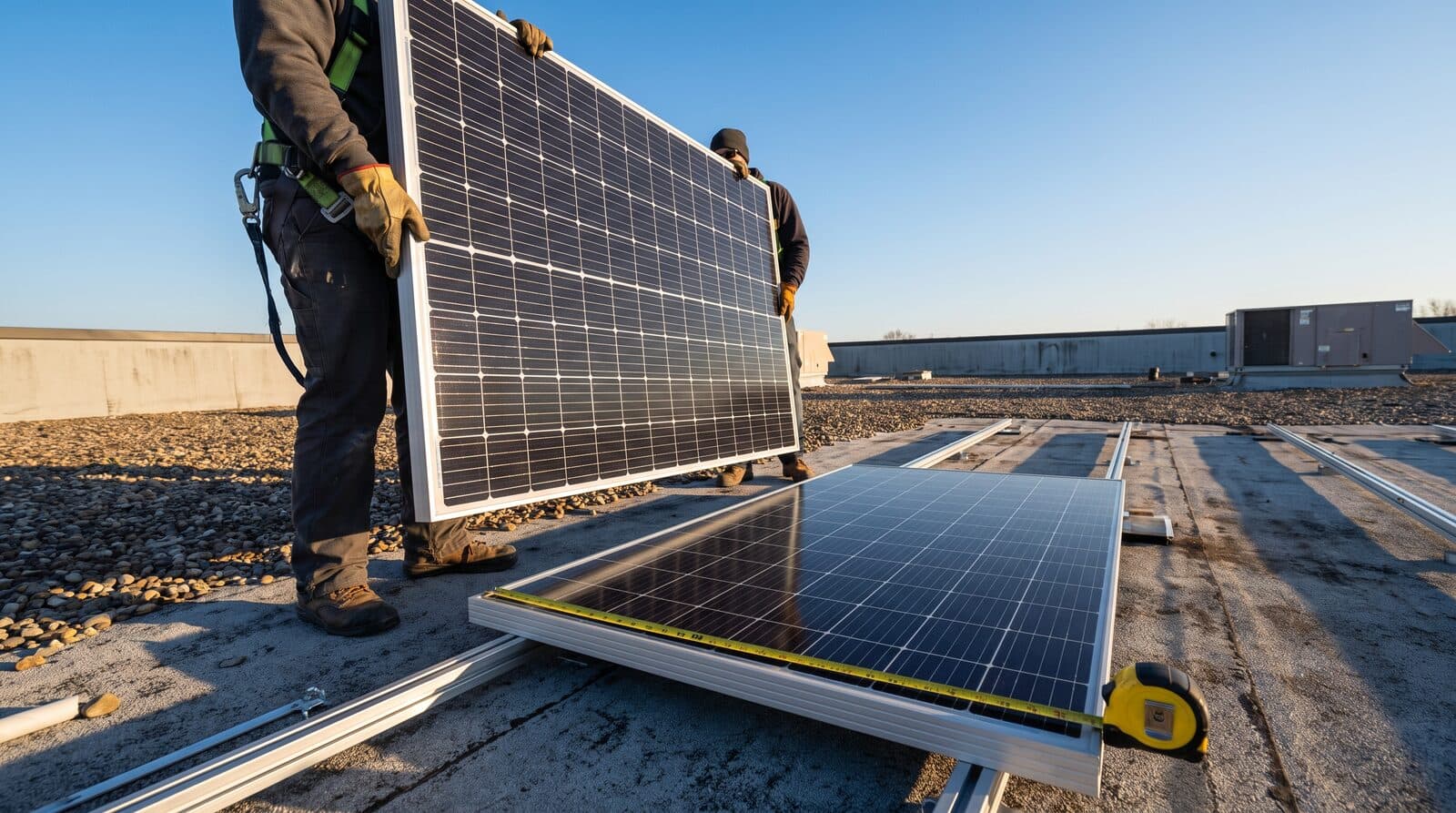
The short answer: three numbers cover almost every panel
A modern solar panel is 1134 mm wide, 30 mm thick, and weighs about 11–12 kg for every square metre of surface. Those three numbers describe the large majority of panels sold today. What actually changes between a 400 W panel and a 700 W panel is the length — and therefore the weight. Here are the three size classes you will meet in practice, measured across 542 real panel series in our equipment database.
| Class | Size (L × W) | Weight | Typical power |
|---|---|---|---|
| Compact residential | 1722–1800 × 1134 mm | 20–26 kg | 390–510 W |
| Large / commercial | 2278–2382 × 1134 mm | 26–34 kg | 515–710 W |
| Utility wide-body | 2384 × 1303 mm | 32–41 kg | 600–770 W |
Notice what is missing from that table: variety in the width column. Two of the three classes are exactly the same width, and the third is the only common alternative. Panel width is not a design choice that manufacturers tune freely — it is locked to the size of the silicon wafer inside. That is the single most useful thing to understand about panel dimensions, and it is where we start.
Where these numbers come from
Why panel width barely changes: it is wafer arithmetic
Of the 542 panel series we measured, 442 — just over 81% — are exactly 1134 mm wide. Another 61 are 1303 mm. Everything else combined accounts for fewer than 40 series, and most of those are speciality products: narrow panels for vehicles, small off-grid modules, and custom glass for greenhouses.
The reason is that a panel's width is not chosen by the panel designer. It is the sum of the cells sitting side by side across the panel, plus the aluminium frame around them. Almost every mainstream panel puts six cells across, and the silicon wafers those cells are cut from come in a small number of industry-standard sizes.
Panel width
Width = 6 × wafer size + frame ≈ 6 × 182 mm + 42 mm = 1134 mmThe dominant wafer standard is 182 mm, usually called M10. Six of them side by side is 1092 mm, and the frame and edge sealant add roughly 21 mm on each side. That produces 1134 mm — not approximately, but exactly, on hundreds of panels from dozens of unrelated manufacturers. The larger 210 mm wafer standard, called G12, produces the other common width:
6 × 210 mm + 43 mm = 1303 mmThis is why panels from Jinko, LONGi, Trina, JA Solar and Canadian Solar can be swapped on the same mounting rails despite being entirely different products. They are not copying each other's dimensions out of courtesy — they are all buying wafers from the same standardised supply chain, and six wafers plus a frame comes to the same number for everyone.
Why there is nothing in between
Why length varies: cell rows are the power lever
If width is fixed, length is the only dimension left to change — and it is how manufacturers build a more powerful panel. Add more rows of cells and you add both power and voltage. A panel's length is roughly the number of cell rows multiplied by the height of each cell, plus frame and junction-box margins.
Panel length (approximate)
Length ≈ rows × cell height + frame margin (80–125 mm)Modern panels use half-cut cells: each wafer is sliced in half, which halves the current through each cell and cuts resistive losses. So a panel described as "108 cells" holds 108 half-cells — 54 full wafers in 6 columns of 9, each row split into two. That gives 18 rows of half-cells, and with 182 mm wafers each half-cell is about 91 mm tall. Eighteen rows comes to roughly 1638 mm, and the frame brings the finished panel to the 1722–1762 mm you see on datasheets.
Step up to 144 half-cells and you have 24 rows instead of 18 — about 2278 mm long. That is the same 1134 mm width, the same 30 mm frame, the same mounting hardware, but a panel that is 550 mm longer and produces roughly 150 W more. Length is the dial manufacturers turn, and every extra millimetre of length is extra weight to carry up a ladder.
Do not calculate a panel's length yourself
How cell count shapes voltage and power
A deeper look at 60, 72, 108, 120 and 144-cell panels and what the count means for string sizing.
Do panel sizes fit shipping containers?
You will often hear that solar panel dimensions were chosen so the panels fit shipping containers. That is half right — and the half that is true is the more interesting one. Container space does not explain the width; that is wafer arithmetic, as we just saw. What it explains is the ceiling on length.
A 40-foot high-cube container has roughly 12032 mm of internal length, 2352 mm of width and 2698 mm of height. Panels travel stacked flat in pallets, and datasheets state exactly how many pallets fit in a container. Run the arithmetic on two real frames and the packing turns out not to be approximate at all:
| Frame | Pallet length | Rows × across × layers | Datasheet states |
|---|---|---|---|
| 2382 × 1134 mm | 2400 mm | 5 × 2 × 2 = 20 | 20 pallets per 40 ft |
| 1960 × 1134 mm | 1980 mm | 6 × 2 × 2 = 24 | 24 pallets per container |
Both use 98.7–99.7% of the container's length, and both match their datasheet exactly. A second manufacturer with a different 2382 mm panel independently reports 740 modules at 37 per pallet — 20 pallets again. Now look at what happens just past that length:
Pallet rows in a 40-foot high-cube
12032 ÷ 2402 = 5 rows · 12032 ÷ 2420 = 4 rowsEighteen millimetres of extra panel length costs a fifth of the container. That is the cliff, and the most common large frame on the market — 2382 mm — sits right on the edge of it. It also explains something visible in our own data: the 2465 mm class has only about 22 series against roughly 117 for the 2382 and 2384 mm frames. Past the five-row limit there is little reason to build.
The myth, corrected
The two width families: 1134 mm and 1303 mm
Because there are two mainstream wafer standards, there are two panel width families. Choosing between them is more consequential than the 169 mm difference suggests — it decides which mounting hardware, which roof layouts and which handling methods apply to your whole array.
| Family | Wafer | Panel width | Share of series | Typical use |
|---|---|---|---|---|
| M10 | 182 mm | 1134 mm | 442 of 542 (82%) | Homes, commercial roofs, most ground mounts |
| G12 | 210 mm | 1303 mm | 61 of 542 (11%) | Utility-scale ground mounts, large flat roofs |
The 1134 mm family is the safe default. It has the widest model choice, the cheapest and most available mounting hardware, and the best chance of a compatible replacement panel being on the market in ten years. Nearly every residential installation uses it.
The 1303 mm family exists because a wider panel captures more power per panel, which cuts the per-panel cost of racking, wiring and labour on very large projects. That advantage only pays off at scale. On a house roof the wide panels are harder to handle, harder to fit around obstructions, and average 37.0 kg against 27.2 kg for the narrow family — a real difference when two people are lifting them onto a pitched roof.
Mounting hardware is width-specific
Solar panel size reference table
These are the fourteen most common frames in our database, filtered to the seven that account for most of the market. Each row is a real frame size shared by many series from different manufacturers, with the true weight and power ranges recorded on their datasheets.
| Frame (L × W mm) | Cells | Area | Weight | Power range |
|---|---|---|---|---|
| 1722 × 1134 | 108 | 1.95 m² | 20.3–24.7 kg | 390–460 W |
| 1762 × 1134 | 96 | 2.00 m² | 20.0–25.0 kg | 430–485 W |
| 1800 × 1134 | 108 | 2.04 m² | 21.0–26.0 kg | 440–510 W |
| 2278 × 1134 | 144 | 2.58 m² | 26.3–32.5 kg | 515–630 W |
| 2382 × 1134 | 132 | 2.70 m² | 27.5–39.7 kg | 590–690 W |
| 2384 × 1303 | 132 | 3.11 m² | 32.2–41.0 kg | 600–770 W |
| 2465 × 1134 | 156 | 2.80 m² | 29.5–35.0 kg | 560–680 W |
Read down the width column again: six of the seven most common frames in the entire market share one number. If you are designing a roof layout, the width is effectively a constant and the length is your only real variable.
Filter real panels by size and weight
Browse our panel database with sliders for length, width and weight — every dimension in this article is filterable.
Why weight tracks area, not wattage
People assume a more powerful panel is a heavier panel. That is only true because more powerful panels tend to be larger. Weight itself is almost entirely a function of surface area, because the front glass is by far the heaviest component — heavier than the cells, the frame, the backsheet and the junction box combined.
Panel weight estimate
Weight ≈ area (m²) × 11.7 kg/m²Across all 542 series the average is 11.7 kg per square metre, and the bulk of the market sits between 10 and 13. That makes the estimate genuinely useful. Take the most common large frame, 2278 × 1134 mm:
2.278 m × 1.134 m = 2.58 m² → 2.58 × 11.7 = 30.2 kgThe real weights recorded for that frame run from 26.3 to 32.5 kg, so the estimate lands close to the middle. The practical consequence is the useful part: within one frame size, a 630 W panel weighs essentially the same as a 515 W panel. Higher efficiency is free in weight terms. You get the extra power without any extra load on the roof or any extra difficulty carrying it.
Buy efficiency, not size, when weight matters
Glass-glass versus glass-backsheet: the weight penalty
The biggest single variable in panel weight, once area is accounted for, is what the back of the panel is made of. Traditional monofacial panels use a thin polymer backsheet. Bifacial panels — which generate from both faces — need transparent glass on the back instead, so they carry two panes instead of one.
Averaged over all our series, monofacial panels come in at 10.9 kg/m² and bifacial glass-glass panels at 12.0 kg/m². Comparing identical frames makes the difference concrete:
| Frame (mm) | Monofacial | Glass-glass | Penalty |
|---|---|---|---|
| 1722 × 1134 | 21.3 kg | 22.3 kg | +1.0 kg |
| 1762 × 1134 | 22.2 kg | 23.4 kg | +1.2 kg |
| 2278 × 1134 | 27.8 kg | 31.0 kg | +3.2 kg |
| 2382 × 1134 | 29.0 kg | 32.7 kg | +3.7 kg |
The penalty grows with area, exactly as you would expect from a per-square-metre effect: 1 to 1.2 kg on a compact residential panel, but nearly 4 kg on a large commercial one. On a small roof it is negligible. On a 30-panel array of large glass-glass modules it adds over 100 kg to the roof, which is worth mentioning to whoever checks your structure.
The extra glass buys durability too
Thickness: why almost every panel is 30 mm
Frame thickness is the most standardised dimension of all. Of the series we measured, 408 — more than three-quarters — are exactly 30 mm thick. The next most common values are 35 mm (54 series) and 33 mm (44 series), then 28 mm (18 series). The entire mainstream market sits in a 25–35 mm band.
The reason is not structural, it is commercial. Mounting clamps grip the panel frame, and every mid-clamp and end-clamp on the market is manufactured for a specific jaw range. A frame outside 30–35 mm would need bespoke clamps, so manufacturers converged on the thickness the existing hardware ecosystem already fits. The frame is deep enough to give the glass rigidity against wind and snow load, and no deeper, because aluminium is expensive.
A thicker frame does buy something real: higher mechanical load ratings. Panels rated for heavy snow often use 35 mm frames, and the datasheet will state the front and rear load figures in pascals. If you are installing somewhere with serious snow, that number matters more than the thickness itself.
Check clamp compatibility before you buy
Thin does not mean light
It is tempting to read thickness as a proxy for weight. It is not. The most striking example in our whole database is a frameless glass-glass panel measuring just 7.2 mm thick — a quarter the thickness of a standard panel — that weighs 32 kg on a 1729 × 1140 mm footprint. At 16.2 kg/m² it is among the heaviest panels per square metre we have on record.
That inversion makes sense once you know where the mass is. The aluminium frame is a small fraction of a panel's weight; the glass is most of it. Removing the frame saves a couple of kilograms but takes away the stiffness the frame provided, so a frameless panel needs thicker glass on both faces to survive wind and snow. You trade a light frame for heavy glass and end up heavier overall.
Frameless panels exist for good reasons — they suit glass facades, carports, greenhouses and canopies where the panel is clamped into a structural glazing system rather than bolted to rails. But they are a specialist choice, not a lightweight one, and they need mounting systems designed for glazing rather than standard PV clamps.
The genuinely light options
What panel size and weight mean for your project
Dimensions stop being trivia the moment you order panels. Five places where they decide the outcome:
- Handling: 25 kg is the practical one-person limit
European manual-handling guidance puts around 25 kg as the ceiling for a single person lifting close to the body — and a solar panel is nothing like close to the body. In our database 207 series (38%) come in at 25 kg or under, 176 (32%) sit between 25 and 32 kg, and 159 (29%) exceed 32 kg. Anything over 25 kg is a genuine two-person lift; over 32 kg on a pitched roof, use a lifting aid or panel hooks.
- Roof load: think in kg per square metre
Your structure does not care what one panel weighs, it cares about distributed load. At 11–12 kg/m² for the panels plus roughly 3–5 kg/m² for rails and clamps, a typical array adds about 15–18 kg/m². That is modest compared with most roof design allowances, but a large glass-glass array on an old or lightly built roof deserves a structural opinion rather than an assumption.
- Layout: length is what fails to fit
Because width is effectively fixed, roof layout problems are almost always length problems. Measure your usable roof area, subtract fire-access and edge setbacks, then check whether your rows divide cleanly by panel length in both portrait and landscape. Switching from a 2382 mm panel to a 1762 mm one can fit an extra row where a longer panel wastes a metre of roof.
- Access: the panel has to reach the roof
A 2384 mm panel is nearly two and a half metres long. It will not go up a tight stairwell, round a loft hatch, or inside a hatchback. Check the route from the delivery vehicle to the roof before ordering large-format panels — this is a common and expensive surprise on retrofits and balcony installations.
- Replacement: the new panel must fit the old rails
If you are replacing a failed panel years later, the electrical match matters but so does the frame. A replacement in the same width family and a similar length drops onto the existing rails; a different width family means re-drilling and re-positioning rails for one panel. Check the frame dimensions alongside the voltage and current.
Replacing a panel that is no longer made
How to find an electrically and physically compatible replacement when your original model is discontinued.
See every panel under 25 kg
A pre-filtered list of one-person-liftable panels from our database, with full dimensions on every model.
Frequently asked questions
What is the standard size of a solar panel?
There is no single standard, but there is a standard width: 1134 mm, on 82% of the panel series we measured. Lengths cluster around 1722–1800 mm for residential panels (390–510 W) and 2278–2382 mm for large and commercial panels (515–710 W). Thickness is 30 mm on more than three-quarters of panels.
How much does a solar panel weigh?
Between about 20 and 41 kg for mainstream panels, depending almost entirely on size. A good estimate is area in square metres × 11.7 kg. A typical residential panel of roughly 2 m² weighs 20–26 kg; a large commercial panel of 2.6–3.1 m² weighs 30–41 kg.
Why are all solar panels the same width?
Because width equals six silicon cells side by side plus a frame, and cells are cut from wafers that come in standardised sizes. Six 182 mm wafers plus a 42 mm frame gives 1134 mm. There is no wafer size that would produce an intermediate width, so no manufacturer builds one.
What size solar panel is best for a house roof?
For most homes a 1722–1800 × 1134 mm panel of 390–510 W is the practical sweet spot. It stays under or near the 25 kg one-person lift limit, fits standard rails, divides neatly into typical roof dimensions, and has the widest choice of models and replacements. Larger panels make more sense on big unobstructed roofs and ground mounts.
How much does a 600 W solar panel weigh?
Typically 27–33 kg. Panels in that power class use frames around 2382 × 1134 mm or 2384 × 1303 mm, and the wider version is heavier — up to 41 kg. Note that a 600 W panel and a 690 W panel in the same frame weigh nearly the same, because weight follows area rather than power.
Are bifacial panels heavier than regular panels?
Yes, but not by much. Bifacial panels use glass on both faces instead of a polymer backsheet, which adds roughly 1 kg/m². On identical frames we measured penalties from +1.0 kg on a compact residential panel to +3.7 kg on a large commercial one. The extra glass often comes with a longer product warranty.
Can I put large commercial panels on my house?
Physically often yes, practically usually not worth it. Large-format panels weigh 32–41 kg, need two people or lifting equipment, may not fit up your stairs or around roof obstructions, and require the wider 1303 mm rail layout if you choose that family. The per-panel savings that justify them on utility projects do not apply on a house-sized array.
Do thinner panels weigh less?
No — thickness is a poor predictor of weight. The thinnest panel in our database is a 7.2 mm frameless module, and it is also among the heaviest per square metre at 16.2 kg/m², because removing the frame requires thicker glass on both faces. Conversely, the lightest panels we hold — down to 4.3 kg/m² — are standard 30 mm thick, and are light because they use thinner glass or none at all. Judge weight by the datasheet figure, not the frame profile.
Check your panels against your inverter
Once you have chosen a panel size, verify the string voltage and current fit your inverter at real temperature extremes.


Discussion
Sign in to join the discussion
We require a quick sign-in to keep this thread free of spam.
No comments yet. Be the first to share your experience.