Balcony Solar: Which Panels Fit an 800 W Microinverter
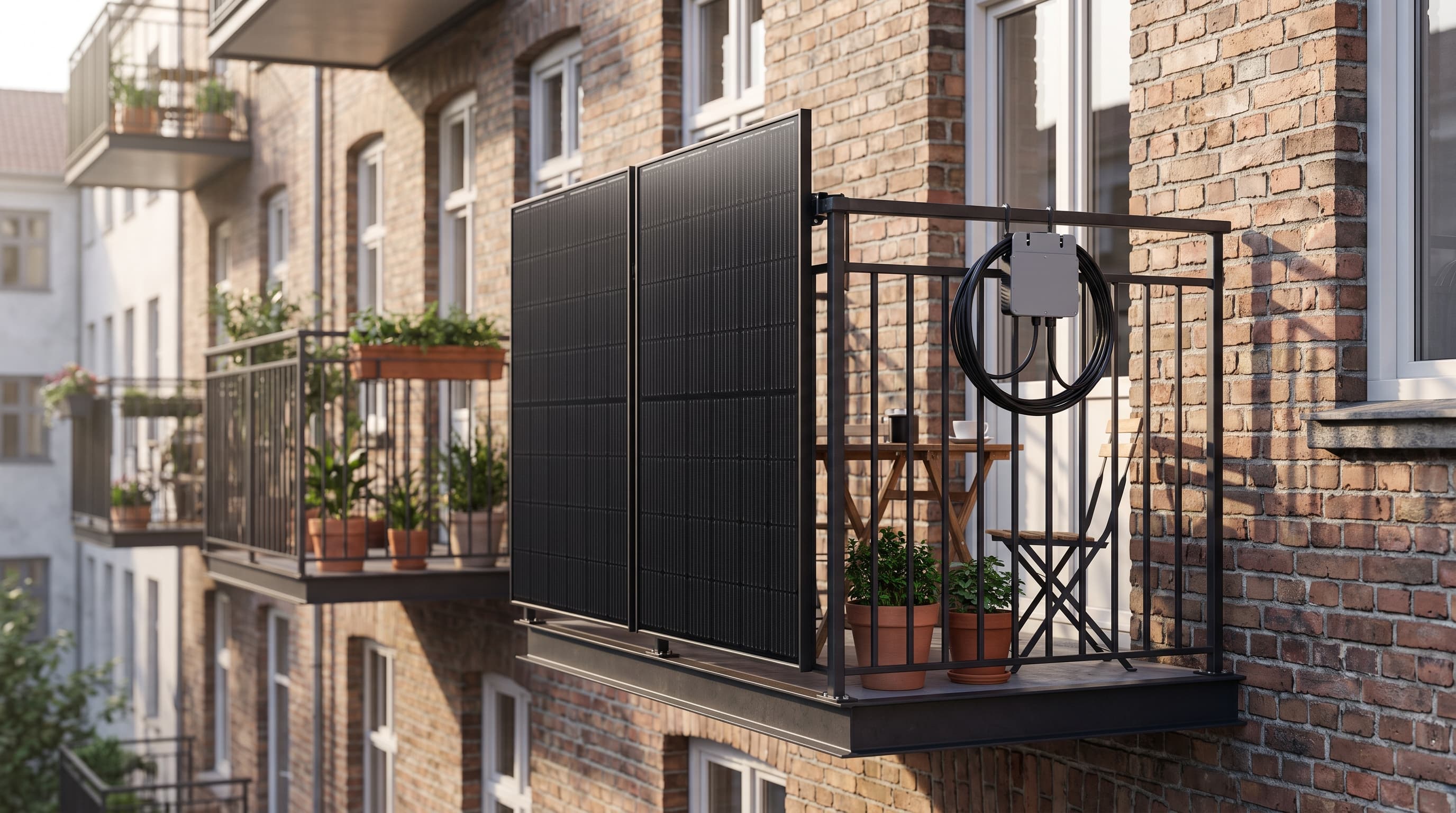
What an 800 W balcony solar kit actually is
A balcony or plug-in solar kit is one to four panels feeding a microinverter whose AC output is capped, plugged into an ordinary wall socket. The cap sits on the inverter, not on the panels: Germany limits the inverter to 800 W but allows 2,000 Wp of modules behind it, the UK allows four panels up to 2,000 W behind an 800 VA inverter, and most US state laws stop at 1,200 W. Whether a given panel works with a given microinverter is decided by four numbers on the inverter's datasheet, not by the wattage printed on the box.
The rules below are what applied in September 2026. Spain and Portugal fold small kits into their general self-consumption procedures (RD 244/2019 in Spain, the UPAC regime in Portugal). Ukraine and India have no plug-in category at all, so a grid-tied kit there follows the ordinary connection process, and many owners run the kit off-grid through a power station instead.
| Where | Inverter cap | Panel cap | Procedure |
|---|---|---|---|
| Germany | 800 W AC | 2,000 Wp; Schuko plug up to 960 Wp (DIN VDE V 0126-95) | Register in the MaStR only; landlords cannot refuse (Solarpaket I) |
| Austria | 800 W AC | No separate module cap | Notify the grid operator, register with E-Control |
| United Kingdom | 800 VA (3.5 A) | 4 panels, 2,000 W | Legal since 27 August 2026; G98 notification, one kit per property |
| United States | 1,200 W in most state laws | Set by the kit's listing | Nine states so far (Utah first, HB 340); UL 1741 inverter, UL 3700 kit |
| Greece | 800 W AC, no export | — | Framework of September 2026: self-consumption only, smart meter required |
| Netherlands | 800 W kits | — | No registration; notifying the grid operator is recommended |
| France | 800 W kits | — | Online declaration to the grid operator, fast approval |
| Italy | 800 W AC | — | One-step notification to the distributor |
| Poland | No plug-in category | — | Full micro-installation notification, meter swap, contract amendment |
Three things are true in every one of those markets: the cap is measured at the inverter's AC terminals, the kit must be a certified whole (inverter, cables, plug), and nothing in the rules checks whether your panels electrically fit the inverter. That last part is on you, and it is what the rest of this guide is about.
Rules move every year
Why a microinverter is sized differently from a string inverter
A string inverter takes 8 to 20 panels wired in series: their voltages add up to several hundred volts, and every compatibility check is about that sum. A microinverter takes one panel per input, runs a separate MPPT on each input, and puts out AC that simply adds in parallel. There is no string. The whole question collapses to: does this one panel fit this one input?
That makes the sizing easier in one way and stricter in another. Easier, because you never add voltages. Stricter, because a microinverter input is small: 55 to 65 V of headroom and 13 to 20 A of current, against 600 to 1,000 V and 15 to 30 A per MPPT on a string inverter. A 700 W panel that a string inverter would swallow without noticing can overload a 13 A microinverter input by a quarter.
Inputs come in three shapes. 1-in-1 units take one panel (Enphase IQ8, Hoymiles HMS-1T). 2-in-1 units are the balcony standard: two independent inputs, two MPPTs, one 600 to 900 W AC output (Hoymiles HMS-2T, Deye SUN-M80G4, APsystems DS3, EcoFlow PowerStream). 4-in-1 units take four panels behind one 800 W output (EcoFlow STREAM Ultra X; Hoymiles HMS-1600-4T at higher power). A handful of designs, such as the Hoymiles MIT-8T, put two panels in series on one 140 V input. Those are the exception, and the datasheet says so explicitly.
Panels per microinverter
panels = inputs × panels per input (2-in-1 with one panel per input → 2)Solar Stack's calculator uses exactly this model. Pick a microinverter and it switches to a per-input mode: it checks one input, meaning its panel or its series pair on the rare designs built for one, against that input's own limits, then multiplies by the number of inputs and units for the system totals.
AC output is the cap, DC input is the fit
The four numbers on a microinverter datasheet
Every microinverter datasheet has a DC input block. Four lines in it decide compatibility: the maximum DC input voltage (a hard limit the panel's cold-morning Voc must never reach), the MPPT voltage range (where the panel's Vmpp has to sit, hot and cold), the maximum input current (the most the MPPT will draw; above it the panel is clipped, not damaged) and the maximum short-circuit current (the most the input can survive; above it the panel does not belong on that input). Many datasheets add a recommended module power per input. Treat it as the wattage ceiling.
| Microinverter | AC (W) | Inputs | MPPT range (V) | Max DC (V) | Max input (A) | Max Isc (A) | Max PV per input (W) |
|---|---|---|---|---|---|---|---|
| Hoymiles HMS-800-2TFind on Amazon | 800 | 2 | 16–60 | 65 | 14 | 25 | 540 |
| APsystems DS3Find on Amazon | 880 | 2 | 32–55 | 60 | 20 | 20 | — |
| Deye SUN-M80G4-EU-Q0Find on Amazon | 800 | 2 | 25–55 | 60 | 13 | 19.5 | 560 |
| Deye SUN-M80G4-EU-Q0-PFind on Amazon | 800 | 2 | 25–55 | 60 | 18 | 27 | 560 |
| EcoFlow PowerStream 800 WFind on Amazon | 800 | 2 | 11–55 | 55 | 13 | 14 | 400 |
| EcoFlow STREAM Ultra X 800 WFind on Amazon | 800 | 4 | 15–60 | 60 | 14 | 20 | 500 |
| SolaX X1-Micro 800 G2Find on Amazon | 800 | 2 | 22–60 | 60 | 14 | 20 | 540 |
| Sungrow S800SFind on Amazon | 800 | 2 | 16–60 | 60 | 16 | 20 | 570 |
| Enphase IQ8HCFind on Amazon | 380 | 1 | 29.5–45 | 60 | 14 | 20 | — |
As an Amazon Associate, Solar Stack earns from qualifying purchases.
The spread is the point. Between the tightest and the widest balcony-class unit in our catalogue, input current runs from 12 to 20 A and the voltage ceiling from 55 to 70 V. A panel that is a perfect match for an APsystems DS3 (20 A, but an MPPT floor of 32 V) can be a poor match for an EcoFlow PowerStream (13 A, 55 V) and a marginal one for a Hoymiles HMS-800 (14 A, 65 V). Our catalogue lists 41 microinverters of 900 W or less; the table shows the ones people actually search for.
'Max input current' is not 'max short-circuit current'
The 60 V line: open-circuit voltage on a cold morning
Voltage is the only number that can actually damage a microinverter. A panel's open-circuit voltage rises as the cell gets colder, by the Voc temperature coefficient on its datasheet, typically −0.23 to −0.30 %/°C for modern TOPCon and HPBC cells. On a clear winter dawn the cells sit at air temperature and the panel is at Voc because the inverter has not started yet. That is the moment the maximum DC input voltage is tested.
Cold-morning Voc (Solar Stack's temperature model)
Voc_cold = Voc_STC × (1 + TcVoc/100 × (T_min − 25))Take three real panels from our catalogue at a −10 °C design minimum. A LONGi LR5-54HTH-440M (108 half-cells, Voc 39.53 V, −0.23 %/°C) reaches 42.7 V: comfortable on every 60 V input. A LONGi LR5-72HTH-585M (144 half-cells, Voc 52.36 V) reaches 56.6 V: under 60 V, but with less than 4 V to spare. An Aiko A800-GRH78Dw (156 cells, Voc 59.32 V) reaches 63.9 V: over the 60 V limit of Deye, EcoFlow, SolaX and Sungrow units, and within 1.1 V of the 65 V limit of the Hoymiles HMS-800. The wattage on the box is 800; the input still cannot take it.
How common is that? Across the 4,435 public panels in our catalogue, 139 exceed 60 V at −15 °C, and 118 of them are 156-cell giants of 700 to 800 W. Not one 108-half-cell panel does, which is why a 430 to 460 W panel is the default in every serious balcony kit.
Two temperatures go into the calculation and they are not the same. The cold one is the coldest clear morning your balcony sees, as air temperature, because the panel is not producing yet. The hot one is the cell temperature on the hottest afternoon: a vertical panel on a railing is well ventilated and runs cooler than a roof panel, but a panel flat against a sunlit wall runs hotter. Our calculator derives the cell temperature from the panel's NOCT rating; enter the air temperatures and let it do the lift.
Over the maximum DC voltage means damage, not derating
How temperature moves voltage and current
The coefficients, the formulas and why a cold sunny morning is the worst case for voltage.
The MPPT window: is the panel's Vmpp inside it, hot and cold?
Between start-up and the voltage ceiling sits the MPPT window, the range in which the input can actually track the panel's maximum power point. Below its floor the microinverter cannot hold the panel at its best point and output sags or stops; above its ceiling the tracker pins to the top of the window and leaves power on the table. The floor is tested on a hot afternoon, when Vmpp is lowest; the ceiling on a cold bright morning, when Vmpp is highest.
Vmpp at cell temperature
Vmpp_T = Vmpp_STC × (1 + TcVoc/100 × (T_cell − 25))At a 65 °C cell temperature the LONGi 440's Vmpp drops from 33.24 V to 30.2 V. That clears the 16 V floor of a Hoymiles HMS with room to spare and the 25 V floor of a Deye, but not the 32 V floor of an APsystems DS3, which is built for higher-voltage panels. The same 210 mm 550 W panel that overloads a 14 A input on current (next section) also runs below the DS3's floor on hot days: 31.86 V at STC, about 28.7 V at 65 °C.
The ceiling matters for tall panels. A 144-half-cell 585 W module has a Vmpp of 44.2 V at STC; at −10 °C it rises to 47.8 V, above the 45 V MPPT ceiling of the Enphase IQ8HC. The panel is not in danger (Voc stays under 60 V), but the tracker cannot follow it on cold mornings, and our calculator reports it as a warning. Enphase publishes which cell counts each IQ8 variant is built for precisely because of this window.
Start-up voltage is a fifth number
Current: why a 210 mm panel loses 19 % on a 14 A input
Current does the opposite of voltage: it barely changes with temperature, rises with irradiance, and cannot damage an input as long as the panel's short-circuit current stays under the short-circuit rating. What it does is clip. The maximum input current is the most the MPPT will draw. If the panel's current at maximum power (Impp) is higher, the tracker moves the panel up its I-V curve to a point where the current equals the limit, and the power at that point is lower than Pmax.
This is where wafer size matters more than wattage. Panels built on 182 mm (M10) wafers deliver about 13.4 to 13.7 A at maximum power; panels on 210 mm (G12) wafers deliver about 17.3 A. The extra watts of a 700 W G12 panel come mostly from current, and current is exactly what a balcony microinverter is short of.
Clipped power on a current-limited input
P_clipped ≈ I_max_input × Vmpp (when Impp > I_max_input)A Risen RSM110-8-550M (210 mm cells, Impp 17.27 A, Vmpp 31.86 V) on a 14 A input yields at most 14 × 31.86 ≈ 446 W of its 550 W: an 18.9 % loss at full sun. On a 13 A input (Deye SUN-M80G4-EU-Q0, EcoFlow PowerStream) it is 414 W, a 24.7 % loss. On an 18 A input (Deye's '-P' variant, APsystems DS3-L) it delivers the full 550 W. And on the PowerStream its 18.28 A short-circuit current exceeds the input's 14 A short-circuit rating outright: a fail, not a clip.
The catalogue numbers show how easy this mistake is. Of 4,435 public panels, 3,420 have a short-circuit current above 14 A, 1,036 above 16 A and 424 above 18 A. The panel classes below use catalogue medians; the percentages are the loss at full sun, not over a year.
| Panel class | Typical Isc / Impp | 13 A input | 14 A input | 16 A input | 18 to 20 A input |
|---|---|---|---|---|---|
| 108 half-cells, 182 mm wafer (430 to 460 W) | 14.5 A / 13.7 A | clips ~5 % | fits | fits | fits |
| 144 half-cells, 182 mm wafer (560 to 600 W) | 14.2 A / 13.4 A | clips ~3 % | fits | fits | fits |
| 132 half-cells, 182 × 210 mm rectangular (620 to 660 W) | 16.5 A / 15.7 A | clips ~17 % | clips ~11 % | fits | fits |
| 120 to 132 half-cells, 210 mm wafer (600 to 720 W) | 18.4 A / 17.3 A | clips ~25 % | clips ~19 % | clips ~8 % | fits |
One honest note on how Solar Stack reports this. The calculator compares the panel's short-circuit current, not Impp, with the maximum input current, because that is the conservative reading of a datasheet line that manufacturers define inconsistently. So a LONGi 440 (Isc 14.3 A, Impp 13.24 A) on a 14 A input shows a warning even though its operating current is under the limit and it will not clip. Read that warning as 'check the headroom'; the fail level, tied to the short-circuit rating, is the one that means 'do not connect'.
The sweet spot for a 14 A input
2,000 Wp on 800 W: oversizing and the DC/AC ratio
Germany allows 2,000 Wp of modules on an 800 W inverter, the UK 2,000 W on 800 VA. Neither is a mistake. A vertical south-facing balcony panel sees only 50 to 70 % of the noon irradiance a tilted roof panel does in summer, and more than the roof panel in winter. Its output curve is flat and low, so a panel that would clip badly on a roof rarely touches the 800 W ceiling on a railing, and every extra watt-peak lifts the morning, evening and winter output that a balcony kit actually lives on.
DC/AC ratio
ratio = panels × Pmax_STC / P_AC_nominal (Solar Stack warns above 1.3 for microinverters)Solar Stack's calculator uses a per-type ceiling for this ratio: 1.5 for string inverters, 2.0 for hybrids and off-grid units, and 1.3 for microinverters, because each micro is sized close to its panel and there is nowhere to send the excess. Two 440 W panels on a Hoymiles HMS-800 give 1.10: fine. Two 550 W panels give 1.38: a warning. Four 500 W panels on a 4-in-1 800 W unit give 2.5, which means most of every sunny noon is clipped even on a balcony.
The ratio is a system-level check. The per-input check is the manufacturer's recommended module power: 540 W per input on the HMS-800-2T, 560 W on the Deye SUN-M80G4, 500 W on the EcoFlow STREAM Ultra X, 400 W on the PowerStream. Our calculator reads that figure from the datasheet when it is published and warns when the panel exceeds it, independently of the ratio.
So which is right, 1.3 or 2.5? For a tilted, unshaded array 1.3 is the sensible ceiling; the warning tells you that you are buying panel you cannot use. For a vertical balcony with morning or evening sun the losses from a 1.5 to 2.0 ratio are small and the winter gain is real. The number to look at is the estimated annual yield: a good 800 W kit in Central Europe returns roughly 600 to 900 kWh a year, and oversizing moves you toward the top of that range.
Clipping is a yield question, not a safety one
Inverter clipping: how much do you really lose?
Ratios, loss curves and a worked example that puts numbers on the flat top of the day.
Two panels on one input: series or parallel through a Y-cable?
The recurring forum question is 'can I put four panels on my 2-in-1 microinverter?'. Electrically there are two ways to hang two panels on one input, and both fail on a 60 V, 14 A input with modern panels.
What adds up
series: V_input = V_1 + V_2, I unchanged · parallel: I_input = I_1 + I_2, V unchangedIn series the voltages add. Two 440 W panels give 2 × 39.53 = 79 V open-circuit at STC, far over a 60 or 65 V maximum DC input, before any cold-morning rise. Only inputs designed for a series pair, such as the 140 V inputs of the Hoymiles MIT-8T, can take it; our calculator models those inputs as a two-panel string and checks the doubled voltage. On every other unit, series is a fail.
In parallel the currents add. Two 440 W panels through an MC4 Y-connector give 2 × 14.3 = 28.6 A short-circuit current, over the 25 A short-circuit rating of a Hoymiles HMS-800 and far over the 20 A of most others: a fail. Even where the rating allowed it, 2 × 13.24 = 26.5 A at maximum power against a 14 A draw means 47 % of the pair's power is clipped. Parallel pairs only ever made sense with old 200 to 250 W panels of 8 to 9 A each.
The answers that work: a 4-in-1 microinverter with four independent inputs (EcoFlow STREAM Ultra X 800 W, or a 1,600 W class Hoymiles HMS-1600-4T where the law allows it), or two 2-in-1 units, bearing in mind that the 800 W cap applies to the whole household, so two 800 W units on one socket are not a legal kit anywhere in Europe.
Mixing panels across inputs is fine; on one input it is not
Series vs parallel wiring explained
What adds, what stays, and why the answer decides which inverter input a panel can use.
Batteries on the balcony
About a third of new German balcony kits now ship with a small battery, and the same units are sold in Ukraine as blackout kits paired with a portable power station. The physics does not change: the battery sits between the panels and the microinverter, and the microinverter's DC input limits still apply to whatever feeds it. The EcoFlow PowerStream 800 W, the most common battery-ready balcony unit, has the tightest input in our table: 55 V maximum, 13 A maximum input, 14 A short-circuit. A 210 mm panel that clips 25 % on it in the day also exceeds its short-circuit rating; a 156-cell panel exceeds its voltage limit on any cold morning.
Storage does not raise the legal cap. The 800 W limit is on what the inverter pushes into the socket; a battery lets you push that 800 W in the evening instead of exporting it at noon, which is the entire economic case. Rule of thumb from the German market: about 1.5 kWh of storage per kWp of panel covers the evening base load of a flat.
For a household that mainly wants light and a router during outages, the honest sizing question is the station's inverter, not the panels: an 800 W plug-in microinverter cannot run anything when the grid is down, because it is grid-following by design and shuts off with the mains. The power station's own outlets are what carry the load; the panels only refill it.
A plug-in microinverter is not a backup
Match your panel and microinverter in five steps
Take the panel datasheet and the microinverter datasheet, and work through the numbers in order.
- Copy the panel's five numbers
Voc, Vmpp, Isc, Impp and the Voc temperature coefficient, all at STC. They are on page 2 of every datasheet, usually under 'Electrical characteristics'.
- Cold morning: Voc against the ceiling
Multiply Voc by (1 + TcVoc/100 × (T_min − 25)) for your coldest clear morning. It must stay below the maximum DC input voltage with 5 % to spare, and below the top of the MPPT range to avoid a cold-morning warning.
- Hot afternoon: Vmpp against the floor
Scale Vmpp to a 65 °C cell (roughly 10 % lower than STC). It must stay above the MPPT floor and above the start-up voltage. Watch the 32 V floor of the APsystems DS3 with low-voltage panels.
- Current: Impp against the draw, Isc against the rating
Impp above the maximum input current means clipping in proportion; Isc above the maximum short-circuit current means the panel does not belong on that input.
- Power: panel wattage against the input and the unit
Panel Pmax against the recommended module power per input, and panels × Pmax against the AC rating: 1.3 is the ceiling before the calculator warns, and a vertical balcony can justify more.
Or let the calculator do all five: pick any microinverter and any panel from the catalogue, enter your temperatures, and it runs the per-input checks and the power checks in one go. The first link opens a ready-made pair, a LONGi 440 W panel on a Hoymiles HMS-800-2T, that you can swap for your own equipment.
Check a panel on an 800 W microinverter
Ready-made pair: LONGi LR5-54HTH-440M on a Hoymiles HMS-800-2T. Swap either side for what you plan to buy.
Browse microinverters up to 900 W
Every balcony-class microinverter in the catalogue with its input current, voltage ceiling and MPPT range side by side.
As an Amazon Associate, Solar Stack earns from qualifying purchases.
Seven mistakes that turn an 800 W kit into a 500 W kit
Every one of these comes from real forum threads and real support mail, and every one is caught by the checks above.
- Buying by wattage alone
A 700 W panel on 210 mm wafers delivers 17.3 A at maximum power. On a 13 A input it yields about 75 % of its rating at full sun; a 460 W panel on 182 mm wafers would have delivered 100 %.
- A 156-cell giant on a 60 V input in a cold climate
59 V at STC becomes 62 to 66 V on a winter morning. It passes nothing rated 60 V and only just fits a 65 V Hoymiles in mild climates.
- Two panels in series on one input
Voltages add: 79 V at STC from two 440 W panels. Only inputs built for a series pair (Hoymiles MIT-8T, 140 V) survive it.
- Y-cables above the short-circuit rating
Two modern panels in parallel put 28 A into an input rated for 20 to 25 A, and clip half of the pair's power even where the rating allows it.
- Vmpp under the MPPT floor on hot days
A low-voltage 210 mm panel drops to about 28.7 V at 65 °C, below the 32 V floor of an APsystems DS3. Check the floor, not just the ceiling.
- Mixing two different panels on the same input
Across inputs mixing is free; on one input the weaker panel dictates. Keep unlike panels on separate inputs.
- Expecting 800 W from a vertical panel
A railing-mounted panel peaks at 50 to 70 % of its STC rating in summer. Two 440 W panels on a south balcony rarely exceed 600 W. That is the physics, not a fault.
Frequently asked questions
Can I connect four panels to an 800 W microinverter?
Only if it has four inputs. A 2-in-1 unit takes two panels; putting two panels on one input either doubles the voltage (series, over the 60 V limit) or doubles the current (parallel, over the short-circuit rating). For four panels use a 4-in-1 unit such as the EcoFlow STREAM Ultra X 800 W, and stay within your country's module cap: 2,000 Wp in Germany and the UK.
Can I connect two panels in series to one microinverter input?
Not on a standard 60 V input: two 440 W panels give 79 V at STC and more on a cold morning. Only microinverters designed for a series pair, such as the Hoymiles MIT-8T with 140 V inputs, accept it, and their datasheets say so.
Will a 550 W panel damage a microinverter rated for 400 W per input?
Not by its wattage. The input draws at most its rated current and simply clips the excess. What damages an input is voltage: a panel whose cold-morning Voc exceeds the maximum DC input voltage. Check Voc first, wattage last.
Why does my 880 Wp kit only show 500 to 600 W in the app?
Usually three things at once: a vertical or east-west panel sees 50 to 70 % of the irradiance a tilted roof sees, the cells run 20 to 40 °C above air temperature and lose 8 to 15 % of their power, and a 210 mm panel on a 13 to 14 A input clips another fifth. Only the last one is a sizing mistake.
Which panels fit a Hoymiles HMS-800-2T?
Any panel with a cold-morning Voc under about 62 V (the 65 V limit with headroom), a Vmpp between 16 and 60 V across the year, and a short-circuit current under 25 A. 108- and 144-half-cell panels on 182 mm wafers fit cleanly; 210 mm panels fit but clip about 19 % at full sun on the 14 A input.
Do I need a Wieland plug or is Schuko enough?
In Germany the DIN VDE V 0126-95 product standard allows a Schuko plug up to 960 Wp of module power and a Wieland-type connector above it. In the UK the plug is part of the certified kit. In the US plug-in kits are listed as a whole under UL 3700. Elsewhere follow the kit's certification: the plug is the one part you should not improvise.
Can I add a battery to a balcony kit later?
Yes, with a battery-ready microinverter such as the EcoFlow PowerStream or a DC storage box that sits between the panels and the inverter. The battery does not raise the 800 W cap and does not give you backup during a blackout, because the plug-in inverter switches off with the grid. Backup comes from the power station's own outlets.
Is a plug-in kit legal where I live?
Germany, Austria, the Netherlands, Italy, France and, since 2026, the UK and Greece have a plug-in category; nine US states have laws; Spain, Portugal, Poland, Ukraine and India route small kits through their ordinary self-consumption or micro-installation procedures. Check the table at the top of this guide and confirm the current limit with your grid operator before buying.


Discussion
Sign in to join the discussion
We require a quick sign-in to keep this thread free of spam.
No comments yet. Be the first to share your experience.