MPPT Input Current Limit: What You Lose When Panels Exceed It
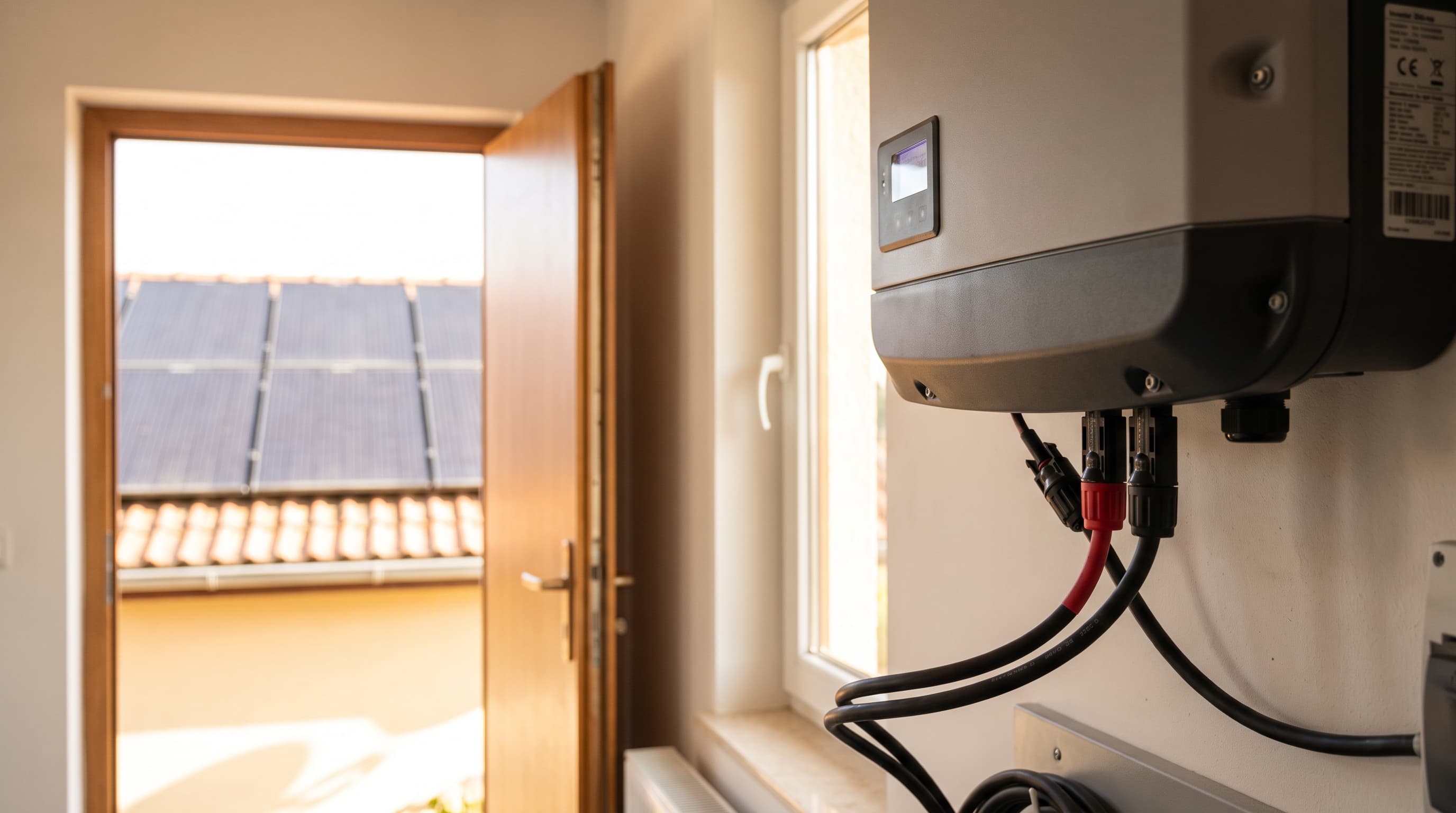
The short answer: nothing breaks, you lose a little
When a string of panels can deliver more current than the inverter's MPPT input is rated for, the inverter does not take it. The tracker moves the string's operating point up the panel's current-voltage (I-V) curve: the voltage rises, the current falls to the rated value, and the string produces slightly less power than it could. Nothing overheats, nothing is damaged, and the panels are operating exactly as their datasheet curve describes.
How much you lose is the surprising part. A 720 W panel with 210 mm cells (Impp 17.4 A) on a 16 A input gives up about 3.4 % of its power at the very peak of a clear day, but only 0.3–0.4 % of its energy over a year in Kyiv or Berlin and about 1 % in Madrid, because the current only exceeds 16 A in the brightest hours. The one arrangement that really hurts is two strings joined onto one input: 20–28 % of the year's energy gone, and the inverter's short-circuit rating exceeded.
That last point matters because the datasheet carries two current numbers, not one. The input current rating is a performance limit: exceed it and the tracker limits the current, costing yield. The short-circuit current rating is a protection limit: the fault current the input hardware can survive. The rest of this article walks through the I-V curve, the numbers for real panels and inverters, an hourly simulation for five cities, and when a different inverter or different wiring is actually worth it.
Two numbers, two meanings
Two current limits on the inverter datasheet
Max. input current per MPPT is the highest current the DC-DC stage behind that input will draw while tracking. It comes from the size of the boost inductor, the switching transistors and the cooling of that stage. Above it the inverter does not draw more; it moves the operating point until the current fits.
Max. short-circuit current per MPPT is a different thing: the current the input wiring, DC switch and protection are built to carry if a string is shorted, at the panels' hottest cell temperature. IEC 62548-1:2023 sizes protection from the string's short-circuit current with temperature applied, and manufacturers void the warranty when a string's Isc exceeds this rating. Here is how the two numbers look on 6 kW residential units from the Solar Stack catalogue:
| Inverter (6 kW, 2 MPPT) | MPPT inputs | Max. input current per MPPT | Max. short-circuit current per MPPT |
|---|---|---|---|
| Huawei SUN2000-6KTL-L1 | 2 | 12.5 A | 18 A |
| Deye SUN-6K-SG04LP1-EU | 2 | 13 A | 17 A |
| GoodWe GW6000-DNS-30 | 2 | 16 A | 23 A |
| Growatt MIN 6000TL-X2 | 2 | 16 A | 24 A |
| FoxESS H1-6.0-E-G2 | 2 | 16 A | 20 A |
| Fronius Symo 6.0-3-M | 2 | 16 A | 31 A |
| Deye SUN-6K-SG04LP1-EU-SM2 | 2 | 18 A | 27 A |
| Deye SUN-6K-SG01HP3-EU-AM2 | 2 | 20 A | 30 A |
16 A is the single most common input rating in the catalogue: 227 of the 1,645 string and hybrid inverters listed carry it, ahead of 20 A (198 models) and 18 A (126). Most residential platforms were designed around 182 mm-cell panels, whose Isc sits near 14 A. The 210 mm panels with 18–19 A of short-circuit current arrived later, and that is why the mismatch this article is about has become so common.
A string sees only its own input's rating
The I-V curve: how the tracker raises the voltage
A solar panel is a current source up to its knee. Between zero volts and roughly 35 V the Trina 720 W panel below delivers almost its full short-circuit current, 18.5 A, no matter what voltage it is held at. Past the knee the current collapses to zero at the open-circuit voltage, 49.4 V. Power is voltage times current, so it peaks just past the knee: the maximum power point (MPP) sits at 41.3 V and 17.44 A, giving 720 W under standard test conditions.
The inverter's DC-DC stage decides the voltage the string operates at; the panel answers with whatever current its curve allows at that voltage. In normal operation the MPPT algorithm walks the voltage until it finds the top of the power curve. When the 16 A input limit is active the controller keeps raising the voltage until the current falls to 16 A, which on this panel happens at 43.5 V, and it holds the string there. That is the entire mechanism: the inverter cannot pull 17.4 A, so it moves to the point on the curve where 16 A is what the panel offers.
Because the curve is so steep past the knee, an 8 % cut in current costs only 3.4 % of power: the voltage gain buys most of it back. Had the inverter been forced to cut current on the flat part of the curve, the loss would be proportional, but a tracker never operates there. This is why current limiting is so much cheaper than the raw amp numbers suggest, and why the datasheet warning "current will be limited" is not the disaster it sounds like.
Power at the current-limited point
P_limited = I_limit × V(I_limit) = 16 A × 43.5 V ≈ 696 W vs P_mpp = 17.44 A × 41.3 V = 720 W → −3.4 %Two consequences follow. First, a string only loses energy in the hours when its Impp actually exceeds the rating, which for a 17.4 A panel on a 16 A input means irradiance above roughly 920 W/m² on the panel surface. Second, the more the current exceeds the rating, the further up the curve the tracker has to climb, and the losses grow much faster than linearly: 10 % over costs about 3 %, 35 % over costs about 18 % at the peak.
Panels in series share one current
Worked numbers: STC, a hot noon, a cloud edge
The same panel, one string, on a 16 A, an 18 A and a 20 A input, under the conditions a rooftop actually sees. STC is the datasheet point; a hot noon is 1000 W/m² with the cell at 55 °C; the cloud-edge row is a short burst of 1200 W/m² when sunlight reflects off the side of a passing cloud, with the cell still at 50 °C because the burst lasts seconds. Power per panel; multiply by the panels in series for the string.
| Condition | At the MPP | 16 A input | 18 A input | 20 A input |
|---|---|---|---|---|
| STC: 1000 W/m², cell 25 °C | 720 W | 696 W (−3.4 %) | 720 W | 720 W |
| Hot noon: 1000 W/m², cell 55 °C | 654 W | 634 W (−3.1 %) | 654 W | 654 W |
| Bright afternoon: 900 W/m², cell 55 °C | 586 W | 586 W | 586 W | 586 W |
| Clear mountain noon: 1100 W/m², cell 60 °C | 710 W | 646 W (−9 %) | 697 W (−1.9 %) | 710 W |
| Cloud edge: 1200 W/m², cell 50 °C | 803 W | 681 W (−15.2 %) | 746 W (−7.1 %) | 794 W (−1.1 %) |
Reading the table: at 900 W/m² the panel's current is 15.7 A and no input limits anything. Heat barely changes the story, because the +0.04 %/°C temperature coefficient of current is tiny while the −0.24 %/°C coefficient of voltage is not: a hot panel has almost the same current and a lot less voltage, so its MPP power is lower and the limited fraction stays around 3 %. The cloud edge is where a 16 A input loses the most, 15 %, but those bursts add up to a few hours a year.
As a string of six: 4,320 W at the MPP under STC, 4,173 W on a 16 A input. The voltage per panel rises from 41.3 V to 43.5 V, so the string voltage the inverter reports climbs from 248 V to 261 V while the current sits flat at 16.0 A. That flat current with rising voltage on a clear noon is exactly how you recognise current limiting in monitoring data.
How these numbers were computed
What a clear day looks like
This is one string of six 720 W panels on one 16 A input in Kyiv, on 1 May 2023, the day of that year with the largest current-limit loss. The data are PVGIS SARAH3 satellite irradiance on a south-facing 35° surface and ERA5 air temperature, hour by hour: 1,067 W/m² and 13 °C air at 13:00, cell 44 °C. A cool spring day with a very clear sky produces the highest panel current of the year, more than a hot July noon.
The lost strip is 0.85 kWh out of 34.3 kWh, 2.5 % of the day, and the tracker is current-limited for three hours around noon. Every other hour of the day the string sits on its MPP as if the limit did not exist. In July the air is 15 °C warmer, the voltage lower and the peak current no higher, so the strip is thinner still; in winter it never appears.
One more thing hides in this chart. If your DC/AC ratio is high, the inverter would have clipped part of this noon peak at its AC output anyway, so the energy the current limit takes is partly energy you had already written off. The two losses overlap rather than add, which makes the current limit even cheaper on an oversized array.
Inverter clipping: how much energy you really lose
The AC-side limit, by DC/AC ratio and inverter type, with a Kyiv worked example
Annual losses: five cities, hour by hour
The same model run over all 8,760 hours of 2023 for one 720 W panel, south-facing at 35°, in five cities. For each hour the I-V curve, its maximum power point and the current-limited point were computed and summed. The yield column is DC energy at the MPP before soiling, cable and inverter losses; the percentages are what matter.
| City | DC yield at MPP, kWh/kWp | Hours limited at 16 A | Loss at 16 A | kWh lost per panel at 16 A | Loss at 18 A |
|---|---|---|---|---|---|
| Kyiv | 1,310 | 207 | 0.34 % | 3.2 | 0.01 % |
| Lviv | 1,282 | 193 | 0.3 % | 2.7 | < 0.01 % |
| Odesa | 1,513 | 347 | 0.42 % | 4.5 | < 0.01 % |
| Berlin | 1,229 | 179 | 0.37 % | 3.3 | 0.01 % |
| Madrid | 2,020 | 644 | 1 % | 14.5 | 0.09 % |
In Central and Eastern Europe a 16 A input costs a 720 W panel 3–5 kWh a year, 0.3–0.4 % of its output. A 12-panel, 8.6 kWp system in Kyiv or Berlin loses about 40 kWh a year: roughly €12 at €0.30/kWh. In Madrid, with 644 limited hours, the loss reaches 1 % and 174 kWh for the same system, about €35 a year at Spanish tariffs. Nowhere does it come close to the price difference between two inverters.
An 18 A input removes the loss almost entirely, down to a few tens of watt-hours a year in Kyiv and 0.09 % in Madrid, and a 20 A input removes it completely, because 20 A is above the panel's current even under a 1,100 W/m² sky. The next section puts that comparison on one table.
Why these yields look high
16 A vs 18 A vs 20 A input: the same string side by side
Take 12 Trina Solar Vertex N 720 W panels as two strings of six, one string per MPPT input, on a rooftop in Kyiv (−25 °C to +35 °C). The three columns are three input ratings found on real 6 kW inverters; the models are examples of each rating, and the brand plays no role in the numbers. Peak power is for one string under STC, the hot-noon row is 1000 W/m² with the cell at 55 °C, and the energy rows are the 2023 simulation for one string.
| One 6 × 720 W string | Growatt MIN 6000TL-X2 | Deye SUN-6K-SG04LP1-EU-SM2 | Deye SUN-6K-SG01HP3-EU-AM2 |
|---|---|---|---|
| Input current / short-circuit rating per MPPT | 16 / 24 A | 18 / 27 A | 20 / 30 A |
| Peak power at STC | 4,173 W | 4,320 W | 4,320 W |
| Power on a hot noon | 3,804 W | 3,926 W | 3,926 W |
| Energy per year, Kyiv | 5,640 kWh | 5,658 kWh | 5,659 kWh |
| Lost to the current limit per year | 19.1 kWh | 0.4 kWh | 0 kWh |
| Hours limited per year | 207 | 27 | 0 |
| Solar Stack calculator verdict | Warning: input current limit | Compatible | Compatible |
The 16 A inverter gives up 19 kWh per string, 38 kWh for the whole system, roughly €12 a year. The price gap between the 16 A and 20 A models is hundreds of euros, so buying a different inverter to recover 0.34 % never pays back. Choose the inverter by the things that decide the project: phases, battery port, number of MPPT inputs, warranty and price. Then accept the calculator's warning for what it is, a note about yield, not a fault.
The comparison changes when the mismatch is large. The same 17.4 A panel on a 13 A input, a Deye SUN-6K-SG04LP1-EU for instance, loses 3.5 % a year in Kyiv and 6.4 % in Madrid: 30 kWh per string, still not dramatic, but now visible on the bill. And that pairing fails the safety check too, because the string's hot short-circuit current of 18.8 A exceeds that input's 17 A rating. There the answer is a different inverter or a different panel, whatever the yield arithmetic says.
Rule of thumb
Compare these three inverters with this string
The comparison page runs every calculator check for each inverter, with 2 × 6 Trina 720 W panels as the array
Two strings on one input: where it really hurts
The tempting shortcut: the second MPPT input is taken by another roof face, so two strings of six go into the first input through a Y-connector. Currents add in parallel: 2 × 17.44 A = 34.9 A against a 16 A rating. The tracker now has to raise the voltage until each string gives 8 A, which on this panel is 47.5 V, almost at open circuit. The pair produces 380 W per panel instead of 720 W: 47 % gone at noon.
Two strings in parallel on a 16 A input, STC
I_per_string = 16 A ÷ 2 = 8 A → V(8 A) = 47.5 V per panel → P = 8 A × 47.5 V = 380 W per panel vs 720 W at the MPP → −47 %Because the limit now bites at half the irradiance, roughly 460 W/m², the loss stops being a noon-only effect and spreads across most of the day. Over a year:
| City | Energy lost, 2 strings on one 16 A input |
|---|---|
| Kyiv | −20.6 % |
| Lviv | −20 % |
| Odesa | −23.4 % |
| Berlin | −18.4 % |
| Madrid | −28 % |
And it fails the safety check outright. The string's short-circuit current at the hot cell temperature is 18.8 A, so two strings give 37.6 A on an input rated for 24 A. The calculator marks that pairing incompatible, and the inverter manual voids the warranty for it. On top of that, IEC 62548 requires a fuse in each string once strings are paralleled, because a shorted string can be back-fed by its neighbour. If you have more strings than inputs, the fix is an inverter with more inputs, an input rated for two strings (26–32 A on many Deye hybrids), or longer strings and fewer of them.
A Y-connector does not raise the rating
Series vs parallel wiring for solar panels
What each layout does to voltage and current, and when paralleling strings is legitimate
Other panel classes and input ratings
The same simulation for the three panel classes on sale today against the input ratings you meet on residential inverters. The cells give the annual loss as a percentage of the panel's energy, Kyiv first, Madrid second. 12.5 A is the Huawei SUN2000 L1 series, 13 A the Deye SG04LP1-EU, 16 A the most common rating, 18 A and 20 A the newer Deye and GoodWe platforms.
| Panel class (annual loss, Kyiv / Madrid, %) | 12.5 A | 13 A | 16 A | 18 A | 20 A |
|---|---|---|---|---|---|
| 460 W, 108 cells, 182 mm: Isc 14.6 A, Impp 13.9 A | 0.48 / 1.32 | 0.23 / 0.75 | 0 | 0 | 0 |
| 600 W, 144 cells, 182 mm: Isc 14.5 A, Impp 13.6 A | 0.37 / 1.09 | 0.16 / 0.58 | 0 | 0 | 0 |
| 720 W, 132 cells, 210 mm: Isc 18.5 A, Impp 17.4 A | 4.46 / 7.84 | 3.48 / 6.41 | 0.34 / 1 | 0.01 / 0.09 | 0 |
Every pairing a homeowner is likely to buy loses under 1.5 % a year even in Madrid, as long as the panel's current is within about 10 % of the rating. The 460 W panel loses slightly more than the 600 W one on the same input because its knee sits at a lower voltage, so the same amp of cut is a larger share of its power. The 720 W panel on a 12.5 A or 13 A input is the combination to avoid: 3.5–4.5 % a year in Kyiv, 6–8 % in Madrid, and in both cases the short-circuit rating (17–18 A) is below the panel's hot Isc of 18.8 A, so the calculator fails it on safety before yield even enters the picture.
A practical way to read the table: match the panel class to the inverter generation. 182 mm panels (Isc about 14.5 A) fit any input from 16 A up with no loss at all and fit a 13 A input with a fraction of a percent lost. 210 mm panels (Isc 18.5 A) want an input rated 18 A or more, and a short-circuit rating of at least 20 A.
Check the short-circuit line before the yield line
Check your own pair in 30 seconds
The Solar Stack calculator runs both current checks for any panel and inverter in the catalogue. It takes the panel's short-circuit current, raises it to the hottest cell temperature of your site (ambient maximum plus the NOCT rise) with the panel's own temperature coefficient, multiplies by the strings on the busiest input, and compares the result with both ratings of that input.
String current at hot cell temperature, as the calculator computes it
I_string,hot = I_sc × (1 + TC_Isc/100 × (T_cell,hot − 25 °C)) × N_parallel = 18.49 A × (1 + 0.0004 × (63.75 − 25)) × 1 = 18.8 A (T_cell,hot = 35 °C + (43 − 20) × 1.25)Above the input current rating you get the "Input current limit" warning: that is the loss this article has quantified, 0.3–1 % a year for a 10 % mismatch. Above the short-circuit rating you get the "Short-circuit protection" fail, and that one is not negotiable: change the wiring so each string has its own input, choose a panel with a lower Isc, or choose an inverter rated for it. Never answer a fail with a fuse. A string fuse protects the cables from back-feed; it does not change what the input stage can withstand.
If you are still choosing the inverter, the finder filters the catalogue by input current, so a string of 210 mm panels can start from the models rated 18 A and up. And if you already own a 16 A inverter, this article is your answer: connect one string per input and enjoy 99.6 % of what a 20 A model would give.
Check 2 × 6 Trina 720 W on a 16 A input
The calculator shows the input current warning, the short-circuit check and every other check for this exact layout
Find 5–8 kW inverters with 18 A or more per MPPT
Filter the catalogue by input current before you shortlist models
Five myths about the current limit
- "The inverter will burn out if the panels give more current than its rating."
It will not. The input current rating is the current the tracker chooses to draw; the inverter limits it by moving the operating point, not by absorbing an overload. The only hard hardware limit is the short-circuit current rating, and that is what the safety check compares against.
- "Holding the panels above their MPP damages them."
Every point on the I-V curve is a normal operating point for a panel; an open-circuited panel sits at Voc all day with no harm. Extracting a little less power leaves a few watts more as heat in the panel, a fraction of a degree, which is nothing next to the 30 °C the sun adds.
- "It is the same thing as inverter clipping."
Related but different. AC clipping caps the inverter's output at its rated AC power; the current limit caps one DC input at its rated current. Both flatten the noon peak and they overlap: on an oversized array part of the current-limit loss would have been clipped at the AC side anyway.
- "A Y-connector solves a shortage of MPPT inputs."
It doubles the current on the input it feeds. On a 16 A input that costs 20–28 % of the year's energy and exceeds the short-circuit rating; only inputs rated for two strings (26 A and up) can take it, and then each string needs its own fuse.
- "Adding panels to the string raises the current."
Panels in series share one current and add their voltages. Ten panels or twelve, the string's current is that of a single panel; what a longer string changes is the cold-weather voltage, which is a different check.
Frequently asked questions
What happens if solar panel current exceeds the inverter's maximum input current?
The MPPT raises the string voltage until the current drops to the rated value and holds the string there. You lose a few percent of power in the brightest hours and typically well under 1 % of the year's energy; nothing is damaged as long as the string's short-circuit current stays within the input's short-circuit rating.
Can I connect 210 mm panels with 18 A of short-circuit current to a 16 A MPPT input?
Yes, one string per input, provided the input's short-circuit rating is above the string's hot Isc, about 18.8 A for a 720 W panel, which a 20–24 A rating covers. The current limit then costs 0.3–0.4 % a year in Central Europe and about 1 % in southern Spain.
What is the difference between max input current and max short-circuit current per MPPT?
The input current is an operating limit: the most the tracker will draw, exceeded at the cost of some yield. The short-circuit current is a protection limit: the fault current the input's hardware can withstand, and exceeding it is a safety and warranty issue. Compare Impp with the first and hot Isc with the second.
Does current limiting damage the solar panels?
No. A panel held above its maximum power point is simply operating further along its own I-V curve, the same curve it sits on at open circuit every evening. The unextracted power becomes a negligible amount of extra heat.
Would an inverter with a 20 A input give me more energy?
Only by the amount the 16 A input loses: about 3 kWh per 720 W panel per year in Kyiv or Berlin, 15 kWh in Madrid. For a 12-panel system that is €12–35 a year, far less than the price difference between models, so choose the inverter by other criteria.
Can I put two strings on one MPPT input with a Y-connector?
Only if that input is rated for the combined current: 2 × Impp within the input rating and 2 × hot Isc within the short-circuit rating, which means an input of 26 A or more for modern panels. On a 16 A input two strings lose 20–28 % of the year's energy and exceed the short-circuit rating. Paralleled strings also need a fuse each.
How do I see current limiting in my inverter's monitoring?
On a clear noon the string current sits flat at the input rating while the string voltage rises above its usual value, by 5–6 % for a 10 % mismatch, and the power curve shows a slight plateau. If the current never reaches the rating, the input is not limiting.


Discussion
Sign in to join the discussion
We require a quick sign-in to keep this thread free of spam.
No comments yet. Be the first to share your experience.