Solar Panels for Off-Grid Inverters: Sizing Guide
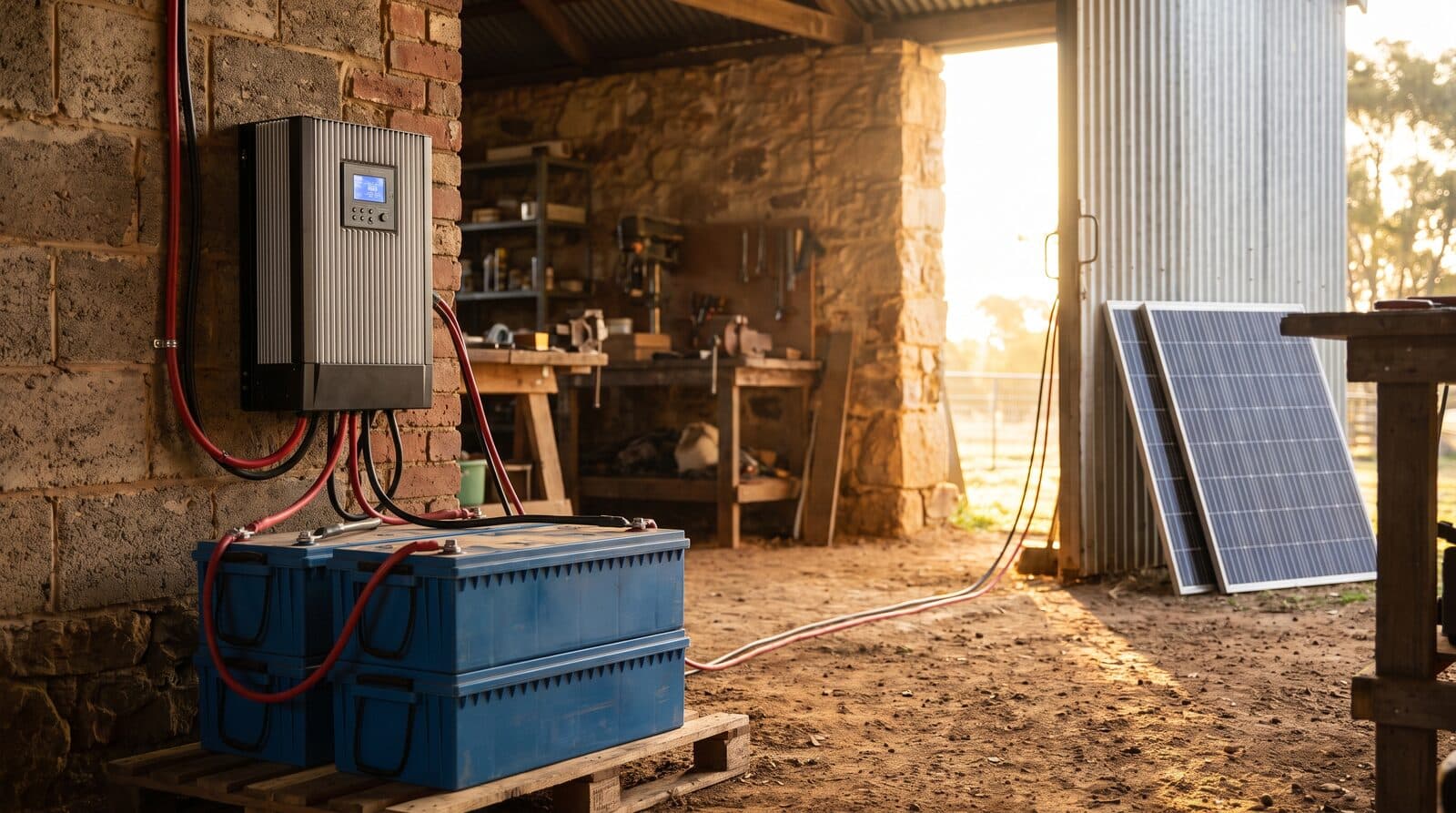
Three PV voltage classes of off-grid inverters
The right solar panels for an off-grid inverter are set by its PV input window, not by its battery voltage or AC power. Every off-grid inverter-charger specifies a maximum PV voltage (145 to 500 V depending on the model), an MPPT operating range, and a maximum PV array power — and the panel string must stay inside all three limits at your site's temperature extremes.
Off-grid inverters on the market fall into three PV architectures. The class determines how many standard home panels (400–460 W, open-circuit voltage around 39 V) you can wire in series:
| PV class | Typical PV input specs | Panels in series | Example models |
|---|---|---|---|
| Low-voltage (12/24 V heritage) | max 102–160 V, MPPT 30–115 V | 2–3 | Growatt SPF 3000TL LVM-48P, EASUN SMG II 4KW-24V |
| Mid-voltage | max 250 V, MPPT 60–245 V | 3–5 | Growatt SPF 6000T DVM-MPV |
| High-voltage (modern) | max 450–500 V, MPPT 60–450 V | up to 10 | Growatt SPF 5000 ES, Deye SUN-5K-OG, Anenji 6.2 kW |
The same brand often sells all three classes side by side under near-identical names. The Growatt SPF 5000 ES accepts strings up to 450 V, while the SPF 5000TL HVM tops out at 145 V — a string that is routine for one destroys the other. Always identify the class from the datasheet, never from the model name or the price tag.
Battery voltage is not panel voltage
Off-grid inverters are named by their battery bus: 12 V, 24 V or 48 V. It is tempting to conclude that a "48 V inverter" needs "48 V panels". It doesn't — the battery bus and the PV input are separate circuits joined by the MPPT charge controller, which converts whatever voltage the panels produce down to battery-charging levels.
That is why two 48 V machines can have wildly different PV windows: the Growatt SPF 3000TL LVM-48P accepts at most 145 V from panels, while the EASUN SMG II 6.2KW-48V takes strings up to 500 V. Residential panels themselves are standardized: a modern 54-cell module runs about 39 V open-circuit and 32–33 V at the operating point regardless of wattage — there is no such thing as a "48 V home panel" in the mainstream market.
Battery voltage does matter for total power: a 24 V bus limits charging current, which is why 24 V units carry small PV power caps. But the number of panels you can put in series is a voltage question, decided only by the PV input specs.
Off-grid, hybrid or grid-tie?
Hybrid vs on-grid vs off-grid inverters
What each type does, what it costs, and how to tell a real hybrid from an off-grid unit.
Reading the PV input block of the datasheet
Find the table usually labelled "PV input", "Solar charger" or "PV module array" in the inverter datasheet. Five numbers decide everything:
- Max. PV input voltage (Voc limit)
The absolute ceiling. Your string's open-circuit voltage on the coldest morning of the year must stay below it — exceeding it damages the charger and voids the warranty.
- MPPT voltage range
Where the tracker can actually operate while charging. The string's working voltage (Vmp) must sit inside this window in summer heat and, ideally, in winter cold too.
- Start-up voltage
The minimum voltage for the charger to wake up in the morning, usually set slightly above the MPPT minimum.
- Max. PV array power
The largest array the charger will actually use. On off-grid units this is often lower than the inverter's AC rating — a trap covered below.
- Max. PV input current
The current ceiling per MPPT input. Modern large-format panels push 14 A — more than some budget units accept.
Voc limit vs MPPT maximum are different numbers
The cold-weather voltage check (Voc)
Panel voltage rises when temperature drops. The Voc printed on the label applies at 25 °C cell temperature; on a clear winter morning the cells are as cold as the air, and voltage climbs by the temperature coefficient — around −0.25 %/°C for TOPCon panels — for every degree below 25 °C.
Cold-weather open-circuit voltage
Voc_cold = Voc_STC × (1 + (TC_Voc / 100) × (T_min − 25))Take a typical 430 W panel: Voc = 39.1 V, TC_Voc = −0.25 %/°C. On a −10 °C morning:
Voc_cold = 39.1 × (1 + (−0.25/100) × (−10 − 25)) = 42.5 VCheck it against the low-voltage Growatt SPF 3000TL LVM-48P (max PV 145 V, MPPT 60–115 V): three panels give 3 × 42.5 = 127.5 V — safely under the 145 V ceiling. A fourth panel is impossible: 4 × 39.1 = 156.4 V exceeds the limit already at +25 °C, before any cold-weather rise. The hard maximum is 3 panels in series.
The most common way budget off-grid inverters die
String sizing from first principles
The full method behind cold- and hot-weather voltage checks for any inverter type.
The MPPT minimum trap: hot-weather Vmp
The opposite failure is quieter. In summer, cell temperature reaches 60–70 °C and the operating voltage (Vmp) sags by 10–12 %. If the string voltage drops below the MPPT minimum, the charger stops tracking and harvest collapses — the panels are fine, the wiring is fine, but production flatlines during the best hours of the day.
Hot-weather operating voltage
Vmp_hot = Vmp_STC × (1 + (TC_V / 100) × (T_cell − 25))Our 430 W panel has Vmp = 32.4 V. At 65 °C cell temperature it delivers about 32.4 × 0.88 = 28.5 V. On a Deye SUN-5K-OG (MPPT 150–425 V), five panels give 5 × 28.5 = 142.5 V — below the 150 V minimum, so charging stalls exactly when the sun is strongest. Six panels (171 V hot) is the real minimum, even though five look fine on paper at 25 °C: 5 × 32.4 = 162 V.
Start-up voltage adds a morning constraint: the same Deye needs 125 V just to wake the charger. Strings sized close to the MPPT minimum also start late and quit early every day. When the datasheet offers a recommended range, aim for its middle.
Why such a high minimum?
Max PV array power: often below the AC rating
On grid-tied inverters the PV array routinely exceeds the AC rating by 20–50 %. Off-grid units flip this expectation: the solar charger is sized for battery charging, not for full AC passthrough — and the PV cap is often lower than the AC output. Three real examples from our database:
| Model | AC output | Max PV array |
|---|---|---|
| Growatt SPF 12000T DVM-MPV | 12,000 W | 7,000 W |
| EASUN SMG II 4KW-24V | 4,000 W | 1,500 W |
| Anern AN-SCI-ES-1000 | 1,000 W | 550 W |
The 12 kW Growatt can pass 12 kW from batteries or a generator to the loads, but its two MPPT chargers together accept at most 7 kW of panels. Plan the array around the PV cap — the AC number tells you nothing about solar.
Our compatibility calculator allows a DC-to-AC ratio of up to 2.0 for off-grid units (versus 1.5 for grid-tie string inverters), because surplus DC power charges the battery instead of being clipped. But the datasheet's max PV array power remains a hard limit that always wins over any ratio rule.
"It accepts 500 V" does not mean "it accepts 6 kW"
Current limits: 13 A units vs 80 A units
Off-grid designs split into two current philosophies. High-voltage units take one series string per MPPT and accept modest current — typically 13–27 A. Low-voltage heritage units expect several short strings in parallel and swallow 50–120 A (Growatt SPF 3000TL LVM-24P: 50 A; SPF 6000T HVM-G2: 120 A) — at the price of thick copper between the roof and the inverter.
The quiet trap sits on the high-voltage side: modern 182 mm-cell panels of 420–460 W run a short-circuit current around 14 A. A charger rated 13 A per input (Anern AZURE series) will simply operate such a panel at its own ceiling — no damage in a properly designed unit, but every panel behaves like a slightly smaller one all year. Some datasheets additionally publish a max short-circuit current that must never be exceeded at all.
Parallel strings multiply current, not voltage: two strings of 14 A panels feed 28 A into one input. That is fine on an 80 A low-voltage unit and out of bounds on a 27 A high-voltage one — which is why high-voltage off-grid datasheets usually specify one string per tracker.
Check Isc, not just watts
PWM controllers and "12 V panels"
The cheapest inverter-chargers and many older units use a PWM charge controller instead of MPPT. PWM does not convert voltage — it connects the panel almost directly to the battery, dragging the panel's operating point down to battery voltage.
With a 12 V battery charging at around 14 V, a standard home panel built to operate at 32–33 V delivers less than half of its rated power on PWM. This is why "12 V panels" exist: 36-cell modules with Vmp around 18 V, made to pair with PWM controllers. On MPPT, by contrast, a standard panel loses nothing — the tracker converts 33 V down to 14 V at nearly full power.
Every model named in this article uses MPPT. But marketplace listings for "solar inverters" still hide PWM units — if the spec sheet shows a PV voltage barely above battery voltage and never mentions MPPT, assume PWM and either buy 36-cell panels or choose a different inverter.
How to spot MPPT in five seconds
Step-by-step: match panels to your inverter
Here is the complete check, in the order that eliminates wrong candidates fastest:
- Write down the PV input block
From the inverter datasheet: max PV voltage, MPPT range, start-up voltage, max PV array power, max input current. From the panel datasheet: Voc, Vmp, Isc and the Voc temperature coefficient.
- Cap the string with cold Voc
Compute Voc_cold at your site's record-low temperature. Maximum panels in series = max PV voltage ÷ Voc_cold, rounded down.
- Floor the string with hot Vmp
Compute Vmp at 65 °C cell temperature. Minimum panels in series = MPPT minimum ÷ Vmp_hot, rounded up. If the minimum exceeds the maximum, the pairing is impossible — change the panel or the inverter.
- Check power and current
Panel count × rated watts must stay at or below the max PV array power, and the panel's Isc (times parallel strings, if any) at or below the max input current.
- Prefer the middle of the window
Among the valid counts, pick one that puts the string's Vmp near the middle of the MPPT range — the system starts earlier, stops later and keeps headroom for hazy-day voltage dips.
Worked example: Growatt SPF 5000 ES + 430 W panels
Limits: max 450 V, MPPT 120–430 V, PV cap 6,000 W. Panel: Voc 39.1 V, Vmp 32.4 V. Maximum: 450 ÷ 42.5 = 10.6 → 10 panels. Minimum: 120 ÷ 28.5 = 4.2 → 5 panels. Any count from 5 to 10 works; 8 panels (3,440 W, Vmp about 259 V) sits mid-window and uses the charger well.
Run the compatibility checks in 30 seconds
Pick your exact panel and inverter — cold Voc, MPPT window, current and power ratio are verified automatically.
5 common mistakes
The failure stories we hear repeat the same handful of errors:
- Matching panels to battery voltage
"It's a 48 V inverter, so I need 48 V of panels" — the PV input window decides, not the battery bus. A 48 V machine may want anywhere from 60 to 500 V from the roof.
- Counting Voc at 25 °C
A string that fits in October can exceed the ceiling on a clear January morning. Always size with Voc_cold at your record-low temperature.
- Too few panels for a high-voltage charger
Two panels on a charger with a 120–150 V MPPT minimum will never wake it up. High-voltage off-grid units are built for strings of 5 panels and more.
- Ignoring the PV power cap
The oversizing habit from hybrids does not transfer: many off-grid units accept less PV power than their AC rating, and panels beyond the cap earn nothing.
- Splitting one MPPT across two roof faces
Most off-grid units below 8 kW have a single tracker. East and west panels on one tracker chase two power maxima at once and lose 10–25 %. If your roof forces two orientations, pick a two-tracker model (Growatt SPF 6000 ES Plus, EASUN SMG II 11KW, Deye SUN-6K-OG).
One tracker = one orientation
Check the pairing before you buy
Our database holds 279 off-grid inverter-chargers — Growatt SPF, EASUN, Anern, Anenji, Must, PowMr, Deye SUN-OG and more — with PV windows, power caps and current limits filled in from official datasheets. The compatibility calculator runs the cold-Voc, MPPT-window, current and DC/AC-ratio checks for any panel and inverter pair, using the same formulas as this article.
Already own the panels and choosing the inverter? Flip the search: the matcher filters inverters that accept your exact panel in the quantity you want.
Find an inverter for your panels
Filter hundreds of off-grid models by your panel's voltage, current and count.
Browse off-grid inverter specs
PV windows, power caps and official datasheets for every model in the database.
Frequently asked questions
How many solar panels can I connect to a 3 kW off-grid inverter?
It depends on the PV class, not on the 3 kW. A low-voltage 3 kW unit (max 145 V) takes 2–3 standard panels; a high-voltage one (max 450–500 V) takes roughly 4–10. Check the max PV voltage, the MPPT range and the PV power cap in the datasheet.
Can I use standard 400–460 W home panels with an off-grid inverter?
Yes — on any MPPT unit whose voltage window fits your string, ordinary residential panels work perfectly. There is no special "off-grid panel". Only PWM controllers require low-voltage 36-cell panels.
What happens if the string voltage exceeds the inverter's max PV input?
Permanent damage to the charger's input stage, typically on the first cold clear morning of winter. It is a hardware limit, not a software one, and exceeding it usually voids the warranty.
Why does my off-grid inverter stop charging in hot weather?
Hot cells drag the string's operating voltage below the MPPT minimum. Add one more panel in series if the cold-Voc ceiling allows it, or choose an inverter with a lower MPPT minimum.
Can I oversize the PV array on an off-grid inverter?
Up to the datasheet's max PV array power — yes, and it is often sensible, because surplus energy charges the battery instead of being clipped. Beyond the cap, extra panels earn nothing.
Why doesn't my inverter start charging until mid-morning?
Your string barely clears the start-up voltage. Strings sized near the MPPT minimum wake late and sleep early; add a panel in series or aim for the middle of the MPPT window when designing.
Should panels be wired in series or parallel for an off-grid inverter?
High-voltage units (450–500 V max): one series string per tracker. Low-voltage units (max around 115–160 V with 50–120 A inputs): short strings of 2–3 panels connected in parallel. The input current limit tells you which type you own.
Is a 24 V or 48 V inverter better for solar?
Above roughly 1.5 kW of load, 48 V is better in almost every case: a higher battery bus means lower current, thinner cables and larger PV power caps. 24 V units make sense only for very small systems.
Verify your string before wiring it
The calculator checks cold Voc, the MPPT window, current limits and the power ratio for your exact equipment.


Discussion
Sign in to join the discussion
We require a quick sign-in to keep this thread free of spam.
No comments yet. Be the first to share your experience.